
Film adaptations of video games can be a dicey proposition. Part of the issue lies in the elements getting lost in translation: the inherently immersive factor of a game rarely makes a successful leap to the screen, and most video games are already so vividly realized that casting real actors against largely CGI backdrops for a movie version feels awfully redundant and pointless. Furthermore, the tenets of the respective media are commonly used as a cudgel against the other, as when Hideo Kojima presents a feature-length cutscene that occasionally makes one wonder if he really should be working in another industry altogether, or when James Cameron’s latest billion-dollar return to Pandora is casually dismissed by naysayers as looking and feeling too much like a video game. Many have tried, and yet the two formats never seem quite fit for marriage, with the most financially successful endeavors — your Sonic the Hedgehogs, your Minecrafts, your Detective Pikachus — are really just glorified cartoons, products for children that lean heavily on their sugar rush aesthetics while expanding a narrative lighter than balsa wood.
All of this is to say that 2006’s Silent Hill serves as the rare success in memorable video game adaptations. Based on the Konami franchise of the same name, the Roger Avary-penned, Christophe Gans-helmed film lacks much in the way of a cogent plot, but it more than makes up for it in terrific atmosphere, beautifully capturing the game’s creepily effective ambience, aided in no small part by the tremendous scoring efforts of Akira Yamaoka, whose iconic music was directly ported over from the games. Silent Hill’s contemporaneous assessment was unfavorable at best, but the 20 years since have allowed for a more enthusiastic response to flourish, with the film building a cult appreciation in the meantime and emerging as something of a spooky season viewing favorite. The franchise was resurrected with a semi-belated sequel that followed in 2012, Silent Hill: Revelation, which jettisoned Avary and Gans in order to cash in on the post-Avatar 3D craze, but the effort effectively killed off any further sequel interest outright.
It seems Gans ignored the memo, however, and seemingly isn’t ready to call it a day on the franchise just yet. Having only released one other film in the two-decade interim — 2014’s Léa Seydoux-starring Beauty and the Beast — the director makes his long-awaited return to Silent Hill with, well, Return to Silent Hill. But just when it seems like there may be hope for this series in the reunion of material and filmmaker, viewers are hit with an unfortunate reality: Return to Silent Hill is a crushing disappointment, offering little in the way of compelling performances, engrossing narrative, or even a reclamation of the original’s nightmarish mood. Gans may be back in the director’s chair, but a sinking feeling builds across the runtime that perhaps this particular film franchise was indeed better off dead.
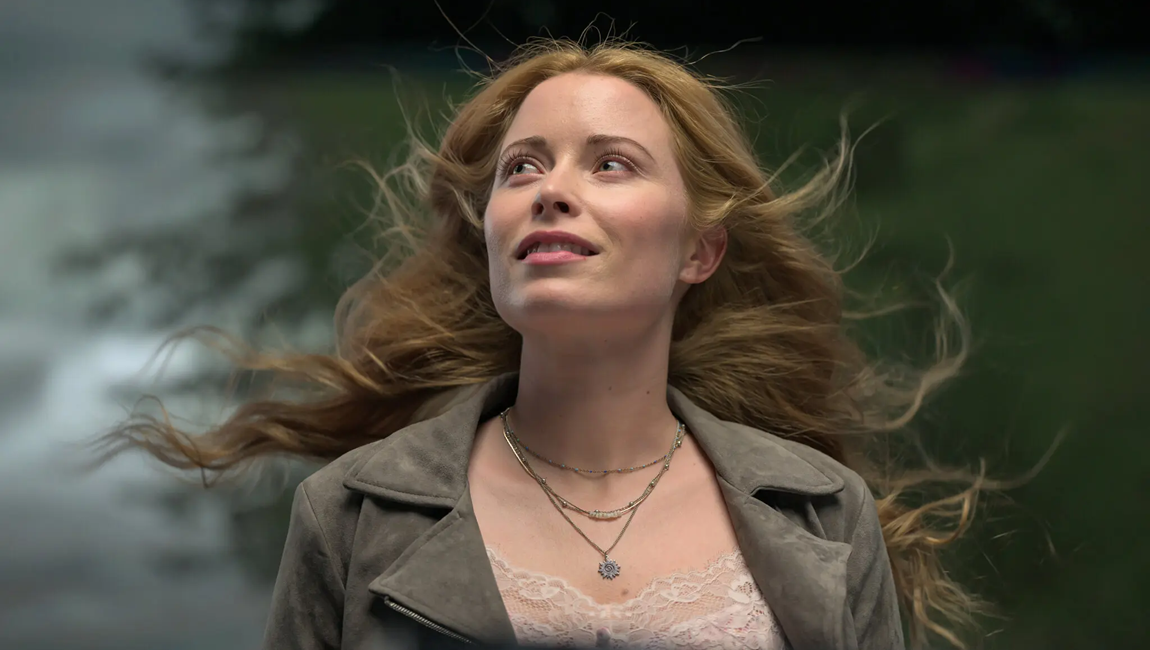
James Sunderland (Jeremy Irvine) was a once-promising artist who has fallen into a pit of despair. Still reeling from the dissolution of his relationship with girlfriend Mary Crane (Hannah Emily Anderson), James frequently finds himself at the bottom of a bottle, often causing trouble during his nights out on the town. Therapist M (Nicola Alexis) offers an ear and a dash of genuine concern, but James remains haunted by his time with Mary, which is only exacerbated by the arrival of a letter from his former lover, beckoning him to return to Silent Hill, the town where they once met and lived together. Making the trek back, James discovers the town engulfed in ash and fog, with the majority of its denizens appearing to be monstrosities who mean him harm. As James subsequently wades through the gloom, memories of his time with Mary come flooding back, and the true nature of their relationship is gradually revealed.
Sharing screenwriting duties with Sandra Vo-Anh and Will Schneider, Gans comes armed with inspiration from video game entry Silent Hill 2, arguably the greatest Silent Hill of them all. The fractured relationship between James and Mary functions as an emotional throughline in Return to Silent Hill, examining James’ grief in a hopeless place as his time in the present is punctuated by flashbacks to happier times with Mary, before everything all went wrong. Gans and co. aren’t keen on remaining entirely faithful to Silent Hill 2, however, and they instead decide to re-introduce the cult from the 2006 film as a malevolent force that violated Mary’s life, sending her and James’ relationship spiraling out of control. It’s a change that will likely leave diehard fans of the games annoyed, and that frustration won’t be helped by the screen presence of Irvine and Anderson, who share very little chemistry and are largely DOA as an onscreen couple, sapping the film of much of its would-be stakes. Return to Silent Hill seems angled to be the most heartfelt film of the franchise, but its raison d’être is totally inert, squandering any semblance of an actually provocative and energizing take on the material.
James and Mary’s failed romantic relationship makes up one half of Return to Silent Hill, which leaves the expected horror to make up the other. Sadly, the film is also lacking in this regard, as Gans offers very little in terms of new frights here, content to lamely play the hits he’s covered before. There are a few encounters with the Armless ghoul who spits up acid, and another sequence devoted to the creepy Nurses in a darkened room, but they are largely missing any juice. Even Pyramid Head, making his requisite appearance as an implacable behemoth, is essentially reduced to a cameo here, popping in briefly to bust some heads before duly exiting the film. Return to Silent Hill‘s digital glaze also flattens its atmosphere and prevents any conjuring of the flavor that made the 2006 film pop; in that absence, as all else fails, Gans instead turns to an unfortunate ear-splitting sound design to jostle viewers in their seats. Perhaps most criminal, however, is the waste of Yamaoka’s score, which goes by almost completely unnoticed this time around, offering none of the maestro’s memorable orchestrations (save for one, belatedly arriving as the lead out into the end credits). Return to Silent Hill is left only to exist as a case study in diminishing returns and exsanguinated genre, sure to disappoint fans and newcomers to the series alike.
DIRECTOR: Christophe Gans; CAST: Jeremy Irvine, Hannah Emily Anderson, Evie Templeton, Eve Macklin; DISTRIBUTOR: Cineverse; IN THEATERS: January 23; RUNTIME: 1 hr. 46 min.
Originally published as part of IFFR 2026 — Dispatch 1.
Comments are closed.