
The mental health epidemic has taken root globally, but only in the U.S. is it likelier to do so behind the barrel of a gun. American culture’s morbid fascination with gun violence has a familiar dialectical bent: shaped undoubtedly by a cancerous union of lobbying, libertarianism, and the simple ease with which one achieves recognition through utter self-negation, this unholy fixation in turn inspires its own rituals of parody and homage, with the would-be martyrs seeking — for the most part — to reclaim their power and agency through various courses of identification. So did George Hang, a seventeen-year-old Chinese-American teen, stencil a swastika amidst reams of Nazi literature before he was due, purportedly, to purchase a gun when he turned of age. Unlike the mass shooters of American legend who continue to be remembered in infamy, however, George never fired a bullet. He was also diagnosed with schizophrenia after the death of his father, and for that received two bullets to his chest instead.
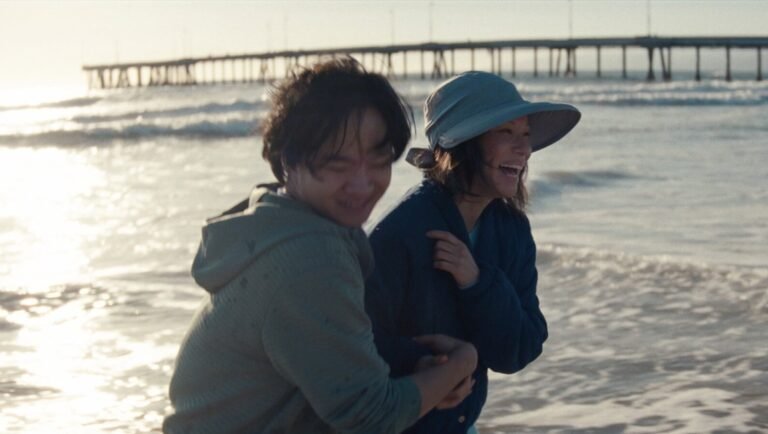
George’s tragic story, per the Los Angeles Times, constitutes the real-life blueprint for Eric Lin’s Rosemead, a film whose earnest pathos just about overshadows its verisimilitude. Rosemead, nonetheless, isn’t necessarily an exercise in blunt realism; cognizant of the ultimately inaccessible rift that divides not just mental illness from health, but, more fundamentally, us from one another, the film mounts a valiant dramatization of familial and communal struggle. Much like Lai Hang, George’s cancer-stricken mother, Irene (Lucy Liu), is a portrait of stoic grief, grappling with unimaginable loss on nearly every front. Her husband’s death has made her son, Joe (Lawrence Chou), a depressed and lost soul. While bringing Joe to his regular therapy appointments and straddling work at her mom-and-pop print shop, she contracts cancer — terminal. Joe cannot know this, but he gradually intuits that something’s amiss, which only makes him act up in pitifully intimate detail. The duo’s relationship, falling short of their respective expectations as a model Asian mom and son, fractures; in the few months leading up to her demise, his condition only worsens. In her maternal anguish, Irene does what she knows to be best.
Rosemead’s otherwise grisly aftermath is accorded due solemnity in Lin’s chronologically faithful account, recasting its heinous quality as one fundamentally steeped in tragedy and rendering it with no little grace. At the film’s heart lies an intangible web of shame whose threats of social prejudice forced Irene, as with her friends and wider community, into a strained silence over the unbearable hurt and anxiety that eventually claimed her entire family. Set in the titular L.A. neighborhood among a heavily Asian-American demographic, Rosemead shares a mood and milieu with Ougie Pak’s Red Card, filmed likewise in the suffocating suburbs of the San Gabriel Valley. If Pak’s film staged, rather lacklusterly, a critique of macho self-worth defined by commoditization, Lin utilizes Liu’s countenance and calculated stiffness to searingly emotional ends, her immense self-deception steadily compounding her inability to seek and proffer help. The film’s various narrative liberties afflict Joe’s character more, consigning him to a generic and watered-down vessel for sympathy. Yet for all its faults, Rosemead stares rage and calamity in the face without quite backing down, turning an easy opportunity for sensationalism into a meditation on the very human cost of agony.
DIRECTOR: Eric Lin; CAST: Lucy Liu, Orion Lee, Lawrence Shou, Jennifer Lim, Madison Hu; DISTRIBUTOR: Vertical; IN THEATERS: December 5; RUNTIME: 1 hr. 37 min.
Comments are closed.