
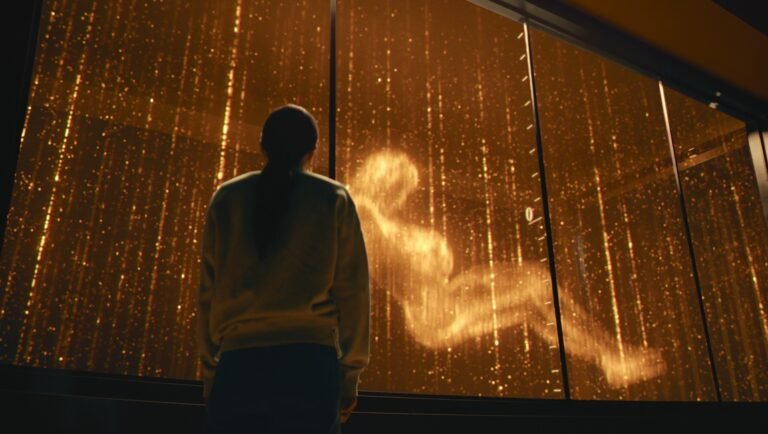
Kim Byung-woo’s fifth directorial effort, The Great Flood, first shows An-na (Kim Da-mi) resignedly trying to quell her six-year-old son Ja-in’s (Kwon Eun-seong) insistent and childish demands, before weaseling her way out of an unwelcome phone call with her own mother that she couldn’t wait to escape. The edit from one interaction to the other creates compelling tension between An-na as a mother and An-na as a daughter, while setting up the canonically required domestic subplot of the disaster genre. This particular family lives on the third floor of a large apartment building, so high enough that you don’t typically expect flooding issues. Unfortunately for them, a meteor crashing in Antarctica begins a new Diluvian age. This all offers a compelling enough setup to be sure, but the issue with The Great Flood is that it stops being about, well, the great flood about halfway through, and instead suddenly becomes a half-baked science fiction thriller caught up in concerns of the oh-so trendy Artificial Intelligence. The baffling transition zaps the last life from a thrilling disaster premise.
Kim Da-mi, whom many will recognize from The Witch (Itaewon Class, to K-drama viewers), appears to be acting in two different films, too. She plays a physically and mentally overwhelmed and desperate mother in the “first film,” willing to put herself on a ledge if it increases her kid’s survival chances, as she runs and climbs while wet and scared from one floor to the next. Her expressive eyes and distraught physicality sell the dangerous premise even without the film’s visual effects. The actress finds herself often led by an eye-level tracking camera that refuses to settle down, and she excels in the pressure-cooker that Kim Byung-woo places her within. Editors Kim Chang-ju and Park Min-sun cross the emergency flood of the present with a past point of aquatic-filled trauma for An-na and her family. It’s altogether boilerplate stuff for disaster flicks at this point, but that’s because it’s an effective way to charge the action with much more relatable emotional drama. In this case, that drama expresses itself in grief, allowing The Great Flood, at least for a moment, to let grief incarnate as a natural disaster.
The “second film” Kim Da-mi finds herself in is a confounding and unnecessarily twisty science fiction film that places much more mental demands on its actors, particularly its lead actress. She works in the AI research industry, and this becomes super relevant as we learn from a corporate super-security officer named Hee-jo (Park Hae-soo) that she is the key to humanity’s future or some other perfunctory gobbledygook along those lines. Every new secret and revelation requires an unreasonable sway in the performance registers of the actors, to the exaggerated degree that it would be ungraceful to attribute any blame to the talent. Very few actors can out-act a bad screenplay.
As incorporated in The Great Flood, AI is nothing more than the “sexy” hot-button issue of the moment stuffed into the film like clickbait in the New York Post. In this thread, An-na’s importance is derived solely because of her unrepentant research in (and help in the development and employment of) a vague entity called the Emotion Engine, which is as hellish as it sounds. The film’s visuals subsequently devolve from sequences of the thrilling and stressful chaos of a mom trying to preserve her child during a herculean flood to, once the sci-fi kicks into gear, hackneyed and uninspired stuff of a futurist’s Prezi project. In fact, it would be shocking if AI wasn’t used like a crutch in several of the effects-heavy disaster scenes. We are asked to buy into the premise that the human future won’t actually be all that human, even if there are a few very, very small nods to anthropologically centered alternatives. The philosophical discussions around the Emotion Engine and its new capacity for machine-felt emotions (engineered for our sympathy, of course) fail to ascertain what it is about humans that actually makes us unique: our capacity to make moral decisions. But disappointing as it may be, perhaps it should come as no surprise that a Netflix production lacks a responsible moral clarity on the human future.
DIRECTOR: Kim Byung-woo; CAST: Kim Da-mi, Park Hae-soo, Kwon Eun-seong, Jeon Hye-jin; DISTRIBUTOR: Netflix; STREAMING: December 19; RUNTIME: 1 hr. 46 min.
Comments are closed.