
There’s a mighty thin line between minimalism and indolence, and Jim Jarmusch has walked it his entire career. When you choose minimalism, you amplify the little things, and Jarmusch thrives on utilizing small moments to celebrate the rudderless misfits he holds so dear. But with minimalism you also run the risk of putting a magnifying glass to the things you overlook or elide, and Jarmusch’s lackadaisical gaze often neglects the finer points of his characters’ experiences to peddle a 20th century vision of a shades-worn-indoors cool with a shelf life that expired shortly after his late-career triumph Only Lovers Left Alive. Father Mother Sister Brother finds Jarmusch, at 72, still cool, still young at heart, and still raging against conformity like it’s 1981. But maybe it’s time he grew up: he’s made a film so light, so fragile, that it cracks at even the most delicate touch — a triptych of family dramas that dare to invert the Tolstoyan adage “all unhappy families are unhappy in their own way” with a shrug that all unhappy families are actually alike because who cares about ordinary people, anyway?
In the film’s first part, “Father,” two well-off adults, Jeff (Adam Driver) and Emily (Mayim Bialik), visit their estranged and eccentric dad (Tom Waits) living a hermetic life vaguely indicated by license plates in Upstate New York. Bookended by a drive to his lakeside house, the two exchange inane dialogue like, “Man, those skater kids are everywhere,” and “Well, that was strange,” calling attention to itself as written by Jarmusch and fed to his actors as avatars for an antiquated “Hi, I’m normal” idea of square rather than coming from the foundation of story or character. It’s not only sloppy writing, it’s patently false: in this economy, skaters have full-time jobs.
Jeff and Emily leave the interaction with no real resolution or growth, and there’s some truth in Jarmusch’s refusal to offer catharsis: families do grow apart, and when they come together more out of a sense of obligation than real desire, the interaction usually ends with a bemusing whimper — a Rubik’s Cube that can never be solved. There are tantalizing hints at a deeper family history, too, like a reference to the recipe “cookie chicken” that is wisely brought up and not explained. But aside from a few tantalizing morsels, there’s just not a lot of meat on the bone here: Jeff and Emily are basically indistinguishable signposts to a prevailing conventionality their father quietly disrupts. Waits, to his credit, does send a shock of energy to his kids and the movie around him, yet the relief isn’t enough to alleviate the pain of watching Jarmusch waste titanic talent on a script that plays like a first draft.
Said talent comes in the form of, for instance, Charlotte Rampling, who is immediately great as the eponymous matriarch of “Mother,” living in Dublin (set there likely in homage to Joyce’s short story collection) as a writer of blockbuster novels. But in another aimless awkward family gathering, Jarmusch rearranges the dynamic only slightly, handing an out-of-place Vickey Krieps the role of eccentric and torpedoing Cate Blanchett with a similar sad-sack salaried character as the ones found in “Father.” Jarmusch can work with clichés — we’ve seen him subvert the prison, samurai, and Western genres to great success — but he chooses here to implement them at face value. There’s commentary on lives lived in secret slowly trickling through Father Mother Sister Brother, yet it’s impossible to say what Jarmusch is actually trying to communicate about these lives because the movie itself keeps it a secret. Families hide things from each other, true, but Jarmusch refuses to tease all but the most obvious of these secrets out: Father is not nearly as destitute as he seems, pinching his son’s money for a relaxed life on the margins of society (a more interesting, and more Jarmuschian, movie awaits at the end of the driveway from which he departs the vignette); Krieps’ Lillith is gay, and conceals it from her disapproving mother; and the siblings of the film’s final segment, “Sister Brother,” try to crack open the impenetrable inner lives of the parents who’ve left them too soon.
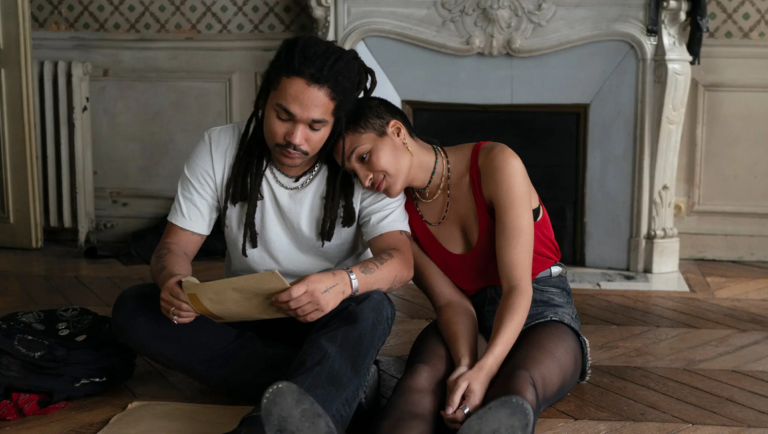
In fairness, “Sister Brother” is distinct from the previous vignettes, and it offers the movie an opportunity to open up: two adult siblings, younger than the others, meet in Paris to take a last look at their childhood home. They’re more at ease with each other, and they’re cool. They must be: brother Billy (Luka Sabbat) microdoses psilocybin, and sister Skye (Indya Moore) retorts that she knows what microdosing is when he tries to mansplain it. It’s the obnoxious reminiscences of an aging art school dropout that you’re forced to listen to because he’s the weed plug, tossing out preposterous one-liners like “It’s all so… impermanent,” or “To quote the great Groucho Marx, ‘Whatever it is, I’m against it.’” It’s all indicative of Jarmusch’s static relationship to authority and contemporary filmmaking. The director could have finally made good on the Ozu crush he’s been gushing about and made that mature work which contended with obsolescence and aging, but instead he clings too tightly to his outsider status despite the fact that, Golden Lion in hand, he’s The Man now.
Anti-establishment filmmaking in Jarmusch’s heyday was easily distinguishable from TV: nobody would mistake All in the Family for Jeanne Dielman, or Dallas for Stranger Than Paradise. Today, independent filmmakers need to work overtime to assert the value of the film image as distinct from second-screen slop (Sarah Friedland’s extraordinary Familiar Touch is a great case-in-point). Jarmusch, however, rests on his laurels, refusing to do anything but point down at the underground from high atop his throne in the balcony at Brooklyn Steel. He’s right that counterculture is thriving, but he just doesn’t realize he’s on the other side of it. To quote the great George Carlin: “It’s a big club, and you ain’t in it.”
DIRECTOR: Jim Jarmusch; CAST: Adam Driver, Cate Blanchett, Tom Waits, Vicky Krieps, Indya Moore; DISTRIBUTOR: MUBI; IN THEATERS: December 24; RUNTIME: 1 hr. 50 min.
Comments are closed.