
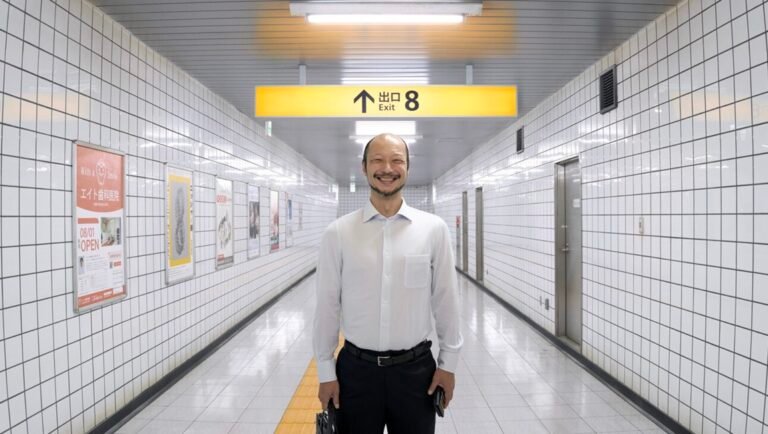
Why 2025 was a year rich in films with purgatorial motifs — everything from Oliver Laxe’s Sirât to Alex Ullom’s It Ends — is a question that begs for a wider interrogation of the zeitgeist. Purgatory, in this allegorical cinematic crop, isn’t portrayed so much as a place of moral bookkeeping as an endless landscape wherein characters try to keep their bearings long enough to remain themselves. Genki Kawamura’s Exit 8 is no exception, and feels like the sterile distillation of the trend. The film details a painfully contemporary nightmare where the notion of a purgatory is reduced to its most bureaucratic (gridded architecture, clinical lighting, the standardized wayfinding system), if not covertly theological (the premise that salvation is available only to those who are capable of noticing the broader design around them), interpretations.
Exit 8 opens with an asthmatic young man, referred to as The Lost Man in the intertitles, finding himself stuck in an endless underground passageway shortly after receiving news of his ex’s pregnancy. The place seems as if it could belong to any major city, and no city at all: the only thing we seem to know about it is that it’s located somewhere in contemporary Japan and operates as an ever-glitching in-between layer of the city’s public infrastructure, repeating itself perpetually with tiny mutations. An instructional placard affixed to the tile walls tells him the rules of this survival game plainly and sequentially: proceed forward only if nothing looks amiss or out of the ordinary; if any “anomaly” is present, turn back immediately. Correct choices advance him toward the higher floors and eventually lead him to the titular Exit 8, the sole threshold that actually offers a way out; wrong choices undo time and snap him back to square one (in other words, Exit 0). The anomalies themselves range from bleeding walls to one-eyed rat-like creatures, forcing the protagonist into an exhausting, never-ending vigilance where his perception becomes labor, and labor becomes the only form of agency left.
Any film that’s poised to lean heavily on its central conceit, more so when it’s a game adaptation, risks tipping into the throes of gimmickry. However, Exit 8 quickly sidesteps the genre’s usual theatricalities by framing the stage as a personality test of readiness and maturity for his characters rather than a puzzle that needs to be solved. The mazelike apparatus doesn’t merely ask its players to exist more concretely in the present, but also to be more mindful of their past and future. By the same token, it treats their gamified failure as a model of modern life’s everyday cruelty: effort met with marginal returns, the dire probability of labor being annulled by an authoritative hand; the small humiliations of resisting as a person against a larger system with infinite resources and patience. The Lost Man’s face becomes a register of micro-defeats in the process, the kind we all could find traces of in our daily interactions (with work, with colleagues, with family). That’s perhaps why, when the anomalies escalate into outright horror in later stages, it comes across less as a bid for shock value than as a visual rendering of what anxiety might look like in today’s world.
What’s more impressive, form-wise, is how much mileage Kawamura gets out of the element of sameness and continuity. He treats repetition as an artistic discipline rather than a structural limitation, so that each deviation, however small (a shifted sign, a wrong piece of information on the poster, a doorknob placed a few inches off), is magnified into a bigger event and lands as a breach in our perception of reality. The horror is subterranean here and is achieved through subtraction: no extravagance, no dependence on external elements to propel the story. The design of this subterranean landscape is also complicit in engineering the seemingly mundane, everyday dread. It holds all the visual cues of an ephemeral, transitional place one might inhabit only as a means to an end: it’s too bright, too airless, and too clean to resemble anything at all. In a medium that often mistakes “world-building” for “exposition,” the commitment Exit 8 shows in its frugal grammar suggests that the environment itself can do the heavy-lifting when it comes to the storytelling, following in the footsteps of the genre’s early predecessors in Cube and The Platform.
Despite all its post-industrial codes, Kawamura’s film has an unexpectedly humane sense of what repetition might do to a person. Through accumulation and incremental erosion, it turns the certainty and scrutiny the game solicits into a very human superstition and paranoia. Because it provokes the viewer by aligning their attention skills with those of the characters, any failure feels cruelly personal. What deepens the sting is the film’s suggestion that attention is an age-dependent ability, something you gradually lose with the test of time. It’s probably no coincidence that among the three main figures, The Boy (introduced in the third and last chapter) is the most diligent, noticing even microscopic changes in the space, to the extent that he keeps trying to warn the adults around him. At the other end of the spectrum stands The Walking Man, the “hero” of the second chapter and the oldest of the three, who seems least able (or least willing) to sustain that level of looking and attention.
What makes Exit 8 more than a pattern-recognition exercise is how it troubles the line between what is real and what is not. In The Lost Man’s chapter, The Walking Man reads as a pure replicate, a stock figure generated by the adversarial, metaphysical underground passageway system. But the following second chapter grants him interiority and turns him retroactively real, even if he remains unreadable to The Lost Man, who has been trained to classify everyone else in the passageway as potential hazards, as obstacles to overcome rather than living and breathing people. That reframing makes The Walking Man’s later drift into the false exit, which welcomes him like the gates of heaven, feel less like a scare than a human mistake that turns him into a permanent part of the system. The same uncertainty haunts The Lost Man when he assumes a child he comes across on one of the floors is an anomaly, turns around in compliance as per the rules of the game, and is punished for it by being snapped back to Exit 0.
This duality is also evident in the film’s dealing with symbolism. At first glance, it’s almost irresistible to liken the passageway floors to the circles of a Dantean hell, each level rearranged with its own petty logic, its own calibrated torment. The farther The Lost Man advances into the game, the less the space around him feels like a subway station and the more its infernal cartography emerges. Progress is permitted only through compliance in this tiered system and disobedience is punished as a cardinal sin. Even the title carries a part of the joke here: the much-anticipated Exit 8 does not deliver The Lost Man a way out so much as a loophole back to where everything started, a final ring that he reaches only by becoming a bettered, more attentive version of himself. That’s also probably why, when the film is most literal about its metaphors, it starts to flirt with a moral legibility that the structure doesn’t naturally support. The corridor is a great image for modern life, yes, but it’s also just a corridor with no horizon on either end, a place so blank it practically begs to be filled with meaning. Likewise, whenever the characters reach for meaning, for explanation, we can feel the air shift, as if the passageway itself has become slightly less dangerous because the logic of the game has been translated into another, more comprehensible language.
That’s also perhaps why the film pivots from the metaphysical to something more nakedly social with its ending. Only when The Lost Man feels he’s finally ready to face the parenthood does he take the eponymous Exit 8 and begin his solo walk against a recently resurfaced swarm of “real” people, most of them anonymous, exhausted service workers, bodies moving in the opposite direction with a dull, almost orderly coordination. The gesture reads like a minor rebellion on his part because he has managed not only to beat the system, but has also stopped consenting to its flow. And yet the film refuses to render this moment of relief as a resolution: by refusing to take the outmost exit out of the underground in the very end, The Lost Man performs his last act of escapism and decides to become lost again inside the loop in his own semi-autonomous way. He doesn’t play the game anymore, sure, but he also doesn’t outright refuse its comforts, its prospective cocoon from the outside world, either; he becomes trapped in his own hell. If the moment Exit 8 comes to a full circle feels rather pessimistic, it’s because of the implication that what is real and what is not have finally become one, that the purgatory, having exhausted its symbolic power, has become indistinguishable from what comes before and what comes after.
Published as part of IFFR 2026 — Dispatch 4.
Comments are closed.