
Moonglow
Writing in e-flux Journal on Klute’s semicentenary, Isabel Sandoval discussed in detail the immeasurable influence of Alan J. Pakula’s neo-noir crime thriller — especially its central female character Bree Daniels, as well as the actress that played her, the great Jane Fonda — on the kind of women that she wrote and often played throughout her erotic, enigmatic filmography and aspires to be as a woman of trans experience, revealing a cinematic lineage that is at once personal and political. “My identification with the Bree/Jane persona — one is inseparable from the other in my mind — became profound and personal as I gravitated toward a more anarchic expression of femininity,” she wrote. Sandoval emulates Bree/Jane just as her ardent admirers emulate her.
Like Bree, Sandoval’s women, from Donna in 2011’s Señorita (her first feature) to Olivia in 2019’s Lingua Franca, are “morally complicated women.” They are anti-femme fatale, full of secrets, both a gift and a curse in Sandoval’s hands, and “fueled by internal contradictions they can’t fully register or control,” as they live in politically tumultuous times. Much the same could be said of Dahlia, her latest heroine in her fourth fiction feature Moonglow, which recently played in the Big Screen competition at Rotterdam.
Film after film, Sandoval has been deeply attuned to the secret poetics of sensuality and subterfuge, and what it means to seek power in it. Dahlia, played by Sandoval herself, is a disillusioned detective in late 1970s Manila, who masterminds a heist against her corrupt superior Bernal (Dennis Marasigan), who is in cahoots with an equally corrupt governor, and secretly funnels the money to the displaced dwellers of a slum deliberately set ablaze by her colleagues. Clueless, Bernal instructs Dahlia to crack the crime, with the help of his nephew Charlie (Arjo Atayde), an ex-cop turned lawyer, who turns out to be the culprit’s former lover and will soon run into the journalist Nick Garcia (Rocco Nacino), who, in turn, is probing Bernal. Dahlia conceals the theft from everyone, save for her aunt Sister Therese (Agot Isidro), who reluctantly agrees to hide the money in the convent where she stays. As the proceedings unfold, the film establishes a pecking order among its characters: first the governor, then the police chief, then his subordinates (including Dahlia and Charlie), and, finally, the people treated as collateral — the reporter, the nun, and the unseen slum dwellers.
Moonglow is, in part, a neo-noir akin to Señorita, but while both films wrestle with systemically nefarious forces, Dahlia’s target, as opposed to that of Donna, is a lot narrower: only Bernal and not exactly the entire police force, though her subservient colleagues eventually get dragged into the whole mess. “In part” because while Sandoval delivers in classic noir terms — the Hitchcockian gesture of instantly revealing the prime suspect as well as all the shootouts and double-crossings, to name a few — she tersely turns the genre on its head, and by extension the fundamentally male auteurial gaze from which noir is conceived, crafting not only a world of darkness and danger, but desires and dreams, too. One might say this is a period romance movie disguised as a neo-noir — or vice versa, depending on whichever you find more tempting.
But, in many respects, it’s also a martial law movie redolent of 2012’s Aparisyon (Sandoval’s only feature she didn’t star in), in that it moves past the images that have become a fixture of martial law cinema (widespread rallies or graffiti protesting the dictatorial regime, for instance) and instead, like Aparisyon, defaults to news of Marcosian unrest delivered on the radio, which is only a fraction of the incredibly textured sound design by Tu Duu-chih, a frequent collaborator of Edward Yang, Hou Hsiao-Hsien, and Wong Kar-wai. Throughout, Sandoval renders the bleak historical period on a scale much smaller than the reported budget of $1.08 million, which is already huge for an independent Filipino film, and therefore more inward and private than one would expect for a martial law movie. As the opening James Baldwin quote fittingly warrants, “People are trapped in history, and history is trapped in them.” Moonglow, at the same time, is a subtle demolition of the heist movie in the vein of Kelly Reichardt’s The Mastermind, or, on a more niche level, a cinema of cigarettes after crime, dangling its title card late in the movie in the sexiest way possible, a stylistic flourish that might as well be a willing accomplice.
Sandoval, by her own admission, essentially makes the same movie many times over, as is so often the case for most directors with distinct cinematic language. It is expected, then, that traces and tendencies of her previous pictures will crop up here: female protagonists in crisis, opening intertitles, a doomed romance, big secrets soon to be disclosed, nuns and religious spaces, and intimate conversations invoked at will via voiceover. Considering these recurrences, it is not far-fetched to imply that Sandoval’s body of work functions as critical metatext for her new film. One can also wonder if the Philippine-born, U.S.-based filmmaker ever envisions her heroines swapping lives, or at least conversing with each other and confronting their cosmic ties.
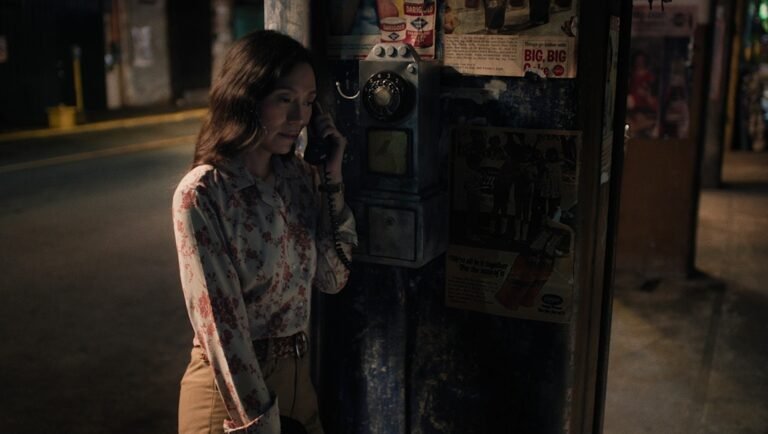
Whereas Aparisyon’s colors are pallid and Lingua Franca’s are muted, Moonglow is Sandoval’s lushest to date. It retains the sensuality and ambiguity that have come to define the filmmaker, who is known for writing, directing, producing, editing, and starring in her own films. Stylistically aiding and abetting Sandoval this time, as in Lingua Franca, is cinematographer Isaac Banks, and the brio and nostalgia with which he shoots a Manila that belongs to a bygone era, replete with analog technology, including wired telephones and wiretapping devices of the ‘70s, but still echoes our living present. Moonglow flirts with the spectral nature of film, as it leaps forward and backward in time, including a documentary-like gesture towards the Philippines of the future that feels more blinding than bright and just as haunted as its people, which will urgently make you think of the director’s Great Depression-set short film Shangri-La. To some degree, one wishes it were a little more obsessed with this specific flourish, but that’s also what makes it stand out, precisely because Sandoval never repeats the gesture.
The film’s compositions are the direct opposite of crowded cinema, often content with at most three performers in frame, who don’t do much but talk or, in the case of Dahlia, smoke. Banks and Sandoval have a knack for a camera that slowly, voyeuristically inches towards the characters until they occupy most of the frame (though, elsewhere, the film boasts two stunning, omnipresent crane shots). Remton Siega Zuasola’s intricate, neon-tinged scenic design features beautiful Binondo sets and vintage cars, as well as the Filipino household staple striped and floral fabric that decorates Dahlia’s rather dingy flat. It makes the 1970s Manila time capsule particularly evocative. At best, such details, combined with the film’s fade-leaning editing, ultimately allow for the tropical, dreamlike atmosphere and the sense of melancholic longing of In the Mood for Love, though instead of the hypnotic hold of waltz, Moonglow flows to the rhythm of jazz, courtesy of composer Keegan DeWitt (who was also responsible for the score of Shangri-La).
The film’s strongest impulse is what it veils and unveils, or what details Sandoval reckons as necessary for Dahlia to trick the men hot on her heels — and for the director to dodge viewer expectations and neat categorizations of her latest effort. Save for the robbery, much of the story has already happened: the arson and demolition; the police chief pocketing the bribe for a soon-to-rise apartment complex; Charlie’s new life in the States (which parallels Sandoval’s own diaspora); and the hazy romance Dahlia and Charlie once shared. Unlike her heroine, Sandoval’s writing isn’t indecipherable so much as intentionally slippery; as a result, a few characters can feel either tangential (Nick) or underwritten (Bernal). And as with her earlier films, the story is always half-asleep, and nothing really resolves. She edges us toward a long-held climax and then proceeds to unsatisfy us, promising an elsewhere that may never really come. One might read it as a lack of commitment or conviction, but it’s actually rather crucial to the sensual pulse of Sandoval’s oeuvre, in much the same way that one might prefer their Alain Guiraudie: teasingly fluid and trembling, always a little bit skewed.
Chic of hair, elusive of aura, Dahlia is a deeply cold and calculating character — well, for the most part, or until the arrival of Charlie, who is a source of alarm not only for the crime she’s trying to hide, but also for a kind of love she no longer thinks possible. Stripped of ravishing sex scenes, Sandoval presents the relationship between Dahlia and Charlie as more star-crossed than that of Olivia and Alex in Lingua Franca and, indeed, as potentially powerful as that of Su Li-zhen and Chow Mo-wan in Wong’s eons-enduring romance. The more he’s drawn to the case, the more she’s forced to confront the specters of desire he once again gives shape to. Clearly, they still have some affection for each other, continually recalling the night of their first meeting over a decade ago, and Sandoval gracefully offers her unfortunate lovers a chance to rekindle what they once had, if only momentarily, even if that means just sharing a cigarette together or listening to each other’s voices over the telephone. Given the weight the director imbues these moments with, it’s easy to want them to sin and sleep with each other, to cross the line they think they shouldn’t, but Sandoval insists otherwise, and saves her sweetest gesture for last.
Although the filmmaker cites Hollywood classics, such as Michael Curtiz’s Casablanca and Nicholas Ray’s In a Lonely Place, as inspirations, her performance hews closer not to the women of those titles, but to Maggie Cheung’s wistful and evocative presence in Wong’s film. The several recurring scenes in which Sandoval lights a cigarette and smokes it so elegantly, indulging in its tendrils swirling upwards, are cinema unto itself. Such scenes trigger a sense memory of sorts, as though the sharp tang of smoke brings with it entire histories. At times, her glow is almost vampiric. This is a sheer testament to Sandoval’s beauty, her rare ability to capture that beauty so artistically, and her clear awareness that it enhances her image-making. She’s a Main Character, but never in the annoying and derogatory way that people are accustomed to using Internet slang.
Meanwhile, the presence of Atayde, a Filipino celebrity turned controversial congressman, who plays a by-the-book investigator, at least initially, inescapably carries an ample dose of irony in a movie about unchecked power and corruption, about people kowtowing to personal and systemic pressures (it’s no surprise that Dahlia wants to play Robin Hood). Atayde’s performance as Charlie, though, is pretty okay and makes the most of what Sandoval — both as writer and director — affords his character, whose deeper motives primarily remain latent. Charlie is not so much a foil to Dahlia narratively as Atayde is to Sandoval stylistically. The onscreen chemistry is there, though it works in a manner more dormant than explosive, which is totally fine if you’re already used to the way Sandoval charts emotional connections in her films; if not, then this is a litmus test.
Sly, sultry, and sinister, Moonglow is Sandoval returning to her roots in an evolved form. Here, she unabashedly references the movies that made her, but not to the point of surrendering her singular cinematic voice. It’s an undeniable extension of the entrancing Sandoval effect, one that attempts to attract a wider and broader crowd, even if it seems destined to be polarizing; it’s the arthouse brand of cool, perhaps. It’s the stuff for real yearners. It also demonstrates the command of not only a bona fide multi-hyphenate but a real movie star. And while the director has a penchant for secrets, this picture and the rest of her movies do not speak in code so much as they resist being decoded, which nonetheless makes them equally riveting and ripe for speculation. “The less of me the audience has figured out, the more power I have over them,” Sandoval noted in the e-flux essay. By this metric, the more elusive Moonglow is, the more enticing it becomes. — LÉ BALTAR
ADGIN PRRX
In any competitive race, the relevant agents can be organized as such: the spectators, who traditionally stay rooted to the spot and view its proceedings as snapshots; the cameras, which assume an omniscient, televised view of start and finish; the corporations, which manufacture and sell the stakes; and the competitors themselves, who live eternity in the moment. Applied to Formula One racing, this organization becomes the spectacle of grandeur writ large. Winning is the textbook objective, but there can only be one winner, and the audience’s jouissance necessarily requires a perverse outlet, captured dutifully by the cameras and secretly coveted by the suits — in crashes, near misses, flames, fatalities. Joseph Kosinski’s F1 (2025), nominated for four Academy Awards, sells the perversion to a consumer base long desensitized to sporting brutality; no shot, for the most part, is more than a few seconds long, and the sheer vulgarity of star-powered endorsements qualifies it as a maximalist IMAX hit more than any lasting hint of violence does. When, some 60 years before, John Frankenheimer filmed Grand Prix (1966), the novelty had a less polished sheen, but the obsessions weren’t drastically different. At the heart of the racing drama lies — and continues to lie — the expression of legacy, more fundamental than humanizing the greats and illuminating their rivalries. With legacy and posterity come their dialectical opposites: death, humiliation, and oblivion.
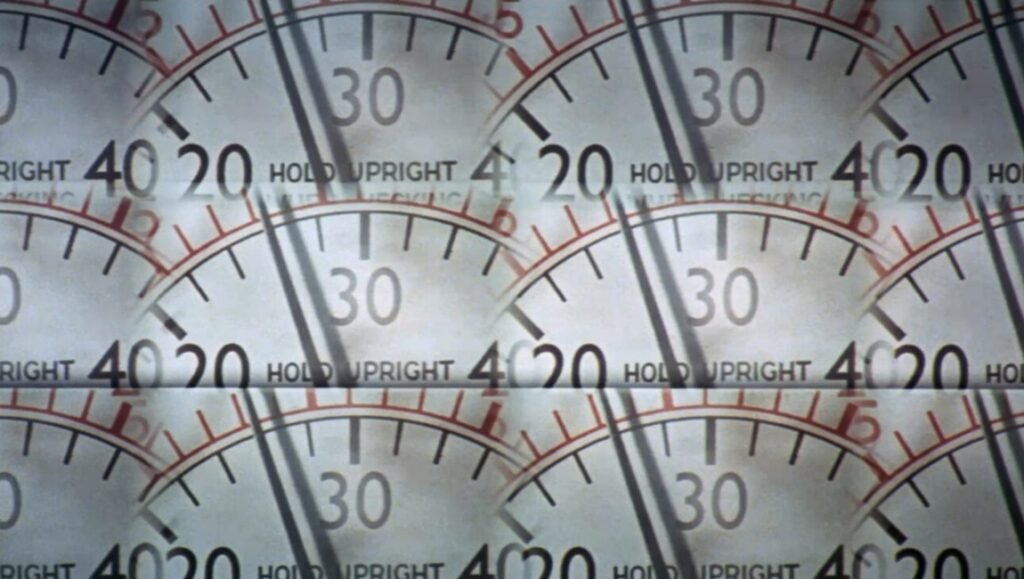
Serving almost as a counter-thesis to F1, Norbert Pfaffenbichler’s re-edit of Frankenheimer’s Grand Prix mounts a grand deconstruction of the former’s watered-down illusions. More accurately, a re-assembly of all the sequences within Grand Prix from shortest to longest, ADGIN PRRX proves challenging by virtue of its formalist trappings. It’s a found footage film par excellence, structured around an empirical organizing principle and bound by certain laws of necessity; its montage, then, centers around the seemingly arbitrary arrangement of discrete units in violation of the original’s continuous, passionate narrative. Arbitrary, too, is the film’s notion of authorship: one wonders how different the output might’ve been had another director (or AI) processed it. Yet in some way, the film both endorses and resists this ensnarement, its anagrammatic modus operandi not far off from the disjointed algorithms of TikTok consumption. Beneath the hot wheels lies a cold, impersonal calculus dominated by metal and machine; from this calculus now springs an unadulterated freedom from the dictates of linear representation.
Pfaffenbichler’s oeuvre has largely been rooted in structural cinema, and even his more narratively conventional 2551 trilogy traverses an outwardly gaudy path toward inner negation. The masked ape-man protagonist of this trilogy exists in an unspecified underground dystopia, marked by signifiers of silent Expressionism and strewn with the images of totalitarian excess amid an ever-squalid darkness; his incursions with and futile subversion of the Law mark, somewhat despondently, an underlying logic of cruelty at the core of civilization. In Grand Prix, crucially, a similar logic is at play. An amoral whirlwind of “speed and spectacle” courses through the fictionalized staging of the 1966 Formula One season, staffed by a celebrity ensemble and interspersed with racing footage of actors and professionals alike. The four main personalities jockey about the racetrack, each with a certain fixation on the sport: for Sarti (Yves Montand), its burdens are many, while the likes of Barlini (Antonio Sabàto) and Stoddard (Brian Bedford) doggedly pursue their fame and legacy, respectively. Aron (James Garner), faulted and sidelined for an accident that hospitalized Stoddard, seizes an opportunity to represent the industrialist Yamura’s (Toshio Mifune) newcomer team. The women of Grand Prix fulfil their spousal and narrative duties accordingly: sickened by his recklessness, Stoddard’s wife considers filing for divorce; Sarti and Barlini, meanwhile, each get involved, romantically, with outsiders (an American reporter; a French nymphet) to the racing industry.
Grand Prix’s interwoven pieces find themselves shattered, then rejigged, by Pfaffenbichler’s hand, as ADGIN PRRX splices sound and image wholesale, forgoing the mythology of the original’s 70mm Cinerama presentation for a creeping exercise of movement and inertia. The audio’s reverberations are carried, on occasion, across shots, their abrupt truncation now intrusive to the viewer’s perception of coherence. Assuming the existence of shots with the exact same length, one might posit some creativity to their mutual organization, whether by chronology or character, or some other association. Gradually, however, a radical sense of contingency begins to assert itself. The recurrent shots reveal the story’s prospective meat: the mountains; the lake; Stoddard in crutches, confronting his wife; the races themselves, propelled on the circuit with a steady, bewitching hum. Celebrations, commiserations, long and extended dialogues are broken up; only faces and impressions remain through the shards.
Had ADGIN PRRX begun with the film’s longest shot and collapsed into a flurry of intense action, one might glean a materialist account of the legend and events. The converse belies something more sentimental but also arguably more candid. As the length of each sequence rises, the façade of continuity paradoxically comes apart. The racing genre’s engines are oiled with seamless repetition, shots tracking briskly from one to another without distraction; by this new design, they sputter at the onset of motive and emotion, swapping the blur of movement for the fog of narrative. Who wins becomes less of a puzzle than a peripheral event, just as the monumental tragedy of Sarti’s death — a stain on the closing frame of Grand Prix — vanishes in the thick of smoke. Incidentally, the film’s final shot is not of the eternal triumph of movement, but a romantic intermezzo between Aron and Stoddard’s wife. Into this comes the afterthought of Sarti and his beloved, entering and exiting the frame momentarily. With it, ADGIN PRRX poses the age-old question — why race? — before jettisoning it, along with man and machine alike, in a heat death of entropy and disarray. — MORRIS YANG
Exit 8
Why 2025 was a year rich in films with purgatorial motifs — everything from Oliver Laxe’s Sirât to Alex Ullom’s It Ends — is a question that begs for a wider interrogation of the zeitgeist. Purgatory, in this allegorical cinematic crop, isn’t portrayed so much as a place of moral bookkeeping as an endless landscape wherein characters try to keep their bearings long enough to remain themselves. Genki Kawamura’s Exit 8 is no exception, and feels like the sterile distillation of the trend. The film details a painfully contemporary nightmare where the notion of a purgatory is reduced to its most bureaucratic (gridded architecture, clinical lighting, the standardized wayfinding system), if not covertly theological (the premise that salvation is available only to those who are capable of noticing the broader design around them), interpretations.
Exit 8 opens with an asthmatic young man, referred to as The Lost Man in the intertitles, finding himself stuck in an endless underground passageway shortly after receiving news of his ex’s pregnancy. The place seems as if it could belong to any major city, and no city at all: the only thing we seem to know about it is that it’s located somewhere in contemporary Japan and operates as an ever-glitching in-between layer of the city’s public infrastructure, repeating itself perpetually with tiny mutations. An instructional placard affixed to the tile walls tells him the rules of this survival game plainly and sequentially: proceed forward only if nothing looks amiss or out of the ordinary; if any “anomaly” is present, turn back immediately. Correct choices advance him toward the higher floors and eventually lead him to the titular Exit 8, the sole threshold that actually offers a way out; wrong choices undo time and snap him back to square one (in other words, Exit 0). The anomalies themselves range from bleeding walls to one-eyed rat-like creatures, forcing the protagonist into an exhausting, never-ending vigilance where his perception becomes labor, and labor becomes the only form of agency left.
Any film that’s poised to lean heavily on its central conceit, more so when it’s a game adaptation, risks tipping into the throes of gimmickry. However, Exit 8 quickly sidesteps the genre’s usual theatricalities by framing the stage as a personality test of readiness and maturity for his characters rather than a puzzle that needs to be solved. The mazelike apparatus doesn’t merely ask its players to exist more concretely in the present, but also to be more mindful of their past and future. By the same token, it treats their gamified failure as a model of modern life’s everyday cruelty: effort met with marginal returns, the dire probability of labor being annulled by an authoritative hand; the small humiliations of resisting as a person against a larger system with infinite resources and patience. The Lost Man’s face becomes a register of micro-defeats in the process, the kind we all could find traces of in our daily interactions (with work, with colleagues, with family). That’s perhaps why, when the anomalies escalate into outright horror in later stages, it comes across less as a bid for shock value than as a visual rendering of what anxiety might look like in today’s world.
What’s more impressive, form-wise, is how much mileage Kawamura gets out of the element of sameness and continuity. He treats repetition as an artistic discipline rather than a structural limitation, so that each deviation, however small (a shifted sign, a wrong piece of information on the poster, a doorknob placed a few inches off), is magnified into a bigger event and lands as a breach in our perception of reality. The horror is subterranean here and is achieved through subtraction: no extravagance, no dependence on external elements to propel the story. The design of this subterranean landscape is also complicit in engineering the seemingly mundane, everyday dread. It holds all the visual cues of an ephemeral, transitional place one might inhabit only as a means to an end: it’s too bright, too airless, and too clean to resemble anything at all. In a medium that often mistakes “world-building” for “exposition,” the commitment Exit 8 shows in its frugal grammar suggests that the environment itself can do the heavy-lifting when it comes to the storytelling, following in the footsteps of the genre’s early predecessors in Cube and The Platform.
Despite all its post-industrial codes, Kawamura’s film has an unexpectedly humane sense of what repetition might do to a person. Through accumulation and incremental erosion, it turns the certainty and scrutiny the game solicits into a very human superstition and paranoia. Because it provokes the viewer by aligning their attention skills with those of the characters, any failure feels cruelly personal. What deepens the sting is the film’s suggestion that attention is an age-dependent ability, something you gradually lose with the test of time. It’s probably no coincidence that among the three main figures, The Boy (introduced in the third and last chapter) is the most diligent, noticing even microscopic changes in the space, to the extent that he keeps trying to warn the adults around him. At the other end of the spectrum stands The Walking Man, the “hero” of the second chapter and the oldest of the three, who seems least able (or least willing) to sustain that level of looking and attention.
What makes Exit 8 more than a pattern-recognition exercise is how it troubles the line between what is real and what is not. In The Lost Man’s chapter, The Walking Man reads as a pure replicate, a stock figure generated by the adversarial, metaphysical underground passageway system. But the following second chapter grants him interiority and turns him retroactively real, even if he remains unreadable to The Lost Man, who has been trained to classify everyone else in the passageway as potential hazards, as obstacles to overcome rather than living and breathing people. That reframing makes The Walking Man’s later drift into the false exit, which welcomes him like the gates of heaven, feel less like a scare than a human mistake that turns him into a permanent part of the system. The same uncertainty haunts The Lost Man when he assumes a child he comes across on one of the floors is an anomaly, turns around in compliance as per the rules of the game, and is punished for it by being snapped back to Exit 0.
This duality is also evident in the film’s dealing with symbolism. At first glance, it’s almost irresistible to liken the passageway floors to the circles of a Dantean hell, each level rearranged with its own petty logic, its own calibrated torment. The farther The Lost Man advances into the game, the less the space around him feels like a subway station and the more its infernal cartography emerges. Progress is permitted only through compliance in this tiered system and disobedience is punished as a cardinal sin. Even the title carries a part of the joke here: the much-anticipated Exit 8 does not deliver The Lost Man a way out so much as a loophole back to where everything started, a final ring that he reaches only by becoming a bettered, more attentive version of himself. That’s also probably why, when the film is most literal about its metaphors, it starts to flirt with a moral legibility that the structure doesn’t naturally support. The corridor is a great image for modern life, yes, but it’s also just a corridor with no horizon on either end, a place so blank it practically begs to be filled with meaning. Likewise, whenever the characters reach for meaning, for explanation, we can feel the air shift, as if the passageway itself has become slightly less dangerous because the logic of the game has been translated into another, more comprehensible language.
That’s also perhaps why the film pivots from the metaphysical to something more nakedly social with its ending. Only when The Lost Man feels he’s finally ready to face the parenthood does he take the eponymous Exit 8 and begin his solo walk against a recently resurfaced swarm of “real” people, most of them anonymous, exhausted service workers, bodies moving in the opposite direction with a dull, almost orderly coordination. The gesture reads like a minor rebellion on his part because he has managed not only to beat the system, but has also stopped consenting to its flow. And yet the film refuses to render this moment of relief as a resolution: by refusing to take the outmost exit out of the underground in the very end, The Lost Man performs his last act of escapism and decides to become lost again inside the loop in his own semi-autonomous way. He doesn’t play the game anymore, sure, but he also doesn’t outright refuse its comforts, its prospective cocoon from the outside world, either; he becomes trapped in his own hell. If the moment Exit 8 comes to a full circle feels rather pessimistic, it’s because of the implication that what is real and what is not have finally become one, that the purgatory, having exhausted its symbolic power, has become indistinguishable from what comes before and what comes after. — SARP SOZDINLER
The Arab
Despite being so nondescript, the title of The Arab actually communicates quite a lot. In the singular nominative, it reduces a specific man or woman to their ethnicity. (“Here comes the Arab.”) But as a collective, it speaks to an entire civilization. (“What is to become of the Arab?”) Algerian director Malek Bensmaïl’s new film explores the complicated slippage between these two identities, and in particular the ways they have haunted the Western imagination.
The Arab is loosely based on the 2013 novel Meursault, an Investigation, by Algerian journalist Kamel Daoud. In the film, Dali Benssalah plays a journalist named Kamel, understood to be the fictionalized avatar of the book’s author. The novel could be called a work of meta-counter-fiction, in the sense that Daoud revisits a canonical text from a radically different point of view. Like Jean Rhys’ Wide Sargasso Sea, which reconsidered Jane Eyre from the perspective of Bertha Mason, the “madwoman in the attic,” Meursault is a speculative novel written in the margins of Albert Camus’ The Stranger. What, the novel asks, if Camus’ story of the Frenchman Meursault, who murdered an anonymous Arab on the beaches of Algeria, were actually adapted from a true event?
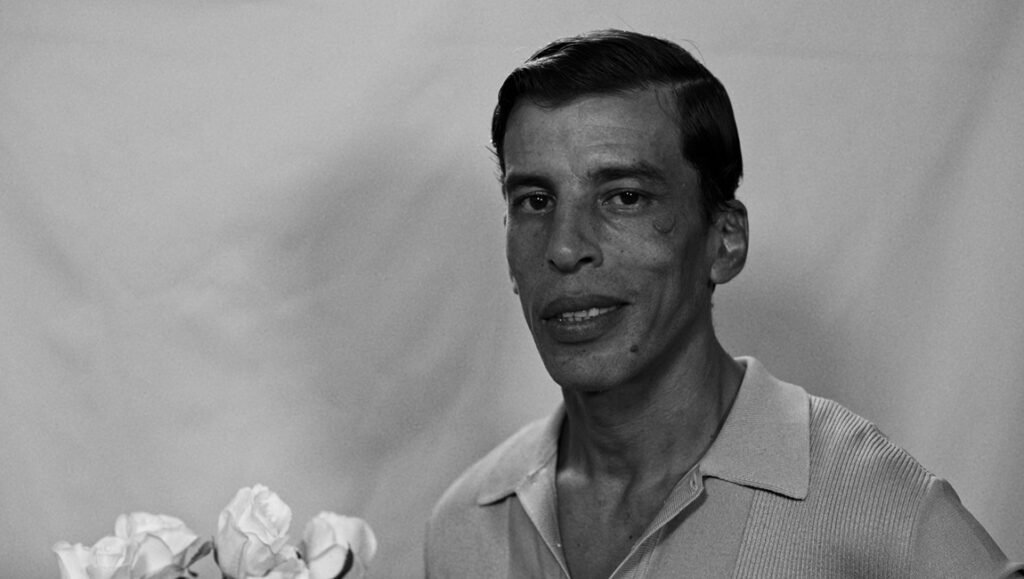
Kamel’s story occurs in the Algerian civil war in the ‘90s. Socialists and secularists like Kamel are under threat from Islamists, and exist mostly underground, meeting in various liberal speakeasies. It’s there that Kamel meets Haroun (Ahmed Benaïssa), a retired civil servant who approaches the journalist with a story he is compelled to share. “The Arab” in The Stranger was in fact his brother Moussa, and he was murdered by Meursault over their mutual love of a woman. But in Camus’ telling, Moussa is rendered nameless, lost to history.
Bensmaïl and co-writer Jacques Fieschi explore the broad canvas of Algerian history through the lives of Moussa and Kamel. In flashback, we see Moussa as a young boy and then as an adult, grappling with the aftermath of his brother’s murder against the backdrop of the Algerian revolution. As the French are expelled from the country, Meursault’s unpunished crime keeps Moussa and his mother (the great Hiam Abbas) psychologically stranded within colonialism, a debt that can only be paid with more spilled blood. Although French racism may have destroyed Moussa’s family, it was his mother’s obsessive mourning that ultimately destroyed his own future, leaving him a miserable drunk.
The Arab deftly moves between Moussa’s past and present, with the revolutionary period depicted in black-and-white and Academy ratio, while the civil war of the present day is in color and widescreen. In one dramatic moment, after Moussa’s mother has forced him to slaughter a different Frenchman (Raphaël Thiéry) in Meursault’s stead, her “war” is over, the aspect ratio expands, and color fills the frame. Bensmaïl’s classicism recalls the work of Rachid Bouchareb, taking in the broad sweep of history and turmoil without sacrificing emotional intimacy. While The Arab is fairly conventional in structure, it is a quietly powerful examination of the persistent scars of colonialism. In the last analysis, even Camus’ gesture of literary defiance proves wanting. — MICHAEL SICINSKI
Heart of Light — eleven songs for Fiji
So rare is contemporary parlance’s penchant for the optimistic, and so sparse are its vocabularies for the beatific, that Cynthia Beatt’s monumental Heart of Light – eleven songs for Fiji might strike one as unnecessarily maudlin. The film’s title comes apropos of Joseph Conrad, whose chronicles of darkest Africa reverberated with the specter of colonial despair; more immediately, however, does it draw its opening quotation from T.S. Eliot (“Looking into the heart of light, the silence”), inverting Conrad’s grandiosity only to emplace its own. Where “The Waste Land” might speak of the central essence of light, Heart of Light renders a curiously parallel interpretation, of a center — or way of being — constituted by light and coalescing around the beauty of observation. Segmented into eleven rather arbitrary vignettes, or “stanzas,” Beatt’s gentle agglomeration of the southern Pacific hemisphere is notable for its two leads: the archipelago and country of Fiji, alongside the actress Tilda Swinton, who plays a lightly fictionalized version of the director returning to a land she once called home.
Consciousness and representation of Oceania, outside of Australia and New Zealand, have traditionally been consigned to either pop infotainment (e.g., 2014’s documentary Next Goal Wins and Taika Waititi’s flippant fictionalized remake) or an idyllic, homogeneous backdrop for the critiques of colonialism (such as Albert Serra’s ravishing Pacifiction). By virtue of their distance and relative disengagement from the travails of the globalized world, Oceania’s shimmering waters and verdant isles lend a pristine and untouched quality to the narratives both realized or imagined within their dominion. In Heart of Light, this quality is largely undisturbed, at least visually speaking, with Jenny Lou Ziegel’s lush and wide compositions of the Fijian landscape fluently stitched together under Beatt and Till Beckmann’s editorial hands. But the film itself is loose and sprawling; a travelogue hybrid of narrative and narration untroubled by their interplay. As Beatt parses out the story of Iona (Swinton), a Scottish woman who spent her childhood in Fiji (where her parents were expats of some kind) before emigrating to Scotland, she surveys the country’s various locales, interweaving the lives of background characters amid a broader recognition of their histories and customs.
Swinton herself remains mostly unseen, appearing only in the last two segments as a sincere if also tentative presence seeking to reconcile her tenuous nostalgia for Fiji with the outsider position she undoubtedly occupies. By her account, she straddles two worlds, neither of which quite inhere, and the film appears almost exculpatory of the colonialist gaze naturally assumed by anyone with her character’s baggage. If Heart of Light succeeds in pushing away this sentiment, however, it is chiefly due to Beatt’s informed engagements with Fiji’s cultural and political realities, which carefully emerge over the course of its expansive runtime. Magellan’s Mar Pacifico, which antedated the effects of Western imagination but not those indigenous to the region, came to bear on shifts in religious and collective identity; later on, with the British, a demographic shift by way of Indian immigrants permanently altered the dynamics of Fiji’s ethnic and economic structures. Beatt, whose first feature (1979’s Description of an Island, co-directed with Rudolf Thome) trained its ethnographic lens onto the neighboring archipelago of Vanuatu, attempts a humbler, more graceful paean here. Over a geography of islands steeped in solitude but intimately connected, the ties of kinship stretch and persist. Against Eliot’s succeeding line of a bleak and empty sea, their very existence, sensitively rendered by Beatt’s cinematic tone-poem, offers no little reprieve. — MORRIS YANG
Mi Amor
The best mysteries always maintain an air of… well, mystery about them. Propelled by the fear, pain, and panic of having all too many questions and too few answers, they possess a particular kind of tension which, when combined with a plot with the right amount of momentum, can make for a most riveting, disquieting story. Unfortunately, such cannot be said for Guillaume Nicloux’s Mi Amor. A filmmaker with some talent in both crime thrillers and psychological dramas, he’s here turned out a rather limp variation on both. Crucially, if its central mysteriousness is what keeps it engaging, it does so only to a point, after which it provides too many answers and becomes the kind of pedestrian schlock you’ve spent most of the movie hoping it wouldn’t be.
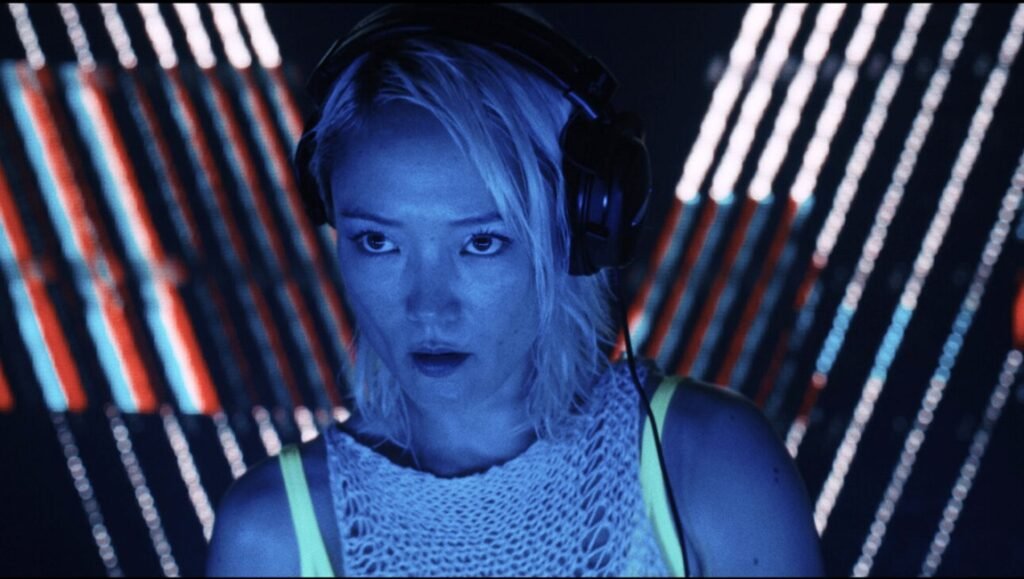
Romy (Pom Klementieff) is a successful DJ based in Paris, but frequently absent due to her work. Her teenage son lives with her mother, Kimi (Elina Löwensohn), as he has done since shortly after birth, when Romy was herself just a teen. Visiting the Canary Islands with her girlfriend, Chloé (Freya Mavor), she grows increasingly unsettled — first in the wake of hearing of Kimi’s illness, then by the peculiar welcome from the locals, and finally by a sudden disappearance and a string of further sinister events. Aided by club owner Vincent (Benoît Magimel), her isolation and frustration only intensify as she desperately seeks the truth in an unfamiliar place where everyone seems to be lying to her.
Nicloux and co-writer Nathalie Leuthreau’s scenario is a pretty unimaginative one, but the director’s sensitivity to the human condition keeps matters interesting, if never quite surprising. Romy and Vincent are drawn with nuance and compassion, and inhabited well by Klementieff and Magimel, and Nicloux touches upon notions of sympathy, kinship, abandonment, and disconnection between them and others with insight and honesty. Deep feelings are held for distant loved ones, tenuous bonds are developed between strangers, and past traumas cloud characters’ perceptions of present relationships — Romy addresses her mother by her given name, for example, and frequently denies the nature of her connection to Chloé. Some interactions pass with ease, other exchanges have a stilted tone, presumably intentional, that quietly amplifies the tension. Nicloux has a gentle, unforced directorial style that allows significant details such as these to register without emphasis, and provides his actors with the scope to deliver subtle yet impactful naturalistic performances.
Yet very little of this works as it ought to, and very much of that is due to the score. Composer Irène Drésel’s pounding electronic compositions drone through most of the movie’s scenes, aggressively directing toward an intensity not present in Nicloux’s air of calm (which is far more compelling and, importantly, far more unnerving). The music in Mi Amor never lets the movie rest, nor do individual scenes establish a mood of their own. It’s a near relentless signal to the nerves to be on edge, when the alternately plaintive and eerie stillness of Nicloux’s approach accomplishes this with considerably more persuasion (or it would, were it allowed to). It’s rare for a single element of a movie to sully it so greatly, yet this single element is so pervasive here that it could hardly not do so.
And then Nicloux sullies it all anyway, with a climactic sequence that nullifies whatever tension remained altogether. Explaining everything away, it’s a cheap, crude solution to a problem the movie never faced. There’s an unstressed note of mysticism here and there in Mi Amor, which, alongside the ever-more enraging uncertainties and obstacles Romy faces, creates a sense of creepiness — the terror of the unknown and the unknowable. That might have lingered, but Nicloux insists that nothing remains unknown, and the denouement he chooses is corny and deflating. It also racks up one too many easy outs for a movie that was already a little too heavy on them — heroic saves at the last minute, lucky chance encounters, and the baffling refusal of local law enforcement to entertain any of Romy’s complaints all stretch disbelief to the maximum.
The result is that Mi Amor is a mystery movie that ends up utterly unmysterious. It has its qualities, but it requires too much digging beneath rote B-movie plotting and an incessant musical score to make them worth the effort to find. Nicloux is a smart filmmaker — he has a strong handle on simple things, like a two-way dialogue exchange, and some more complex ones (the film has some of the most accurate cinematic depictions of modern clubbing in a long time). But he’s gone astray here, and the most mysterious thing about Mi Amor is how easy it would have been not to. — PADAÍ Ó MAOLCHALANN
Why Do I See You in Everything?
What happens when an act of resistance evolves from a single event into a living condition? In her debut feature, Why Do I See You In Everything?, Syrian filmmaker Rand Abou Fakher explores this question through a hybrid film form, bridging archival past, uncertain present, and a future that lives largely in dreams.
The story follows two men, Qusay and Nabil, who have known each other since they were five years old. From exploring the fields of Syria together as little boys, to joining the protests at 16 and later living in exile in Berlin, two friends intimate a deep connection that transcends uncertainty. The political context appears briefly, resurfacing here and there, but remains largely in the background, functioning more as an atmospheric state than as a sustained space of inquiry.
“I was kidnapped when I was four hundred years old,” says the voiceover, as the archival footage of olive trees being taken out of their home soil appears on the screen. Breaching the idea of a natural right to peace with obliterating violence, Fakher instantly prepares the viewer for a lyrical, yet unapologetic journey.
The inability to separate memory from perception is not a failure; it’s the main circumstance in Why Do I See You In Everything? Especially felt in the personal archive parts of the film, the idea of a memory turning into a pixelated stroke of pain is persistent and haunting. Slowly dissolving in the fogs of reminiscence about spaces and places that now exist only as an echo, two friends coexist in a reality both lived and acted out.
Passing the camera to one another as an intimate gesture of trust, from hands to hands, from eyes to eyes, from screen to screen, the two friends and the film’s director roughly maneuver the points of view. Inhabiting various visions, the film jumps locations and timelines as much as mood shifts. From a pro-Palestine protest in Berlin, resulting in another onslaught, to a peaceful bike ride, from the alluring Syrian landscapes, to its streets filled with weaponry, the film puts emphasis on a vicious instability.
“They want us to lose the capacity to see the truth, how harsh they are,” says Nabil to Qusay, “we should keep seeing and remembering.” Fakher’s film itself acts as a conductor of this remembrance, not shying away from being poetic but direct about police brutality, civilian massacres, and collective punishments of local populations. Side to side with the gentleness of taking shelter by the olive trees or collecting the ripe harvest, bearing “the horrifying” appears especially harsh.
The viewer begins to succumb and inhabit this liminality, just as their vision becomes altered by violence on the screen. The brutal black-and-white footage from the CCTV cameras contrasts with the grainy and soft sequences of nature in the same way dreams and nightmares might clash in fever. The images are no longer neutral, as they arrive already wounded.
The shaky camera movements during moments of stress and the fixed, almost suspended frames during moments of calm work as an effective emotional grammar. At times, Fakher might lose the viewer in rough transitions, relying on a drifting logic that feels closer to intuition than orientation. Yet the film unfolds like a beautiful walk that occasionally forgets to tell the viewer why it turned left instead of right.
During the tender scenes of intimacy, in words of support, it’s hard to say whether Qusay and Nabil are aware of the camera’s presence. Once in a while, the viewer could catch a glance at the camera; another time, the camera is openly discussed and manipulated, creating a quiet, contemplative presence. Perhaps the act of recording became an inseparable part of their lives as much as a continuous reimagining of survival.
In a continuous state of tension and resistance, in both the film form and the human condition, radical care seems to be a method of perseverance. Kindness, together with love, serves as a firm direction and a deliberate choice against all the painful changes or traumatic events. Care becomes a way of staying perceptually alive. Qusay and Nabil search for each other in protesting crowds, console each other during the hardships, and create peaceful moments for each other in times of complete turmoil.
The film begins with poetry, and ends with it, too. “There are roads we walk with our soul, and despite the pain… the time… the experiences… and despite places and distances, we will always find each other,” states the voiceover in the end, as Qusay and Nabil peacefully sit together under an olive tree.
Why Do I See You In Everything? offers a special approach to resistance. It opens itself to the viewer through unashamed fragility, giving space for visceral reactions as much as compassion. Rand Abou Fakher doesn’t answer the question posed in the title directly, instead only suggesting. In moments of turbulence, when remembering is altered by violence, one might see the other everywhere as an act of resistance and care. — LIZA KOLOMIIETS
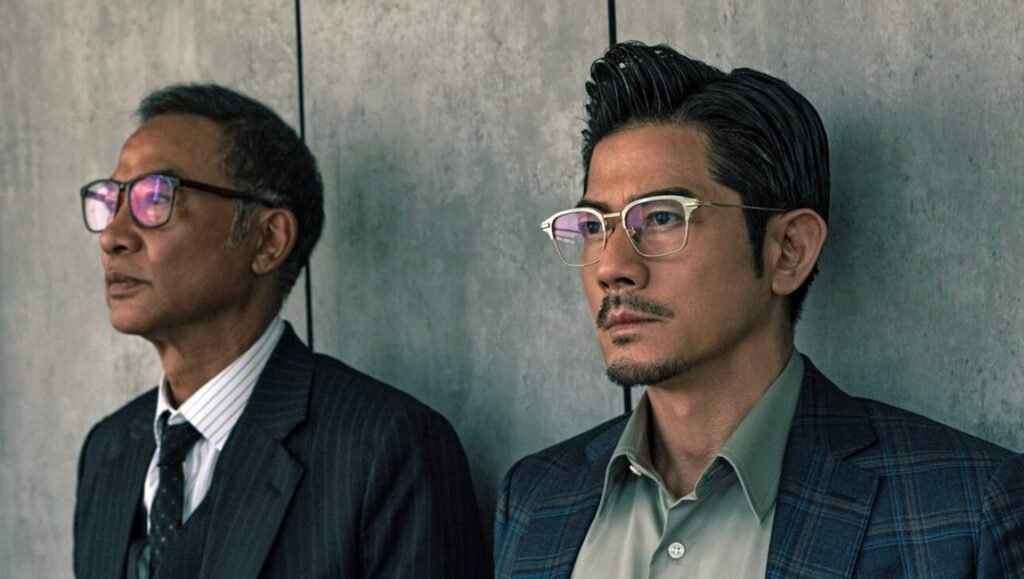
Under Current
There’s no one out there making them quite like Alan Mak, for better or worse. One-third of the team behind the Infernal Affairs series, along with co-writer Felix Chong and director Andrew Lau, Mak has spent the past 20 years crafting glossy thrillers about expensive men in expensive suits creating complicated schemes to rob each other in expensive rooms. He’d be the foremost chronicler of 21st-century Hong Kong’s conspicuous consumption if he weren’t also the foremost example of it. Movies like the Overheard series (2009-2014), Integrity (2019), and now Under Current feature an all-star cast of aging celebrities going through the convoluted motions of a screenplay built around needless complications and flash that, in the end, leaves you wondering what, if anything, it was all about. More often than not, it turns out to be about nothing at all.
Aaron Kwok plays a defense attorney who, after a crisis of conscience, begins investigating the suicide of a non-profit CFO played by Simon Yam. Yam, it seems, has uncovered some kind of embezzlement or money laundering that someone has been using the NGO for. Francis Ng plays the cop who helps Kwok out (it’s a mostly straight performance by Ng, though Hong Kong’s most reliably weird actor does get some moments to shine in his own inimitable way). Elsewhere, Alex Fong plays Yam’s boss, while David Chiang plays Kwok’s. The Chiang and Fong combination is, of course, a notable reunion of the male stars of Teresa Woo’s Iron Angels, though one doubts that’s what Mak was going for. Instead, they’re more simply a pair of old guys meant to evoke the generation that preceded the Handover, while Kwok and Ng are the stars who came up during the transition from colony to SAR (and beyond). Meanwhile, Felix Lok plays the shadowy villain, and he’s likewise been around forever, with one of his first film roles being in Yim Ho’s New Wave classic The Happening. At this point, a pattern has emerged: none of the male stars are less than 60 years old; all of the women are though.
The screenplay is constructed haphazardly around flashbacks to Yam’s final months as Kwok’s investigation proceeds. It’s kind of fascinating how all the characters know what’s really going on (money is being stolen), but no one knows by whom or for what purpose. Except for the viewers, halfway through, when that ancient Hong Kong bugaboo, the Golden Triangle, is invoked, and the whole thing turns out to be an overly complex drug deal. Or rather, it’s a really simple drug deal that Mak has devised to show us in the most convoluted ways possible. In other words, if you like to see a screenwriter working really, really hard, then Mak is the guy for you.
This still being Hong Kong, Mak does give us a couple of fight scenes, one in the middle and one at the end. Neither is especially remarkable, though it must be noted how truly terrible the special effects in the finale are, even by Hong Kong standards; a silver lining is that the taekwondo showdown immediately preceding this is pretty solidly executed. Still, it seems that all of the money on screen must have been spent on the lens flare budget instead. In the end, Under Current asks the question: What are non-profits really for anyway? If it’s so easy to launder drug money through them, then are they worth it? Left unsaid, but strongly implied, is that maybe these functions are better left to the government. You know, perhaps that friendly one that strongly believes in law and order and censoring motion pictures? — SEAN GILMAN
Comments are closed.