
Writing in e-flux Journal on Klute’s semicentenary, Isabel Sandoval discussed in detail the immeasurable influence of Alan J. Pakula’s neo-noir crime thriller — especially its central female character Bree Daniels, as well as the actress that played her, the great Jane Fonda — on the kind of women that she wrote and often played throughout her erotic, enigmatic filmography and aspires to be as a woman of trans experience, revealing a cinematic lineage that is at once personal and political. “My identification with the Bree/Jane persona — one is inseparable from the other in my mind — became profound and personal as I gravitated toward a more anarchic expression of femininity,” she wrote. Sandoval emulates Bree/Jane just as her ardent admirers emulate her.
Like Bree, Sandoval’s women, from Donna in 2011’s Señorita (her first feature) to Olivia in 2019’s Lingua Franca, are “morally complicated women.” They are anti-femme fatale, full of secrets, both a gift and a curse in Sandoval’s hands, and “fueled by internal contradictions they can’t fully register or control,” as they live in politically tumultuous times. Much the same could be said of Dahlia, her latest heroine in her fourth fiction feature Moonglow, which recently played in the Big Screen competition at Rotterdam.
Film after film, Sandoval has been deeply attuned to the secret poetics of sensuality and subterfuge, and what it means to seek power in it. Dahlia, played by Sandoval herself, is a disillusioned detective in late 1970s Manila, who masterminds a heist against her corrupt superior Bernal (Dennis Marasigan), who is in cahoots with an equally corrupt governor, and secretly funnels the money to the displaced dwellers of a slum deliberately set ablaze by her colleagues. Clueless, Bernal instructs Dahlia to crack the crime, with the help of his nephew Charlie (Arjo Atayde), an ex-cop turned lawyer, who turns out to be the culprit’s former lover and will soon run into the journalist Nick Garcia (Rocco Nacino), who, in turn, is probing Bernal. Dahlia conceals the theft from everyone, save for her aunt Sister Therese (Agot Isidro), who reluctantly agrees to hide the money in the convent where she stays. As the proceedings unfold, the film establishes a pecking order among its characters: first the governor, then the police chief, then his subordinates (including Dahlia and Charlie), and, finally, the people treated as collateral — the reporter, the nun, and the unseen slum dwellers.
Moonglow is, in part, a neo-noir akin to Señorita, but while both films wrestle with systemically nefarious forces, Dahlia’s target, as opposed to that of Donna, is a lot narrower: only Bernal and not exactly the entire police force, though her subservient colleagues eventually get dragged into the whole mess. “In part” because while Sandoval delivers in classic noir terms — the Hitchcockian gesture of instantly revealing the prime suspect as well as all the shootouts and double-crossings, to name a few — she tersely turns the genre on its head, and by extension the fundamentally male auteurial gaze from which noir is conceived, crafting not only a world of darkness and danger, but desires and dreams, too. One might say this is a period romance movie disguised as a neo-noir — or vice versa, depending on whichever you find more tempting.
But, in many respects, it’s also a martial law movie redolent of 2012’s Aparisyon (Sandoval’s only feature she didn’t star in), in that it moves past the images that have become a fixture of martial law cinema (widespread rallies or graffiti protesting the dictatorial regime, for instance) and instead, like Aparisyon, defaults to news of Marcosian unrest delivered on the radio, which is only a fraction of the incredibly textured sound design by Tu Duu-chih, a frequent collaborator of Edward Yang, Hou Hsiao-Hsien, and Wong Kar-wai. Throughout, Sandoval renders the bleak historical period on a scale much smaller than the reported budget of $1.08 million, which is already huge for an independent Filipino film, and therefore more inward and private than one would expect for a martial law movie. As the opening James Baldwin quote fittingly warrants, “People are trapped in history, and history is trapped in them.” Moonglow, at the same time, is a subtle demolition of the heist movie in the vein of Kelly Reichardt’s The Mastermind, or, on a more niche level, a cinema of cigarettes after crime, dangling its title card late in the movie in the sexiest way possible, a stylistic flourish that might as well be a willing accomplice.
Sandoval, by her own admission, essentially makes the same movie many times over, as is so often the case for most directors with distinct cinematic language. It is expected, then, that traces and tendencies of her previous pictures will crop up here: female protagonists in crisis, opening intertitles, a doomed romance, big secrets soon to be disclosed, nuns and religious spaces, and intimate conversations invoked at will via voiceover. Considering these recurrences, it is not far-fetched to imply that Sandoval’s body of work functions as critical metatext for her new film. One can also wonder if the Philippine-born, U.S.-based filmmaker ever envisions her heroines swapping lives, or at least conversing with each other and confronting their cosmic ties.
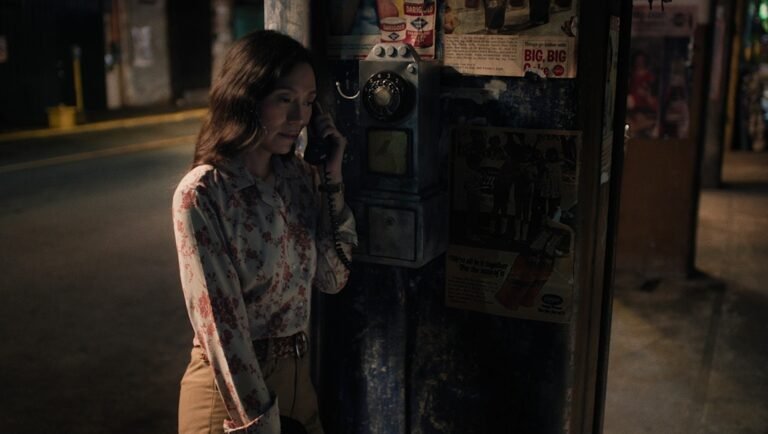
Whereas Aparisyon’s colors are pallid and Lingua Franca’s are muted, Moonglow is Sandoval’s lushest to date. It retains the sensuality and ambiguity that have come to define the filmmaker, who is known for writing, directing, producing, editing, and starring in her own films. Stylistically aiding and abetting Sandoval this time, as in Lingua Franca, is cinematographer Isaac Banks, and the brio and nostalgia with which he shoots a Manila that belongs to a bygone era, replete with analog technology, including wired telephones and wiretapping devices of the ‘70s, but still echoes our living present. Moonglow flirts with the spectral nature of film, as it leaps forward and backward in time, including a documentary-like gesture towards the Philippines of the future that feels more blinding than bright and just as haunted as its people, which will urgently make you think of the director’s Great Depression-set short film Shangri-La. To some degree, one wishes it were a little more obsessed with this specific flourish, but that’s also what makes it stand out, precisely because Sandoval never repeats the gesture.
The film’s compositions are the direct opposite of crowded cinema, often content with at most three performers in frame, who don’t do much but talk or, in the case of Dahlia, smoke. Banks and Sandoval have a knack for a camera that slowly, voyeuristically inches towards the characters until they occupy most of the frame (though, elsewhere, the film boasts two stunning, omnipresent crane shots). Remton Siega Zuasola’s intricate, neon-tinged scenic design features beautiful Binondo sets and vintage cars, as well as the Filipino household staple striped and floral fabric that decorates Dahlia’s rather dingy flat. It makes the 1970s Manila time capsule particularly evocative. At best, such details, combined with the film’s fade-leaning editing, ultimately allow for the tropical, dreamlike atmosphere and the sense of melancholic longing of In the Mood for Love, though instead of the hypnotic hold of waltz, Moonglow flows to the rhythm of jazz, courtesy of composer Keegan DeWitt (who was also responsible for the score of Shangri-La).
The film’s strongest impulse is what it veils and unveils, or what details Sandoval reckons as necessary for Dahlia to trick the men hot on her heels — and for the director to dodge viewer expectations and neat categorizations of her latest effort. Save for the robbery, much of the story has already happened: the arson and demolition; the police chief pocketing the bribe for a soon-to-rise apartment complex; Charlie’s new life in the States (which parallels Sandoval’s own diaspora); and the hazy romance Dahlia and Charlie once shared. Unlike her heroine, Sandoval’s writing isn’t indecipherable so much as intentionally slippery; as a result, a few characters can feel either tangential (Nick) or underwritten (Bernal). And as with her earlier films, the story is always half-asleep, and nothing really resolves. She edges us toward a long-held climax and then proceeds to unsatisfy us, promising an elsewhere that may never really come. One might read it as a lack of commitment or conviction, but it’s actually rather crucial to the sensual pulse of Sandoval’s oeuvre, in much the same way that one might prefer their Alain Guiraudie: teasingly fluid and trembling, always a little bit skewed.
Chic of hair, elusive of aura, Dahlia is a deeply cold and calculating character — well, for the most part, or until the arrival of Charlie, who is a source of alarm not only for the crime she’s trying to hide, but also for a kind of love she no longer thinks possible. Stripped of ravishing sex scenes, Sandoval presents the relationship between Dahlia and Charlie as more star-crossed than that of Olivia and Alex in Lingua Franca and, indeed, as potentially powerful as that of Su Li-zhen and Chow Mo-wan in Wong’s eons-enduring romance. The more he’s drawn to the case, the more she’s forced to confront the specters of desire he once again gives shape to. Clearly, they still have some affection for each other, continually recalling the night of their first meeting over a decade ago, and Sandoval gracefully offers her unfortunate lovers a chance to rekindle what they once had, if only momentarily, even if that means just sharing a cigarette together or listening to each other’s voices over the telephone. Given the weight the director imbues these moments with, it’s easy to want them to sin and sleep with each other, to cross the line they think they shouldn’t, but Sandoval insists otherwise, and saves her sweetest gesture for last.
Although the filmmaker cites Hollywood classics, such as Michael Curtiz’s Casablanca and Nicholas Ray’s In a Lonely Place, as inspirations, her performance hews closer not to the women of those titles, but to Maggie Cheung’s wistful and evocative presence in Wong’s film. The several recurring scenes in which Sandoval lights a cigarette and smokes it so elegantly, indulging in its tendrils swirling upwards, are cinema unto itself. Such scenes trigger a sense memory of sorts, as though the sharp tang of smoke brings with it entire histories. At times, her glow is almost vampiric. This is a sheer testament to Sandoval’s beauty, her rare ability to capture that beauty so artistically, and her clear awareness that it enhances her image-making. She’s a Main Character, but never in the annoying and derogatory way that people are accustomed to using Internet slang.
Meanwhile, the presence of Atayde, a Filipino celebrity turned controversial congressman, who plays a by-the-book investigator, at least initially, inescapably carries an ample dose of irony in a movie about unchecked power and corruption, about people kowtowing to personal and systemic pressures (it’s no surprise that Dahlia wants to play Robin Hood). Atayde’s performance as Charlie, though, is pretty okay and makes the most of what Sandoval — both as writer and director — affords his character, whose deeper motives primarily remain latent. Charlie is not so much a foil to Dahlia narratively as Atayde is to Sandoval stylistically. The onscreen chemistry is there, though it works in a manner more dormant than explosive, which is totally fine if you’re already used to the way Sandoval charts emotional connections in her films; if not, then this is a litmus test.
Sly, sultry, and sinister, Moonglow is Sandoval returning to her roots in an evolved form. Here, she unabashedly references the movies that made her, but not to the point of surrendering her singular cinematic voice. It’s an undeniable extension of the entrancing Sandoval effect, one that attempts to attract a wider and broader crowd, even if it seems destined to be polarizing; it’s the arthouse brand of cool, perhaps. It’s the stuff for real yearners. It also demonstrates the command of not only a bona fide multi-hyphenate but a real movie star. And while the director has a penchant for secrets, this picture and the rest of her movies do not speak in code so much as they resist being decoded, which nonetheless makes them equally riveting and ripe for speculation. “The less of me the audience has figured out, the more power I have over them,” Sandoval noted in the e-flux essay. By this metric, the more elusive Moonglow is, the more enticing it becomes.
Published as part of IFFR 2026 — Dispatch 4.
Comments are closed.