
With miscarriage after miscarriage of justice, the United States has all but exposed the amorality at the heart of its empire: first the Epstein files were withheld, then they were redacted, then they found limited release, and, when released, were blatantly defended by the very conditions under which they were permitted public scrutiny. As the Trump administration employed its playbook of deflection and astroturfing measures to cover up a legacy of atrocities, one might recall the nauseous confusion that quickly beset anybody who cared. There were few answers, fewer calls to action that led anywhere; conspiracy upon conspiracy was generated, anonymized, sequestered in bubbles of text. As witnesses to collective trauma, vox populi easily degenerates into cynical babble, wanting for truth and certainly lacking in faith for the pronouncements of vox Dei.
The cult of Mormonism may seem quaint by comparison, but its organizing principle is rather similar. Caricatured by polite society and therefore contained within the limits of respectability, cult members are given virtually absolute freedom to enact absolute control in their self-imposed wilderness, manufacturing a moral echo chamber with no vent or outlet. The reign of polygamy as instituted by the Fundamentalist Church of Jesus Christ of Latter-Day Saints typically involved child brides who were promised the sweet hereafter in exchange for undying devotion to their righteous husbands; and, as Cora Lee Witt, a survivor of the Church’s sexual violence, attests, the expectation of submission was as much a communal one as a nuptial one. Having become the “plural” second wife at 13 to a Richard Wayne Fischer, eight years her senior, Cora bore Richard eight children and raised them alongside those of his first wife after she died. When she discovered Richard sexually abusing their kids on multiple occasions and sought help, intervention came quickly — against her.
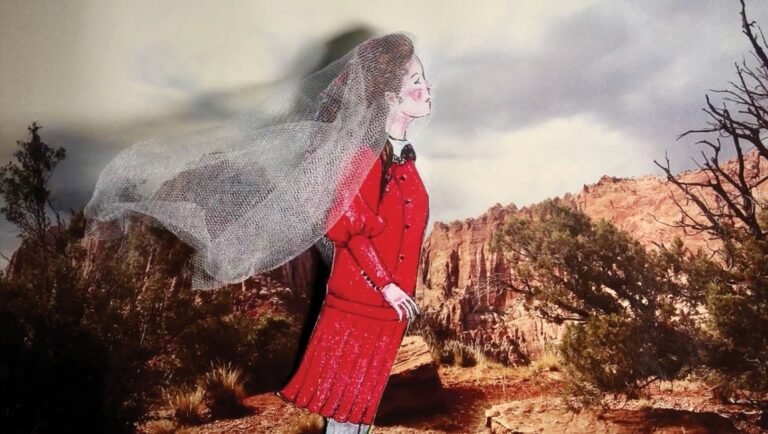
Cora’s tragic past and escape from the cult are documented in Jill Orschel’s Snowland, whose portrait of wondrous resilience is narratively faithful if also dispiritingly unremarkable. Having been shunned and ostracized by the Church authorities for reporting Richard, Cora was deemed a broken woman and spent the good part of her adult life working to heal that image. Her response — an eponymous quartet of novels penned under the name C. Raven — made recourse to a pristine and archetypal land of innocence: set in a fantasy ice world, C. Raven’s Snowland follows a princess of royal, magical blood who gets kidnapped and removed from succession, only to discover her true nature as she grows. Orschel mostly mines insight from Cora’s first-hand testimony of the Church and interweaves it with the stop-motion artworks (courtesy of animator Bridey Bush) that tease a wider fairytale imagination of fae and fair Prince Charmings populating the author’s cathartic subconscious.
As Cora attempts, with the help of her daughter Becca, to pitch the series as a TV production, Snowland quickly reveals its paucity of conceit. For all its bracing earnestness, her scripts and designs lack depth, frozen as it were in a stunted projection of lost purity. “We don’t have anything romantic about these characters,” mother and daughter both acknowledge as they surf for stock photos of kissing couples to be used as moodboard inspirations; their fairytale universe might resemble Lucile Hadžihalilović’s The Ice Tower if the director had further abstracted it into a radically infantile interpretation of immaculate wonder. Orschel, for her part, is interested in telling Cora’s story to completion, from its troubled years to her search for acceptance by her family and community. As Becca eventually leaves for Paris in pursuit of an artistic career, Cora applies for a house in a border town between Utah and Arizona, hoping to settle down. The dust does settle, and it is largely therapeutic. But those looking for the snow to melt and reveal untold iniquities beneath would do better to look elsewhere.
Comments are closed.