
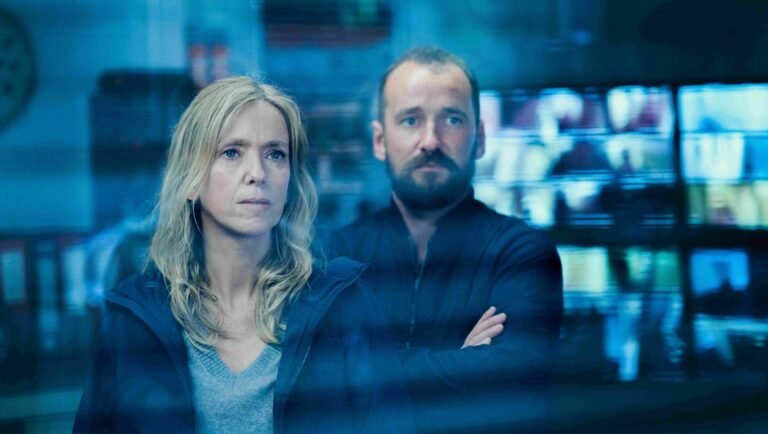
At first glance, Dominik Moll’s Case 137 looks a lot like his last film, the César-winning The Night of the 12th. That film was a police procedural organized around an unsolved murder that used its inherent lack of resolution as means to both explore a broader social issue, a prevailing cultural misogyny, and drill into the personal psychology of its police protagonists. If its structural aspirations brought to mind Zodiac or Memories of Murder, its form was decidedly more pedestrian and its impact hampered by clumsy thematic underlining in dialogue. But while Case 137 arrives with the style and the rhythms of its predecessor intact, they are employed to greater effect in this context and bolstered by a great central performance from Léa Drucker.
Set during the early days of France’s yellow vest protests in 2018, the film follows IGPN (that’s French for Internal Affairs) officer Stephanie Bertrand (Drucker), whose desk is inundated with complaints regarding police violence against protestors. Her work is fairly routine and the heavy workload — not to mention institutional indifference — leaves little time to properly investigate each case. But the case of a brutally injured young man shot in the head with a riot round becomes an object of obsession. The injury’s severity is part of her interest, but the man’s family’s origin in her hometown of St. Dizier draws her in further. Whether this is simply personal connection or latent working class solidarity on Bertrand’s part is left purposefully unclear.
Her investigation unfolds mostly as a series of interviews with the victim’s family and police suspects in the offices of the IGPN, with sequences of fieldwork being few and far between. These scenes are presented either in the kinds of snappy montages that create a mosaic reconstruction of events through multiple testimonies or as long interrogations of a single subject which use their extended duration to gesture at progress before routinely denying clean answers or erecting a new institutional roadblock. Though this is typical, generic form, Moll executes it skillfully and without attention-seeking fuss. Where The Night of the 12th was sometimes limited by its unadorned style, Case 137’s even greater stylistic restraint produces an oppressive atmosphere within the drab interiors. If his previous film announced its lack of resolution in an opening title card, Moll now suggests the limits of internal police investigation by building aesthetic walls that mirror a bureaucracy designed to frustrate Bertrand and protect the perpetrators of state violence.
Though Moll doesn’t abstain from the simple pleasures of a policier — an early crack in the case involving a string of security cameras and a roving gang of masked police is a thrilling bit of procedure — most of the film’s drama is mined from the gray area inhabited by IGPN police like Bertrand. She is set apart from the other cops, including her narcotics detective ex-husband and his new girlfriend, who treat her as an adversary as they repeatedly invoke the police union and accuse her of wanting to destroy the reputation of the police in an increasingly fraught time for the profession. Any suggestion of oversight is an affront to the immunity cops seem to take for granted. It is increasingly clear as the film goes on that the police see themselves as at war with not just the yellow vest protestors, but the public at large.
Bertrand, however, still views herself as a cop — she transferred to IGPN from narcotics when her son was born — and is rankled by ACAB sentiment. She operates in the field like a detective as well, and her interactions with witnesses verge on overreach. To the public, she is just another police officer, an uncaring figurehead who exists only to offer the illusion of accountability. When confronted by a witness, Bertrand concedes that no police officers have been successfully convicted or even fired as a result of these internal misconduct investigations. Bertrand’s lack of allies allows Case 137 to build empathy for her impossible situation, but the film does not let her off the hook as a member of the force. Good as her intentions may be, the shape of the film suggests that internal investigation is doomed to fail, that a system by which the police regulate themselves is ineffectual at best.
Moll’s narrow focus on policework short changes the yellow vests themselves, however. They are uncomplicated victims of systemic injustice, and while the film’s sympathies never leave them behind, their actual politics are only paid lip service, as if the setting of the film is just useful context for a police story Moll wants to tell more than an ideological struggle of its own. Zooming in to portray the IGPN’s part in the protests limits the film’s political dimensions, but if this gives it something of a ceiling, Case 137 remains an effective procedural with designs toward a structural social critique.
Published as part of Rendez-vous with French Cinema 2026.
Comments are closed.