
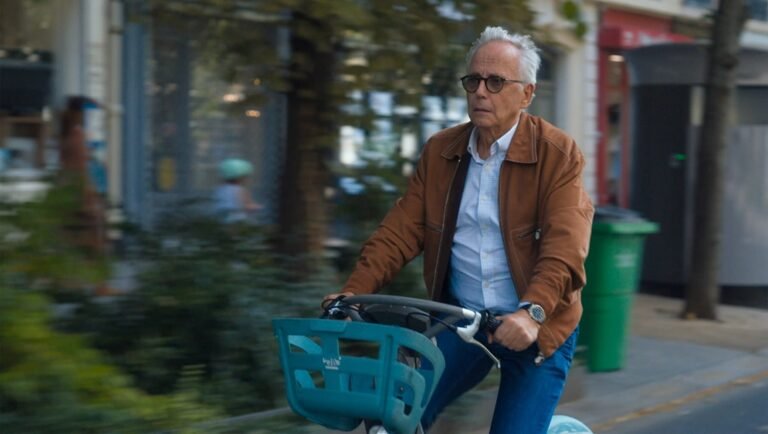
Robert Zucchini — with a nom de plume that simultaneously signifies an Italian origin and mitigates any self-seriousness — loves Victor Hugo. He’s a writer, an actor, and a director, and inhabits all three roles in his successful one-man show where he simply reads a curated selection of the great Frenchman’s writings and comments on their significance. His attitude to Hugo during these shows is fawning, laudatory, hagiographic, but still a tad funny, as when he engages in call-and-response readings of Les Contemplations to point out its peculiar comedic timing. He also loves his daughter, though she’s nowhere near as present in his life as the long-dead Hugo.
This is the setup of the late Sophie Fillières’ last screenplay, Victor comme tout le monde (bizarrely translated as Hugo for American audiences, as if that title won’t be immediately cannibalized by a certain Scorsese picture on any Google result), and one can guess where it goes from here. But, like all of Fillières’ works, familiarity is no damper on quality, and this picture, directed by Fillières’ partner Pascal Bonitzer, plays the right notes during its riffs on family, obsession, French literary history, and the rotating obligations of thespian life.
Longtime Éric Rohmer favorite Fabrice Luchini (another French-Italian) plays the lively Zucchini with his typical warm yet distanced approach. He does it well, as he’s been doing it for some time in his very own Fabrice Luchini Reads Victor Hugo series for the stage. But, offstage, he plays another kind of obsessive — one who constantly looks at his phone in case his estranged daughter Lisbeth (Marie Narbonne) finally forgives him for not attending his ex-wife’s (and her mother’s) funeral. Once she reestablishes contact by attending one of his performances, Zucchini intends to repair what he’s broken, though he constantly tries to do so through the ever-narrowing lens of Hugo’s life and works. Yet, this is not a film that relies on high-stakes drama or big displays of emotion. Only one scene even pretends to feel tense, and most disagreements and little fights are nearly instantly resolved. Fillières, like Rohmer, finds value in the moments in-between those most dramatic, and this light-hearted tale of reunion — of the missteps and tiny acts of forgiveness on the path to reconciliation — is a valiant effort in portraying the complications of life and art.
Most of the story’s little pleasures come from Zucchini’s inability to take even playful criticism of his beloved idol without, albeit cautious and friendly, launching into another miniature lecture about Hugo’s life and circumstances. When he finds out that Lisbeth is involved with a smaller theater putting on a reading series from the perspective of Hugo’s “femmes” — obvious counter-programming to his performance — he simultaneously launches into bouts of praise for the women while trying to excuse Hugo’s infidelity and fatherly shortcomings. Of course, Lisbeth’s friends don’t care to “take down” Hugo and find the grand actor’s constant “but”s and “because”s to be nothing but amusing, but Zucchini can’t stop himself from defending Hugo against a possible #MeToo claim that never materializes. A lesser film may have made this the focus: an out-of-touch old man railing against Gen-Z women critical of Hugo and therefore the entire French literary tradition. But this film makes the whole thing a humorous misunderstanding, one that can still play with those themes without reducing anyone to a cartoon.
But at the heart of the film is a rhyme between Hugo’s daughter’s own death (”the key to everything” regarding Hugo’s personal life and later works according to Zucchini) and the distance between Zucchini and his own daughter. A trip to Hugo’s home in Guernsey begets a conversation of Zucchini and his late wife’s trip there, one that resulted in their first kiss. Lisbeth, thinking this story quite meaningful, leaves in the morning with her boyfriend to go out to the very same sea her parents’ relationship first took to the current. When Zucchini can’t find them, he panics as he recounts, who else, Hugo and his drowned daughter Léopoldine. It’s in moments like this that the obvious parallel between Zucchini and Hugo announces itself too much and borders on the saccharine and the weepy in an otherwise low-stakes venture.
Hugo’s cinematography and music never seek to impress, but why would they? This is a film about little moments, and the camera and sound fully service each of those moments such that faces can be seen wincing at the right time and Luchini’s flustered personality never comes across as dismissive. It’s a subtle, charming work with humble aspirations, and it takes a certain kind of talent to make such a picture buoyant and lively, like a small boat riding the currents off the Guernsey coast.
Published as part of Rendez-vous with French Cinema 2026.
Comments are closed.