
In an old interview with David Ehrlich, filmmaker and critic Kent Jones recalls a conversation with Arnaud Desplechin in which the great French director told him “a script is a very small thing. The movie is the thing.” It’s a wonderfully succinct summation of Desplechin’s interests as an artist; there’s always a story, a plot, and characters in his movies — he is in some ways a fairly traditional dramaturgist. But what brings his best films fully to life are the small moments of idiosyncratic behaviors he captures, formal flourishes that cause a rupture in the proceedings. It’s in these ruptures, these fissures, that Desplechin’s art truly resides.
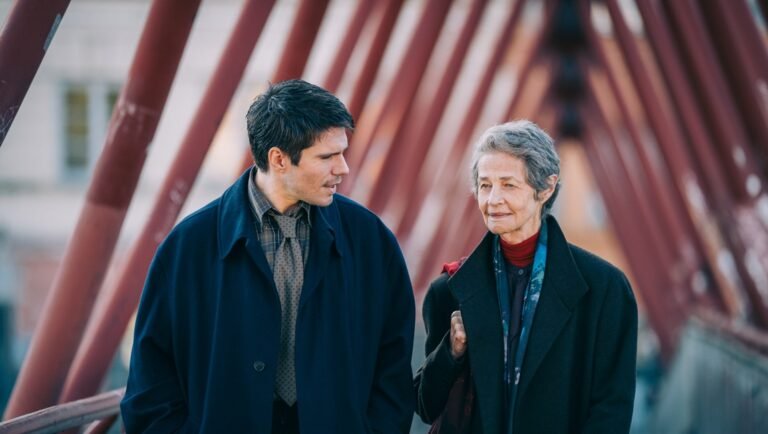
It will surprise no one that Desplechin’s latest film, Two Pianos, is a story of star-crossed lovers separated by time and circumstance. Mathias (François Civil) is a piano prodigy who has returned home to Lyon after an eight-year sojourn in Japan. He has been summoned by his mentor, the renowned pianist Elena (Charlotte Rampling), who wants him to accompany her on a series on concerts that will act as her farewell to public performances (and, it is intimated, return Mathias to a level of fame that he has squandered in the intervening years). Desplechin and co-writer Kamen Velkovsky also introduce Claude (Nadia Tereszkiewicz), her husband Pierre (Jeremy Lewin), and their son Simon (Valentin Picard), as well as Claude’s best friend Judith (Alba Gaïa Bellugi) and Mathias’ agent Max (Hippolyte Girardot). It’s a sprawling number of characters, and much of the first half of the film is spent establishing Mathias’ connection to each. Claude is Mathias’ old lover and Pierre his former best friend, while Max acts as a sort of guardian angel who protects Mathias from his worst instincts. Which feels necessary, because the former prodigy is a mess, running from his past and his talent, still in awe of Elena but hesitant to play for her. He drinks, gets tossed in jail, and upon laying eyes on Claude for the first time in eight years, immediately faints.
The patented Desplechin rupture comes in two parts, their connection eventually revealed as Mathias and Claude’s shared past comes into full view. First, Pierre dies suddenly, with no warning, in a stunningly abrupt sequence. Next, Mathias spots a young boy at a playground and is stunned to see that he looks exactly like himself at age 8. Mathias tumbles into an existential funk, convinced he has found some sort of doppelgänger that haunts him like a ghost. It’s a metaphysical conceit that will ultimately have a more quotidian explanation, but not until Pierre’s funeral leads to a sort of reunion (but not a reconciliation) between Mathias and Claude.
What’s so enthralling about Two Pianos is Desplechin’s odd rhythms, his own kind of musicality in form. The narrative stretches and compresses in fascinating ways, revealing major plot points in just a few lines of dialogue while allowing moments of doubt or fear or lust linger and undulate. Characters enter the narrative only to just as abruptly leave, the scenario gradually paring itself down to focus entirely on Mathias and Claude. Long musical interludes consisting of Debussy, Chopin, and Bartok lend the proceedings an almost operatic grandeur, even as the emotions on display are familiar, even granular. Ever the playful formalist, Desplechin employs frequent jump cuts, disrupts shot-counter-shot conversations with mismatching lines of sight, and often distorts the widescreen image via wide-angle lenses.. The image bulges and compresses in fascinating ways, everything left just slightly off-balance. Which is to say, Two Pianos is a film endowed with the energy and unconventionality of life itself. Early on in the narrative, Elena tells Mathias that she’s a “monster” because she has no home. She chose performing all over the world in lieu of marriage and children. Two Pianos becomes, then, a story of a man who must choose if he too is willing to become a monster. It’s a portrait of the artist in the act of becoming. If there is no room in modern cinephilia for Desplechin, then we have truly lost something.
Published as part of Rendez-vous with French Cinema 2026.
Comments are closed.