
Christian Petzold’s Miroirs No. 3 begins with two bodies in motion and ends with a woman trying to remember how to still herself. Somewhere between those two states, a fairy tale is staged, played out with grace, and, perhaps characteristically for Petzold, left to the devices of moral ambiguity. Nominally the “air” entry in Petzold’s loose elemental trilogy that had begun with Undine (water) and continued with Afire (fire), Miroirs No. 3 is light in plot yet heavy with atmosphere, a chamber piece that doubles as a ghost story and is haunted by a troubled, unresolved past.
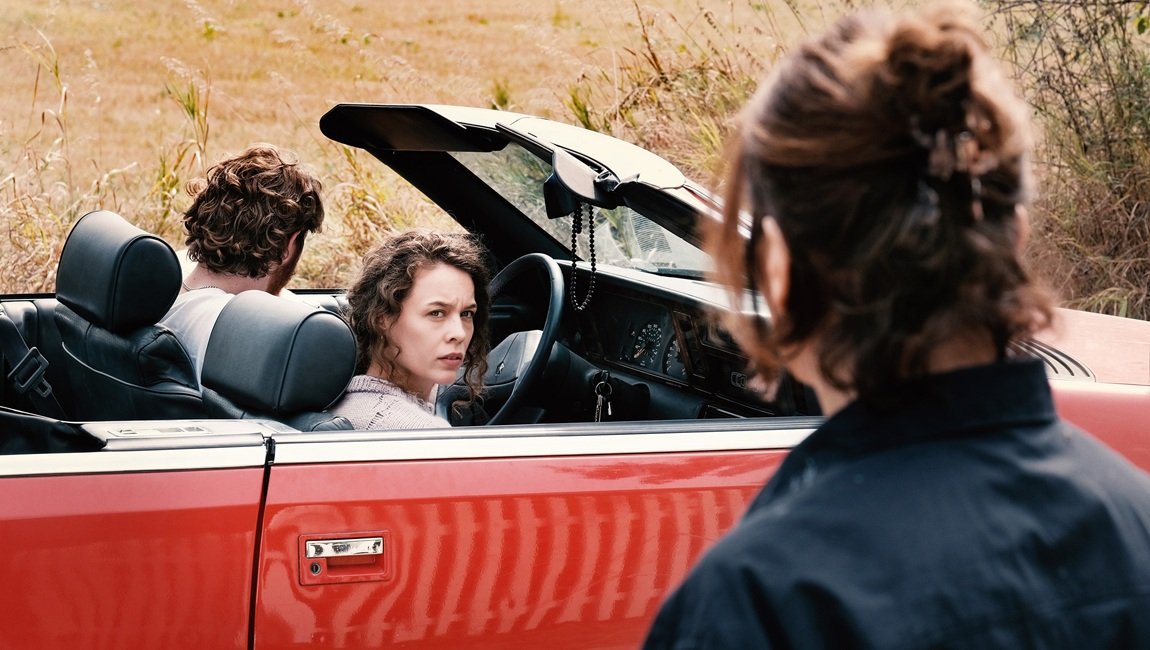
The setup starts with the kind of complicated catastrophe Petzold often favors in his films. Laura (Paula Beer), a young pianist studying in Berlin, is on a weekend trip in the countryside when she gets involved in a car accident with her boyfriend. After the dust settles, we find Laura’s boyfriend dead on impact and her improbably intact. A woman in late middle age, Betty (Barbara Auer), registers everything from her house a little farther down the road and makes her way toward the scene of the accident. Instead of stepping back into the role of a mere witness, she accepts Laura into her home to help her with her recovery. She gives her a bed and a bundle of new clothes, careful not to pry. The overture operates as both an act of kindness and proposition on Betty’s part: over time, her hospitality hardens into a ritualized, almost liturgical routine that veils a deeper family tragedy. Only later will Laura learn that Betty once had a daughter who died in that house, and that the imprint of her lost child has been quietly laid over Laura’s presence.
Around this improvised semi-adoption, Petzold builds a small, odd, not quite functional domestic universe. Betty lives on the edge of a bedraggled settlement near the German-Polish border; her husband Richard (Matthias Brandt) and adult son Max (Enno Trebs) run a shabby garage which offers the family members a much-needed distance from one another. The family business is legally gray and morally foggy: luxury cars appear, cash changes hands, and vehicles leave with a tinkered in-built tracking system. That’s the first juxtaposition the film offers us: the garage becomes the film’s dirty mirror, a place where a life can be swapped with another one, rather than being repaired.

One would be right in summarizing that Petzold’s films are, in a way, about the living dead: lovers presumed drowned who show up at doorsteps; women who resemble Holocaust victims; refugees who exist in a bureaucratic limbo; seasonal workers drifting through ghosts of capitalism. Miroirs No. 3 belongs to a similar breed of modern hauntings, and the supernatural suggestion here is thinner than ever, functioning more as a prevailing mood than a narrative construct. The house Betty keeps is crowded with so many memories and unacknowledged behavioral oddities that one starts to think the past is doing its own quiet housekeeping on the characters’ sanity. The dead daughter’s room hasn’t quite been cleared; the family’s conversations seem to have a missing participant; there are glances across the dinner table that are loaded with a history that Laura doesn’t seem to share. When Richard and Max first come to dinner and find a stranger serving Königsberger dumplings to them as if she’d always been there, their horror becomes less about the ethical impropriety of the situation than about the déjà vu it offers: they’ve already played out these roles before, opposite someone else who is no longer there. The film’s darkly comic tone emerges in these moments, in the way the men’s protest against the strangeness of the situation is brushed off as a defect on their part rather than the existential alarm bells the whole arrangement is supposed to ring.
This is where the title does its quiet work. Petzold’s film is named after the third piece in Ravel’s piano cycle Miroirs, “Une barque sur l’océan” (a barque on the ocean), a piece of music built from oscillations, cross-currents, shimmering figures that never quite settle into a stable theme. Laura practices Ravel at the university and at home, stretches her fingers over a keyboard that seems to offer her a balancing ground. The third and final act echoes this musical structure throughout the film: scenes rock back and forth between the Berlin music academy and the hazy countryside where time seems to pool around Betty’s kitchen table. In one world, Laura’s future has a clear shape: recitals, competitions, the impending ascent from student to professional. In the other, she is a replacement part, already performing a role that had predetermined its boundaries long before she walked through the front door.
Petzold renders this tension as something almost meteorological in its composition. If Afire was about heat and emotional drought, Miroirs No. 3’s microclimate could be best registered as imperceptible currents in the air. We get lingering views of curtains drawing in and out of open windows, grasses flattening under invisible gusts, cigarette smoke curling between faces at the kitchen table. Petzold lets those pauses hang just long enough to feel slightly portentous. Laura seems acutely aware that she is constantly being watched — by Betty, by the camera, by the imagined dead girl whose place she has taken — and her refusal to offer big catharses or lengthy confessionals becomes one of the film’s most ethical choices. In the long view, there’s a kind of stubborn opacity to the protagonist’s aloofness: while she cooks for the family, listens to their stories, and allows them to project their unresolved feelings onto her, there’s always a withheld interiority behind the surface, a sense that something in her refuses to participate in this sham domestic theater.

Opposite her, Betty is easy to misread as pure victim or pure saint, depending how one might choose to interpret her motivations. Miroirs No. 3 is at its most unsettling when it refuses to give Betty a recognizable psychological frame that is consistent with those who are grappled with grief, loneliness, and marital disappointment, yet her performance keeps slipping out of our grasp. One moment she is fussing over Laura’s diet; the next she is orchestrating an almost ritualistic family dinner, seating her new “guest” in the exact place her daughter had once sat. Richard and Max hover on the edges like survivors of a long-running domestic horror. Petzold finds a sour humor in the way these men, who spend their days laundering other people’s vehicular wrongdoings, are horrified to find their own family narrative undergoing a similar kind of repurposing. Yet the film never lets its characters off the hook of a moral register: after a certain time has passed, everyone in the family starts to benefit from the comfort of pretending their beloved family member has returned from the dead, even as they had initially bristled at the delusion.
If the film has a clear structural fault line, it is the way this domestic setup has to end. Miroirs No. 3 is so precise about the mechanics of substitution that the eventual reveal of the truth feels almost redundant. When Laura finally realizes that she has been cast in a pre-ordained role from the start, and returns to Berlin, the film follows her toward a different kind of test: a final exam performance at the university. Having tracked her down, Betty and her family sit in the audience and watch as Laura plays Ravel for the jury. They cheer silently from their row as she pretends not to see them. We can feel the consequences of this twisted roleplay in the final beats, which has an almost “airless” quality: Laura walks back into her Berlin apartment, standing alone, and the film simply stops breathing, having run out of oxygen.
In the end, Miroirs No. 3 refuses to inflate its domestic entanglement into a grand allegory or a private salvation for its characters. There is no vast machinery of trauma grinding inside the rooms, no hidden cure awaiting Laura around the corner; only a woman dealing with the consequences of an incident she shouldn’t have survived, and a family willing to bend reality around a loss that they shouldn’t have gone through, until reality itself loses all its emotional coherence. Petzold stages this fragile arrangement with the same patient, unshowy craft he has practiced for two decades, so that what remains feels more like Ravel’s drifting figures than a carefully plotted crescendo. It is a minor work in the sense that a small mirror is minor: limited in surface area, perhaps, but ruthless in what it reflects. And by the time Laura sits at her piano for her exam, with her stand-in family watching from the stands, the film has already posed its quiet central question: at what cost must a self be shed in order to live out a different fate? The only answer Petzold can offer is another question, addressed not to his characters but to us viewers: when you look at the people who keep you afloat, can you tell which one of you is the barque and which one of you is the ocean?
Comments are closed.