
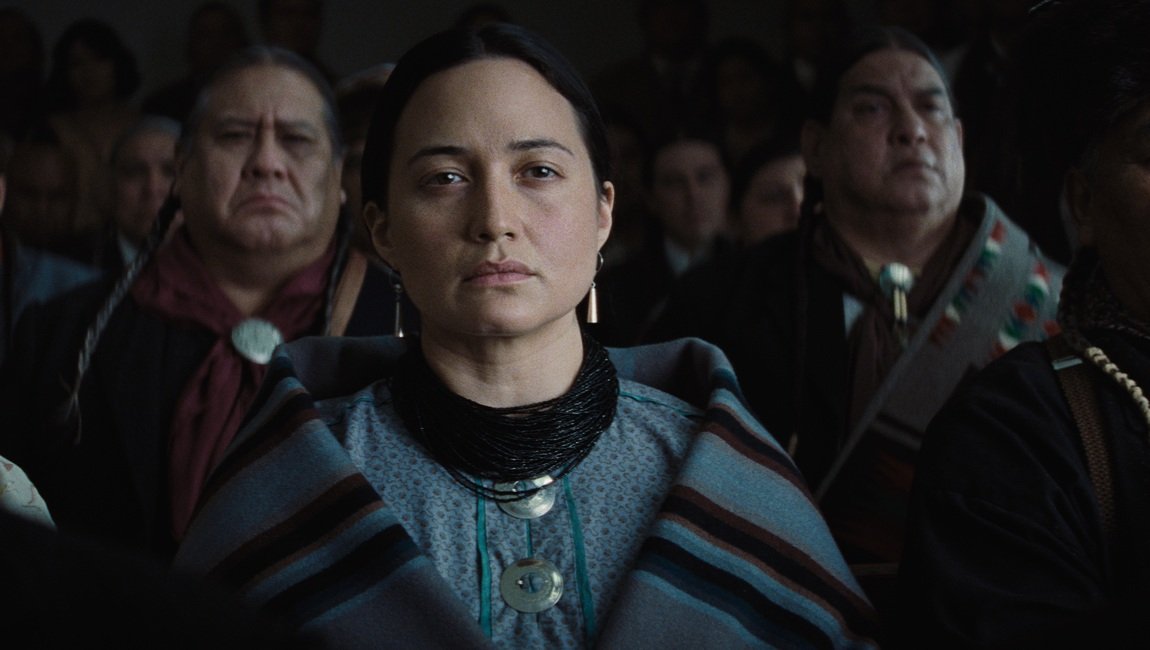
In just a few short years, the resonance of Martin Scorsese’s Killers of the Flower Moon, a film already laced with devastating history and complications, has grown exponentially. With the horrific pillaging of other nations, most recently Venezuela and Iran, by the American Empire, the parallels to our original sin burn brighter. The fact that we exist on stolen land is no secret, but we often see or hear that story through one mode, one based centuries ago. It can be hard to compute that we’ve always subjugated the Indigenous people of this country. It can feel alien to see these stories told with images of cars or in FBI investigations. The truth, one told through clear eyes and firm conviction, is on full display in Scorsese’s evisceration of American imperialism. It’s a truth much closer to us than we realize and one that’s still going on to this day.
Killers of the Flower Moon is nowhere near as successful without the astonishing performance from Lily Gladstone. In Mollie Kyle, Gladstone has to hold the weight of not only an entire history of someone’s life, but also the complicated nuance that exists within them. Mollie Kyle was a victim of abuse and attempted murder by her husband, Ernest (an incredible Leonardo DiCaprio), yes, but she’s also a loving sister and wife, a powerful figure of resilience, and a woman who found success long before Ernest ever entered the picture. Gladstone, one of cinema’s great faces and listeners, plays this with rich, textured nuance. Every hint of elation, sadness, love, and fury swirls through her expressive eyes, giving one of the great performances of the century. Three years removed, the film has lost none of its power and only strengthens the frustration many felt that it lost at that year’s Oscars.
As Killers of the Flower Moon enters the Criterion Collection with a gorgeous new release, I sat down with Gladstone to discuss the nuance of Mollie Kyle, compartmentalizing joy with trauma, and cinema as oral storytelling.
Brandon Streussnig: The tension around Mollie and Ernest’s relationship is what resonates with me most each time I watch the film. It’s so much more complex than “Oh, this man is just evil.” I mean, he clearly is, but he also loves her. Or, at least seems to think he does. It’s a dynamic that I don’t think many want to reconcile, but does exist to a frightening degree in this country. We see these kinds of marriages constantly. How did you approach that tension when crafting this performance?
Lily Gladstone: I think the idea of finding what it is that benefits the Osage characters in these unions as well is part of it. I think you can’t really simplify just the lovey-dovey doe eyes, not seeing what’s in front of you, because we all do that. We do that in a lot of different relationships we have as people, to maintain them or to maintain the status quo. So there were those elements, the lying to yourself in real time that we had to dig up because a lot of times that just happens in a way that you can’t point to until you’re in a therapist chair years later.
Then there’s “What did Mollie have to gain in all of this?” When we were exploring that, this system that was set up of guardianship made it impossible to move and do anything with your own money. So a lot of Osage men and women would marry white people so they could de facto have their guardian in the home with them. They wouldn’t have to travel to go see their guardian and sit and give them the grocery list and do the weekly audit of everything that they’re doing, and beyond auditing, ask for their own money to do what they want. I think a big part of that was building what Mollie’s blind spots would’ve been for Ernest to hide in. That’s when we found what was really helpful. The story that I was told by one of my language teachers, Chris Côté, was the trickster story. Then a light bulb went off in my head: this love story, on its face, may be a love story the way a lot of trickster stories are, but there’s something much deeper going on underneath here.
So, having that framework of the whirlwind and coyote story, this kind of hedonistic, self-serving, foppish character falls in love with something that feels more like a force of nature, and the way that it comes back on him later, that was an Osage oral tradition. The parallels were very obvious once that story was told and shared. That’s when Mollie calling Ernest “Coyote” popped up. It’s a reference to that oral tradition and that trickster narrative. The whole film itself feels a little bit like a trickster noir, a cautionary tale, but something that’s very sacred and shapes the way the world moves. That’s the way a lot of our trickster stories are. They’re origin stories in a lot of ways. They’re animative. They have real-world impact. So getting to dig out what the whole story was helped make the characters feel a little less simple.
BS: Speaking to that oral tradition, is that something that’s on your mind, making any film, but especially one like this, where you’re relaying a real history? It feels like cinema is a logical extension of that tradition. Is there ever a moment where you’re like, “I’m doing something I’ve always done, but now on a scale that can reach many, many people?”
LG: Yeah, and I think because of the responsibility of having grown up with oral tradition, where you do hear multiple versions of the same story, there’s no one right way. You hear a story evolve as the times evolve. The major components never change, but the flavors, the elements, the way it’s told change, as it should. When you put something on film, it’s there forever, but what’s important is maintaining the space, like with all art, that it stays subjective enough. In this one, in the micro details, it was important to me that I had enough space as Mollie, and luckily, it was in the writing. It was such a gift as an actor to see these scenes where Mollie could be saying one thing, but meaning several things with one line. That’s the best stuff when you have a script that’s as layered and as subjective as that. But the scenes themselves revolve around the same end. I’m thinking of both table scenes that Ernest and Mollie had, particularly, and then the final scene at the end between them.
That was one reason it was so important to work so closely with Osage folks on this, because there are so many unanswered questions from that period of time anyway. Opening the box and scratching the itch of the why can cause a little bit of snowballing. So we needed to approach it delicately, but also with enough room for reality to be as subjective as it is. It’s so gratifying as an actor to hear different folks who have watched this and really watched it. You can tell when somebody’s had it on, and they’re crossing it off their list, and they’re on their phone the whole time. They miss half of the film. But when we talked to folks who watched it, gave it the time, gave it the space… What I love about that is it’s how you listen to a story. It’s why you’re listening to a story.
When people give a piece like this the time, they’re not just honoring the filmmaker, that is Martin Scorsese, or the time of the actors and the crew, which is always just so important. They’re also honoring the story and the people and the history that this came from, and giving it a necessary watch and letting the nuance of it seep in. I love that I’m hearing different interpretations, particularly how we referenced William Wyler’s The Heiress for that last scene, which is also in the Criterion, and Olivia de Havilland’s final moment there. Marty wanted to replicate the feeling of not knowing if she was going to bring this man back into her life or not, which also said so many things about society, history, and culture than just Ernest and Mollie in the film.
My reference filmically for that was Philip Seymour Hoffman in Doubt. When you watch his performance, you make up your mind going into it about, “Is he guilty or not?” You see in the performance, both ways are validated in front of your eyes, both times. It was the magic of the way that man worked. So that was something I was also holding. When somebody is haunted by this story and wants to go back and rewatch it, I want them to be able to see all of the different shades of how each individual family experienced this period of time, how each descendant has heard stories of that time. It was a huge task, but trying to hold the space for everybody’s interpretation of one event to be represented, which feels impossible, but it’s also just reality, the shape of the universe, multiple stories of this cosmic space we all share, not to sound woo-woo, but it’s shaped like everybody’s experience. There’s not one way. It holds everything.
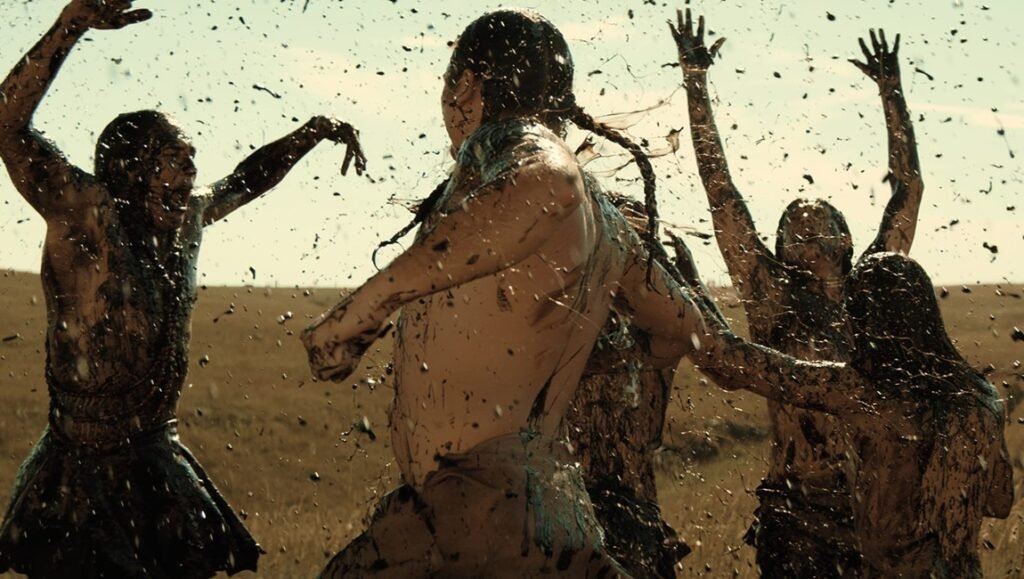
BS: I often wonder, with stories or films like this, how do you compartmentalize? What I mean is, you were rightfully praised and given many accolades, it’s an astonishing performance. The film was rewarded heavily as well. Now, a few years later, it’s getting this beautiful Criterion release. All of this is well deserved. But how did you or do you hold space for that and for the weight of telling a very real, painful story?
LG: Thank you for asking that. I’ve thought a lot about a conversation I had with Kelly Reichardt several times while we were making Certain Women. It was either our last day or our penultimate day. It may have been Kristen’s last day. In any case, Kelly and I were visiting between takes, and I was soaking it in. I remember just looking at the train tracks, looking at the gas station, just looking at the crew, and she kind of caught that I was doing that and she said something along the lines of: “Production’s the best part of our job and some just really enjoy being here because when you’re done, it goes to the edit, becomes something different, it goes to the audience, becomes something entirely not yours anymore, it becomes the audience’s, and then you just get further and further away from what it was, the making of it.”
Making Killers of the Flower Moon couldn’t have been done any other way than immersing, and not just immersing and learning who Mollie could have been. It required falling in love with real people and finding a great love for so many people, and what the community went through. I’m still really close to folks down in Pawhuska, Fairfax, and Osage Nation. I make it down as often as I can. It’s been a hard year for Osage this year. There have been several elders who have passed away. A really good friend of mine passed away a couple of months ago, unexpectedly.
BS: Oh, I’m so sorry to hear that.
LG: It’s ok. He loved the film. He was the former chief, Jim Gray, and his family is direct descendants of Henry Roan, and he’d become a good friend. But yeah, there’s this interesting moment, and I hadn’t shared this before, but because the premiere was shut down for us, the actors couldn’t go because this was during the actors’ strike. I had the opportunity to be in Osage County, and I spent the night of the premiere sitting at Mollie’s grave. I went to the cemetery and was sitting with the Kyle sisters while the film was premiering in L.A., and had my own practice there, had my own way of showing my respect at their grave sites.
I’d gone out to meet them to pay my respects when I got there. I went out once again when I left after the filming process, and then I went back again that night. I think at that moment it was a nebulous thought, but I thought of that conversation with Kelly and how much that was probably going to prepare and help me. I was at least anticipating how strange it was going to be to watch this experience that I had, where I found a new community, change. I can never describe what it was like meeting Mollie Burkhart’s great-granddaughter and just seeing all of it reflected, and having that human moment, and getting to hug her, and getting to spend the time with Marty.
Sitting there and just knowing that the audience was going to now take this film and it was going to be critiqued. It was going to be up for awards. It was going to bring all of this glitz and glamour into my life. I remember thinking how appropriate it was that the experience that I could have had, I don’t want to say it was withheld because I’m a union girl; we very much needed to have that strike, that experience became an Osage experience. The descendants of this history were the ones who got to experience that, that moment of the story joining the world. That felt almost like a ceremony to me. It felt like this transfer of something that was real and something that was bigger.
It’s weird talking about the film in terms of a performance that I gave. There was so much behind it, and it’s a real person. It’s a real history. So any conversation with Mollie’s name on it still just kind of haunts me, and I kind of anticipated that. So when I was out there, I was thinking about that. I was hoping that that didn’t have some kind of ripple haunting effect back there. We’re the ones who put it on celluloid. We’re the ones who made it into a movie. So any critique that comes, let it just stop with me, let it land on me, don’t let it reflect on these real people.
That was part of that nebulous thought, but also really hoping that it’s the life that it would have as a film in the world, and the kind of film that I knew it was going to be, and the kind of audiences I knew it was going to reach. Let that compassion go with it, let what these women went through change how people watch it, maybe recognize what some of these dynamics are. As you said, this type of marriage is not foreign. We see it everywhere. It’s very present in my own family, so I understood it either firsthand in my grandparents’ generation, that coupling, or hearing more secondhand, like my great-grandma’s generation, what that says about colonization, what it says about history, what it says about these dynamics. I was really glad that there was a trickster story that was said there that could catch it all.
BS: You’re not the spokesperson for Indigenous stories on film, so I don’t think you have the answer for this, but how does Hollywood continue to tell these stories and avoid that moment feeling hollow? I started my writing career writing about action, and I think a lot about Crouching Tiger, Hidden Dragon’s moment, and how that didn’t lead to more exploration of Taiwanese or Chinese cinema. Or RRR and Indian cinema. What can be done differently?
LG: I think one thing I’m really excited about is this burst that Indigenous creators had several years ago. I’m so happy that it wasn’t just Killers of the Flower Moon that was doing it. It was a lot of different folks, actors, directors, writers, having moments together. We had a lot of movement in the TV space that broke down a lot of barriers. Reservation Dogs and Rutherford Falls premiered while we were filming Killers of the Flower Moon, so it felt like that door was already opened by other people. This other one was coming behind it.
What’s really exciting is the core group of creatives that I’ve known for years, we’ve gotten to celebrate each other’s rise together, and a lot of it started at the Sundance Film Festival in the independent space, which Hollywood always finds a way to commodify, sometimes more successfully than others. I think when it’s an earnest commitment to the art and the storytelling and what people have to say, then you can strip away this idea of, “Oh, it’s trendy this year.” Crouching Tiger, Hidden Dragon did well, then people had the wrong takeaways, or Barbie and the famous sort of talking point around it, “Oh, let’s make another toy movie.” It’s like, no, this was a moment for women. This was a moment for examining patriarchy. That’s what audiences connected with.
So I think what’s important is looking deeper into what the story being told is, not the one-sheet you get with the way that you can market it, the way that you can package it and push it back out so that you make money on it. I mean, unfortunately, that’s the machine, but people who are working in Hollywood are there because they love stories in their core. Remembering that we love stories because they expand our capacity as humans, they help us understand the world around us. They help imagine a world that we would rather be sharing, maybe. Just revisiting the origin of why it’s important that we do what we do and why it’s fun why we do what we do. I think that’s key. Then culture is not a commodity. After that, culture is an extension of humanity, and revisit what the story is, not the aesthetic.
Comments are closed.