
“Cura animarum is a historical Latin term originating from ecclesiastical law, which translates to ‘the care of souls’ or ‘the cure of souls.’ It refers to the spiritual responsibility and pastoral duties of a cleric, such as a priest or bishop, towards the members of their congregation or diocese. This concept encompasses guiding individuals in their faith, providing spiritual instruction, administering sacraments, offering moral support, and ensuring the spiritual well-being and salvation of those under their charge.” – LSD Law Legal Dictionary
Akira Kurosawa would have turned 116 this month, and precisely because it’s not a major birthday, it’s actually the best time to reflect on the ongoing question of his legacy. For quite a while, he was both a critical darling — Seven Samurai, Ran, Rashomon, and the subject of this very essay routinely appear on Greatest of All-Time lists — and a portal for the budding Western-oriented cinephile into the wider world of global cinema. Today, he’s taken somewhat for granted. It’s a good problem for a supercentenarian to have, surely: widely watched in crystal clear restorations and routinely acknowledged as one of the best to ever do it. Yet there’s something perfunctory about the way he’s engaged with right now — a sort of “yeah, yeah, tell it to the judge” flippancy prevails. His mastery is so obvious and so universally accepted as fact that it can come at the cost of a serious engagement with the body of work as a whole, which is to say that the body of work should really be evaluated as individual accomplishments.
It’s difficult to choose one film with which to explicate Kurosawa’s genius when they’re all so good, though. Francis Ford Coppola once said, “So many of them are great… you could ask yourself which are the great ones, and which ones are merely very, very excellent,” and he’s right (while also slightly feeding into the uncritical praise-industrial complex that’s proliferated around Kurosawa). There’s so much that makes him one of our very best filmmakers: the kinetic vivacity of Dynamo Kurosawa found in Yojimbo and Hidden Fortress; the wry social critiques Teacher Kurosawa proffers in films like High and Low and The Bad Sleep Well; the fabulist Kurosawa who sweeps us off our feet in grandiloquent works like Ran and Dreams. But one film gets awfully close to typifying all of the many Kurosawas.
Ikiru is Kurosawa’s cumulative work, the one which synthesizes all of his passions and everything he’s learned: there are better Kurosawa movies, to be sure, but there is no movie more Kurosawa. The teacher is here, and so is the dynamo; the fabulist goes full bore. Yet if one follows that line of thinking, there are plenty of movies in his filmography which give voice to the many Kurosawas. Ikiru stands out for a different, better reason: it’s the movie that uses his many voices to express his animating principle. Akira Kurosawa holds the movies to the standard of spiritual nourishment, and holds himself (and by extension all who hold the occupation of film director) to the standard of acting as a modern-day secular priest who takes the charge of ensuring the spiritual wellbeing of his viewers. Ikiru is his clearest argument that we, too, should hold the movies to that high and noble standard of Cura Animarum.
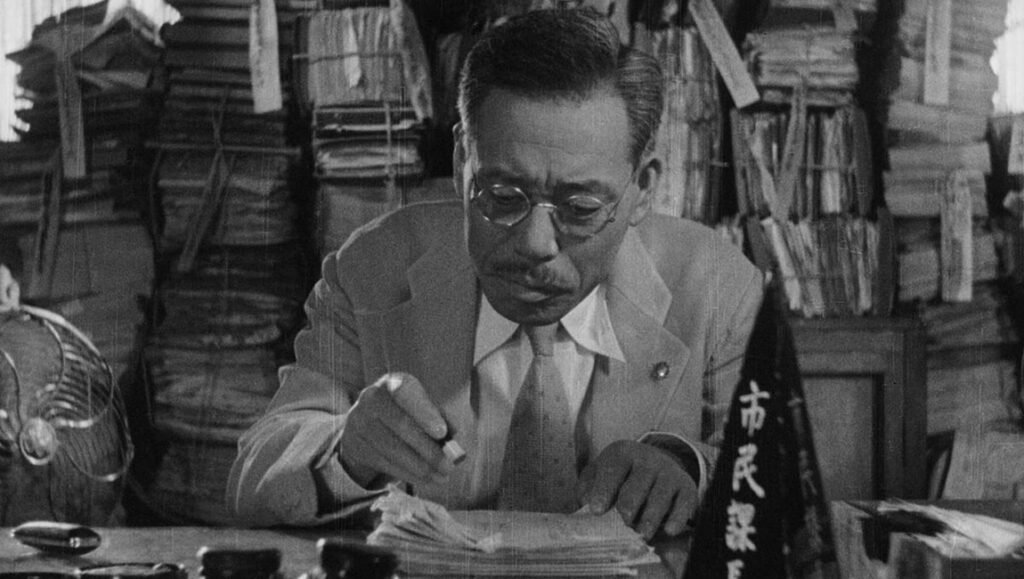
It begins with the image of an X-ray: “This stomach belongs to the protagonist of our story,” the anonymous narrator says, a faint echo of It’s a Wonderful Life’s angels in his voice. It orients us immediately: what follows is both fable and grounded in contemporary reality. We then move to the Public Works department in City Hall, where in one scene alone we get all the Kurosawas working cooperatively. Kurosawa the teacher chimes in through the V/O, preaching that, watching Kanji Watanabe, “you can’t call this living.” Kurosawa the fabulist tells the whole story of Watanabe’s life in a single cut, showing him opening his desk drawer to reveal a decades-old efficiency proposal and returning to a medium shot wherein he wipes his inkwell on it. All of Watanabe’s hopes are unrealized, all his ambition has been thwarted and left to rot. Kurosawa the Dynamo trumpets his arrival with a wipe into a montage depicting a group of people getting bounced from department to department only to land back at public works in their quest to get a local cesspool drained. The sequence, and all the Kurosawas working in concert, speak to cinema’s power to make the everyday interesting, to get us to see it clearly, and, most importantly, to assume a point of view.
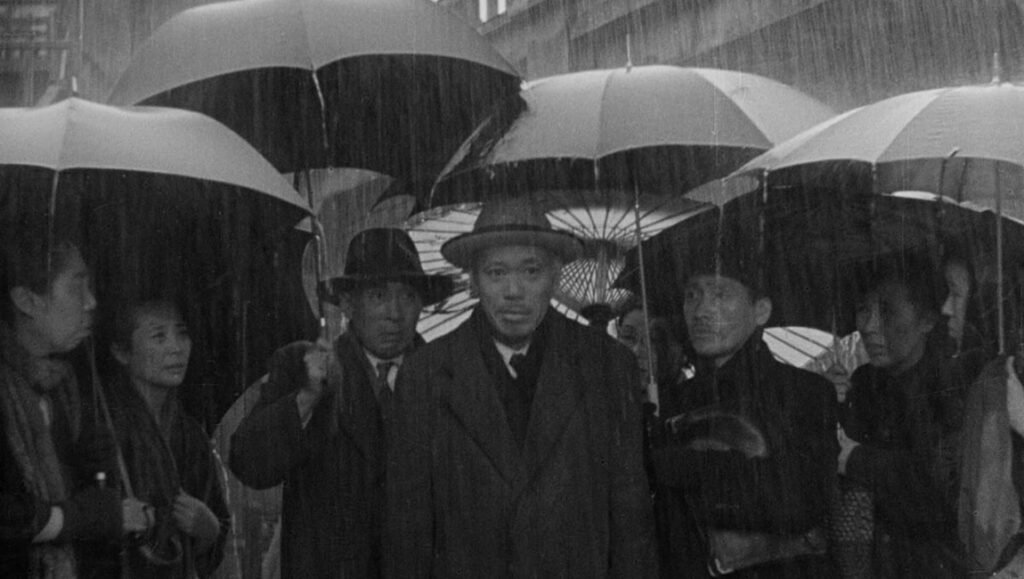
And no doubt Kurosawa has a point of view. He remains one of the more politically confounding of the Grand Masters, heaping on the liberal humanism which has certainly served as an access point for generations of cinephiles, but also sneaking into his work a light helping of social conservatism. In critiquing all branches of bureaucracy in Tokyo (both in the film’s opening and beyond), Kurosawa throws the baby out with the bathwater and undermines the value of civic institutions in toto. That said, the abuses and small indignities faced by Watanabe and his co-workers do ring true today (for those lucky enough not to have had their jobs automated away yet, at least). The digital world has quirked things up a bit, but we still have thankless jobs that overwork us and divorce us from our hearts. Kurosawa, for all his whiplash-inducing political turns, never loses sight of that heart.
He finds his way to the heart in Ikiru through a dance with legendary actor Takashi Shimura. Leaving the hospital after figuring out he has stomach cancer (not from his doctor, notably, in a scene that improves upon The Quiet Duel’s attempt to wrestle with the dovetailing phenomena of illness and ethics), Watanabe dolefully saunters down the sidewalk in total silence. The camera tracks with him until he’s about to cross the street, at which point it pulls back to reveal a dense thicket of trucks and cars as the sound rushes back in. It’s a terrific intermingling of performance and camera: we’re drawn in by Shimura’s performance, but the scene isn’t complete without the sound gimmick and the camera’s choreography. It demonstrates that the world keeps moving, but also that we in the audience learn to engage with it through the small and the particular. Kurosawa and Mifune, the Emperor and the Wolf, rightfully stand among the great actor-director pairings in film history. Yet Ikiru suggests the Emperor and the Basset Hound may have had just as much to offer.
Following a Proustian detour into his past as he reflects on his dead wife and his ungrateful son, Watanabe embarks on a Faustian detour with a novelist who calls himself “Beneficent Mephistopheles,” and they descend into a Tokyo nightlife scene filled with postwar decadence. The clubs are full to bursting, the Pachinko machines a “vending machine for dreams and aspirations,” and the music, notably, American. It’s all foreign to Watanabe, and something of a prison, too. Kurosawa the teacher lays it on pretty thick: there are shots behind bars that resemble a cell, and, at a bar, Mephistopheles calls Watanabe Christ (in jest, but it still plants the idea). The most egregiously manipulative moment comes when Watanabe sings “Life is Brief” to a crowded dancehall, but Kurosawa the fabulist doesn’t waste these moments; they pay off later in a major way.
Watanabe discovers that hedonism is not the way, and he turns instead to youth for refuge. A young employee, Toyo, shows up at his house to give him a letter of resignation, and the interaction sparks a May-December friendship. They walk around Tokyo and share their feelings openly, and the sequence is a more mature revisit of Kurosawa’s earlier One Wonderful Sunday, wherein two lovers explore a Tokyo still in the process of rebuilding and begin to see the humanity in each other more deeply. Two weeks later, however, Toyo comes to resent Watanabe. In a climactic scene, a rueful look at a birthday party happening nearby in a restaurant and a yearning look over at the young couple communicate all there is to know about her relationship to life: Watanabe is experiencing everything he missed out on, but she is missing out on her own youth. Through this exchange, we get to see that a life lived fully, a human being seen completely (or at least more honestly), must include different facets — we’ve seen that Watanabe is human because of his illness, his long-suffering nature, and his hangdog demeanor, but we know him most when we understand that he can also be unlikable. Being uncomfortable, being disliked — indeed, being desperate — these are all parts of life, too. “You’re so lively,” he moans. He yearns for her youth, almost like a vampire, and one of his close-ups is shot with a distinctly Murnau-ish vibe. Lest the dynamo get left behind, however, Kurosawa reignites the narrative with a fresh jolt of determination; Watanabe decides to do the right thing at his job with the time he has left. He’s going to do something good with the power and talent he has: he will build a park over the cesspool those people at the beginning of the movie were complaining about.
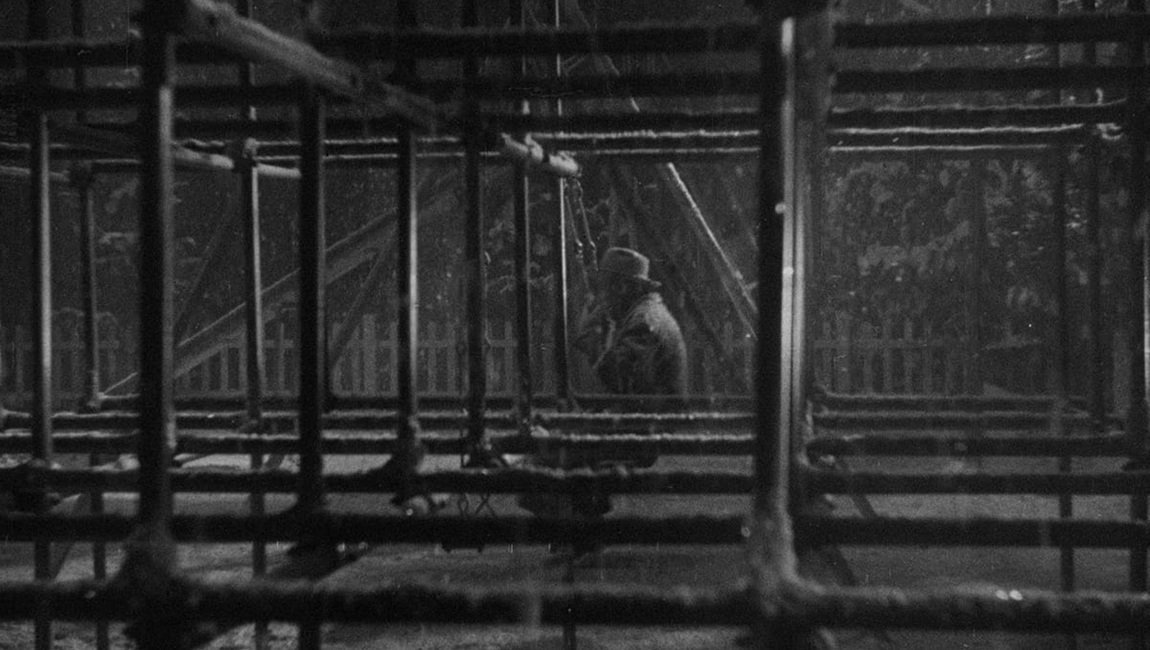
But then a major structural contradiction occurs: this movie, so steeped in the humanist tradition, denies us catharsis. Watanabe dies suddenly — not just suddenly, but in the past tense. “5 months later, our protagonist has died,” the narrator says, and the cut to Watanabe’s wake is the single most surprising moment in Kurosawa’s career. Kurosawa the fabulist launches us into a sort of Rashomon-meets-12 Angry Men (five years ahead of schedule!) wherein mourners analyze Watanabe’s final months, debating and ultimately convincing themselves of the truth. In typical bureaucratic fashion, they inevitably bicker over the subtleties of how Watanabe’s park was built. Watanabe didn’t hold the hammer and nail, but slowly they acknowledge an ineffable will to make it happen that bureaucracy can’t account for. In the film’s actual climax, a police officer shows up to detail Watanabe’s final moments. Watanabe sings that song “Life is Brief” again, swinging with hard-won mirth. He’s shot through the bars of a jungle gym, between them, beyond them, free from the constraints of obedience and mindless conformity. It’s a moving callback to the dancehall sequence, but it’s even more powerful when viewed as a home for the impetus behind Kurosawa’s failed The Idiot adaptation: Watanabe pushed the park through with a naïve sense of city politics, but in fact it’s not naïveté at all — it’s enlightenment. The group animates themselves into a drunken tizzy because of Watanabe’s valor, insisting they’ll be in service to the people, too. It’s a wry move by Kurosawa, emulating the likely experience of the audience after having gotten our catharsis. Of course, they, like us, settle down into their old bureaucratic ways, buried under mountains of paperwork. But one good deed is enough. One other person clearly agitated into positive action is enough.
Peppered throughout the film are small references to Yasijuro Ozu, both narratively and in formal decisions that one could call the Kurosawa-ing of Ozu’s style. It’s there, in the talk of remarriage for a widow, and certainly in the decline of remarriage out of a sense of family fealty. There’s also a fair amount of eating and drinking, and while the camera does bend to join its subjects on the Tatami mats, it never quite hits the floor. But the film’s closing is a deep bow to Ozu, who by 1952 had already established himself firmly as Japan’s great screen artist and, crucially, played a small role in ensuring the distribution of Kurosawa’s debut film Sanshiro Sugata. It’s the closest, filmically, Kurosawa got to acknowledging Ozu’s own good deed.
Three shots before the movie ends, the camera looks down at the convert who actually took Watanabe’s actions to heart and pans as he looks on at the playground Watanabe built — a Kurosawa shot, through and through: the camera is engaged with the individual in relationship to the society he inhabits, but does so from a position of authority. Kurosawa’s in charge. The penultimate shot is more neutral, taking in the whole playground as a mother calls her children in for supper. The final shot is pure reverence: the children float off the swing set, upon which the camera’s focus remains for a moment, perhaps in deference to Watanabe. It then tilts up to reveal the bridge the convert stands on, the convert himself, and the skyline including a never-ending telephone wire. Ozu utilized many such similar shots in his career, holding the contradictions between nature and modernity with ease. For Kurosawa the balance is uneasy, but here he got it just right. We follow the man as he walks off, taking the lessons learned with him. It is the convert, but really it could be anyone. All it takes is one person to move the needle, to hold the virtue of Cura Animarium close at heart and keep the fire burning. It could be the deputy mayor, finally learning his lesson. It could be a young filmmaker stumbling into Japanese cinema for the first time. It could be Kurosawa himself: the dynamo, the fabulist, and the teacher as one. It could be you.
Comments are closed.