
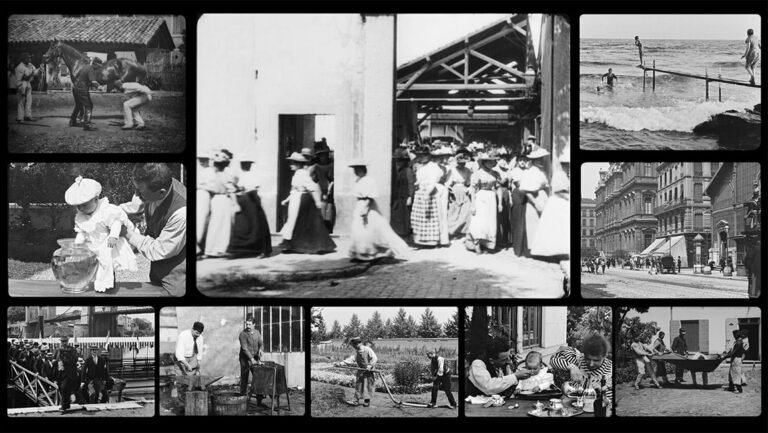
There are two — or if someone is feeling incredibly ambitious, 101 — films to review in Thierry Frémaux’s Lumière, Le Cinéma, a cine-documentary exclusively positioned by Janus Films as a “glorious re(telling) of the genesis of cinema [that also doubles as] a profound meditation on the beautiful world captured—and the mysterious world imagined—by the Lumière Brothers.” One (or 100) of them is the film within Frémaux’s film, a veritable collection of known and forgotten (or only recently discovered) films produced and directed by Louis and Auguste Lumière. Restored in 4K in their original format — “1:33 aspect ratio with rounded corners” — the Lumière brothers’ films, all approximately 50 seconds long each, are astonishing. They practically serve as a cinematic institute in and of themself for an increasingly rarefied form of filmmaking: one that impresses without, as per Frémaux’s narration, “feeling the need to be impressive.” Panorama of the Grand Canal Taken from a Boat (1896), directed by one of the brothers’ key cinematographers, Alexandre Promio, comes closest to using camera movement as a means of exciting by exoticizing the scenery of a “foreign location.” Most of their other work shown in Lumière, Le Cinéma, however, is not characteristic of this; the exceptionally directed mise-en-scène — a camera that captures the ebbs and flows of life, reverberating through painterly, static shot compositions — is.
Most famously, we see this in their angled camera observing hordes of workers — some underacting to avoid the cinematograph’s gaze, others overacting to direct the camera(person) toward them — leaving the Lumière factory in (multiple versions) of Workers Leaving the Lumière Factory (1896). Or, in The Arrival of a Train at La Ciotat (1896): cinema’s first 3D-horror film, created by the Lumière brothers’ ingenious decision to frame the oncoming train diagonally to make it seem like it’s cutting through the screen even if it really is only cutting across it. But, really, pick any of the Lumières’ films — comedies, actualities, travelogues, home videos, “war” films — and you simply marvel, if not at the compositions themselves, then at the “attractions”: the bellowing of smoke, the furtive glances at the camera, the outrageous stunts. Each and every film of theirs feels consistently alive, teeming with curiosity and eagerness to, as Frémaux puts it, “create new points of view” that the human eye could not — and perhaps still cannot — perceive.
It’s slightly disappointing, then, that the film showing all these films — directed and narrated by Frémaux — doesn’t feel the same; and this is especially even more disappointing because Frémaux’s previous film about the Lumière brothers, titled Lumière! (2016), did. Frémaux’s constant narration in Lumière! — pitched perfectly between blind adoration for the filmmakers and analytical insight about their film form — contributed to the hallucinatory appeal of watching so many of the Lumière brothers’ films back-to-back. The arrangement of the material itself helped: we jumped forward and back in time, not necessarily to chronologize the origin of film but to illuminate the incredible range (and disparate styles) of the Lumière brothers’ work. But even the insight itself went beyond Frémaux simply stating “how beautiful” the compositions are. He drew our attention to the multiplicity of film forms existing in a single frame, when, for instance, describing the extraordinary Workers Repair a Street (1897) — “The smoke renders the image abstract, part film, part photograph. The camera grasps the moment with grace, with the usual sense of spontaneity of documentary. Almost. A closer look reveals how well placed the workers are, and in the background, how perfectly aligned the onlookers are.”
In Lumière, Le Cinéma, however, both insight and the arrangement are slightly infantilized. Frémaux structures the documentary much more conventionally, sifting through the origins of cinema chronologically for about half of the film’s runtime before ditching that structure entirely to haphazardly introduce other films in the brothers’ catalogue that don’t fit the timeline. His narration, too, is a little too amicably nostalgic without being particularly insightful: it’s a bit like listening to an uncle flip through his photo album, excitedly reminiscing about the glorious past of it all without really expanding on anything about said glorious past. Overlaps with Lumière! — not only in the material shown, but also in whatever insight Frémaux has to give — also don’t help. But repetition (and remakes) can be productive when slightly expanded or commented upon. Unfortunately, Lumière, Le Cinéma doesn’t have any of that: its value, unlike Frémaux’s Lumière!, is almost entirely indebted to the brilliance of its subject and not to the arrangement (or narration) thereof.
DIRECTOR: Thierry Frémaux; DISTRIBUTOR: Janus Films; IN THEATERS: March 20; RUNTIME: 1 hr. 44 min.
Comments are closed.