
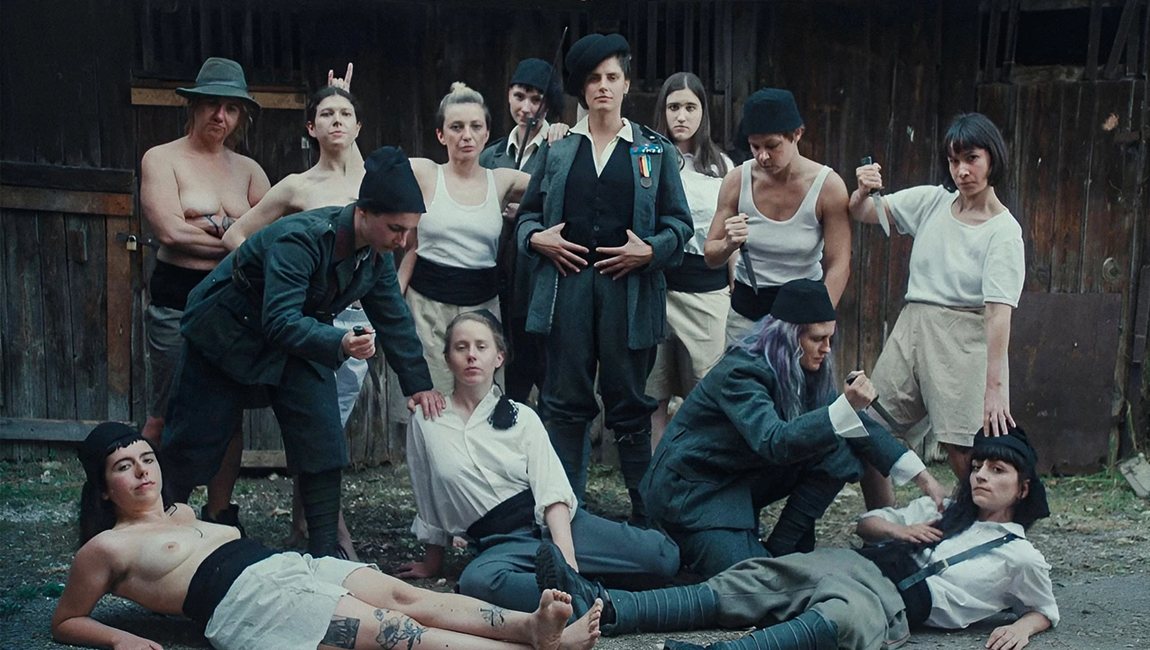
While easy to forget given its catastrophic success, fascism came into the world a mess. The writer and public intellectual Umberto Eco wrote in a 1995 essay that the ideology’s original Italian form, under which he spent much of his childhood, had “no special philosophy.” This, Eco contests in Eternal Fascism: Fourteen Ways of Looking at a Blackshirt, is what distinguished fascist Italy from the “true totalitarian regimes” that would come later. Hitler’s Germany and Stalin’s USSR oversaw political and cultural platforms that were clear-cut, to be obeyed to the letter. The former had its guiding theories of race and entartete Kunst (“degenerate art”), as well as a foundational text in Mein Kampf. Under Stalin there was a fixed interpretation of Marx’s dialectical materialism, as well as a culture policy engineered by arch-propagandist Andrei Zhdanov. Mussolini, by contrast, presided over a “fuzzy totalitarianism, a collage of different philosophical and political ideas, a beehive of contradictions.” Fascist Italy was obviously still brutal, with Eco noting the cruel fates of the Marxist philosopher Gramsci and other dissenting voices. But this “fuzziness” did create a somewhat amorphous environment: the monarchy, for instance, could coexist with “revolution” (if only for a time), as could dogged traditionalism with Marinetti’s futurist art movement.
Then there was the paradox of Gabriele D’Annunzio, a decadent poet who became the “bard of the regime.” Before Mussolini took power, D’Annunzio was already hard at work inspiring the Duce-to-be by occupying the Adriatic city then called Fiume (now Croatia’s Rijeka). He felt that the multi-ethnic city, with its large Italian minority, was owed to Italy following its victory in the First World War. It was during the resultant year-long feat of irredentism that D’Annunzio, according to historian Robert O. Paxton, made liberal use of the “Roman salute,” the balcony address, and the uniformed parade for what would soon be familiarly illiberal ends, devising “the public theatricality that Mussolini was later to make him own.” But the proto-fascist managed all of that while being, as Eco puts it, “a dandy who in Germany or Russia would have been sent to the firing squad.”
A passerby on the streets of Rijeka interviewed some 30 years after Eternal Fascism gives his own puzzled assessment of the man who once occupied his city: “he was both an artist and a dictator, a brute and a kind soul, so I think he was a little odd…” The interaction comes from the opening sequence of Croatian (and Rijekan) director Igor Bezinović’s startling new hybrid feature, Fiume o morte!, winner of Best Documentary at the European Film Awards earlier this year. It is with that amusingly understated “I think he was a little odd” that the starting gun for the film’s own grappling with fascism’s amorphous side is fired: how was it that an early lodestar of a political idea associated with such brutal uniformity was also a colorful poet, a philanderer, and a not entirely unbeguiling rogue? As the remnants of that idea today happily gravitate toward red baseball caps and other guises more garish than grey uniforms, it’s the right question to be asking.
The interviewee ends his otherwise lyrical musings with a clinical — and pretty plausible — answer: “I think he was mentally ill. That’s what I think he was.” But the broader film’s diagnosis is that back then, as today, the zaniness was a front for unsophisticated thuggery. The extent to which the front was (or is) conscious is a separate question, but its impenetrability poses a problem either way. During a Q&A before the film’s release, Bezinović discussed his aim to undercut the “sexy avant-garde” myth of his city’s occupation that some of its more misguided chroniclers, like the American anarchist Hakim Bey and the Italian art historian Claudia Salaris, have played up. The seductive traits are there for those who wish to fall for them: D’Annunzio’s “Italian Regency of Carnaro” played host to various artists and thinkers, its founding charter proclaimed music to be a “religious and social institution,” and its eventual martyrdom was sealed from the outset — the coup was not sanctioned by the then not-yet-fascist Italian government itself, meaning the poet’s “legionnaires,” as he called his small contingent of die-hard irregulars, went it alone before being put down by their own country’s official armed forces.
Behind the free-spirited sheen, though, was a microcosmic dictatorship. Bezinović catalogues, among other crimes, the suppression of polling stations, violence against the city’s non-Italian residents, and the drafting of that alluring founding document without the consent of anyone who actually lived there: “not a single Fiuman was involved in drawing up the constitution of our city,” the film’s narration objects.
The director’s task, in his own words, was to show that D’Annunzio’s act of nationalist aggression was as “banal as any other war.” But how to affix the “banality of evil” label when there’s so much peacock plumage in the way? The conventional, Arendt-lite treatment of last year’s Nuremberg would be a non-starter here. James Vanderbilt, that film’s director, commented that what was most scary about his subject, Nazi second-in-command Hermann Göring, was that he committed atrocities while also being a loving husband and father. That ordinary humans were behind Nazism is a position that will bear repeating for as long as there are people naïve enough to believe otherwise — but it is one that by now, thankfully, conventional wisdom has more or less accepted.
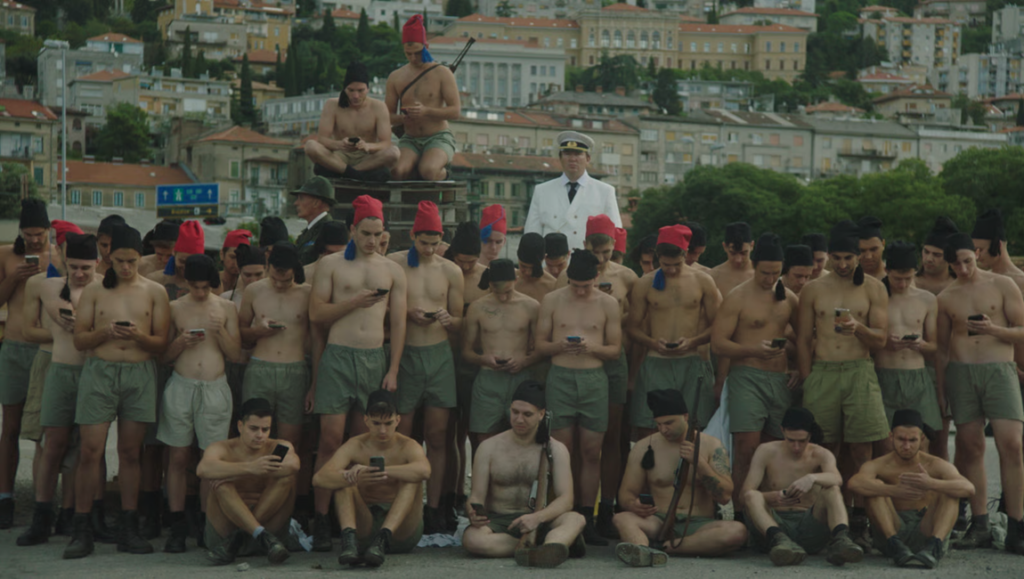
Bezinović has it harder. Though Göring’s crimes of course eclipse those of D’Annunzio, the latter’s own monster-human duality is a kookier, if less horrific, circle to square. Never mind a family man, this is someone who inflicts great suffering while also renaming his favourite tavern after a Platypus. And as for conventional wisdom, select scholars of the avant-garde are not the only ones who have let the myth obscure the man. While remembered bitterly by Croatians today and not exactly a household name elsewhere, his cult lives on in Italy. One scene captures his receipt of a fresh monument in Trieste to honor the occupation’s centenary.
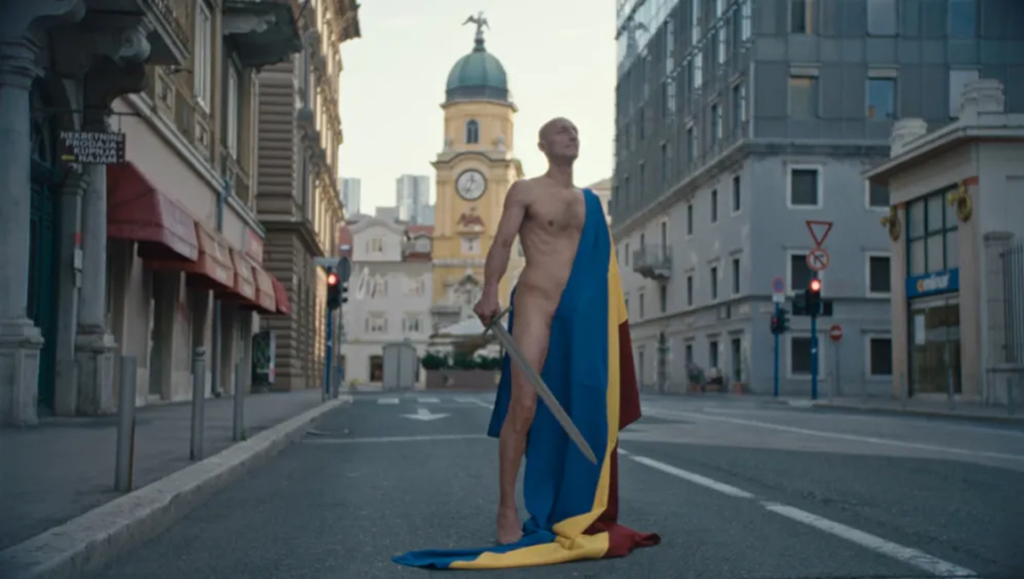
So the right pressure point is needed. Brilliantly, Fiume o morte! finds it by responding to D’Annunzio’s weaponized weirdness in kind. Like the man and his dictatorship-in-microcosm, the film is harrowing in content but vibrant in form. Bezinović recruits a motley group of fellow locals to reenact the events of 1919-20, on location in the modern day, including several bald men who play the villain of the piece. At one point, a “D’Annunzio” who in real life is the frontman of a local band breaks character and joins his bandmates to provide punk backing to a “military convoy” (here columns of modern commercial trucks) descending upon Rijeka. Far from making light of D’Annunzio’s actions, this offbeat approach is, in another paradox, what nails him. These recurrent left-field anachronisms strip fascistic militarism of the monochrome mystique afforded to it by the archive footage the film constantly plays them against. They show, in full color, the unglamorous reality: not a conqueror at the head of a triumphal procession, but a wannabe rockstar hauling (literally) truckloads of narcissistic baggage into town.
Fittingly, a motif throughout is the recreation of real images of the occupation — D’Anunnzio, in his vanity, ensured that up to 10,000 were taken of him and his athletic “legionnaires” — in vivid color by Bezinović’s ragtag cast of non-professionals. One of these sees D’Annunzio’s close confidante, the free-loving aviator and naturist Guido Keller, posing nude as Neptune-with-trident on a rock peeking above the harbour’s surface. Unlike the original, the reshoot is not static; we actually see the effort “Keller” expends getting into the precarious pose. The elegant backlighting of the black-and -white shot had gifted him a fig leaf, but now nothing is left to the imagination. The film argues that, in returning these statuesque martyrs to fallible (and jiggling, in Keller’s case) flesh, we might begin to hold them accountable.
This guiding principle owes a great deal to the Russian formalist Viktor Shklovsky’s notion of ostranenie (
(“defamiliarization”). In his 1917 essay “Art as Device,” Shklovsky asserts that the “purpose of art” is to “lead us to knowledge of a thing through the organ of sight instead of recognition.” In simple terms, this amounts to presenting something that is otherwise familiar with conscious strangeness, often in a way that draws attention to the artifice of the whole endeavor. Done correctly, this should shock the spectator out of passivity and force them to really scrutinize (and so “seeing,” not just “recognising”) what’s in front of them.
In Fiume o morte!, the established myth of D’Annunzio makes up the “familiar.” The film’s openly fake and offbeat representation then makes us see it for the hoax it is. The fact that the occupier himself relied upon strangeness adds a final layer to the whole subversive enterprise: defamiliarization in the film is also a reclamation, that of the eccentricity that violent charlatans hide behind. A wayward poet gets his poetic justice.
For Shklovsky, the device’s value was first and foremost aesthetic, it was an aspirational model not for political critique, but for the written word. Nonetheless, his essay makes provisions for defamiliarization’s real-world significance. One of its passages draws on an extract from Leo Tolstoy’s diary that sees the novelist forget whether he had dusted off his sofa or not due to the action’s routineness. Shklovsky observes with quiet terror that such neglect to truly see what is in front of us has the potential to numb, among life’s other fundamentals, “our fear of war.” The playwright Bertolt Brecht would heed this warning in the decades following “Art as Device” with his Verfremdungseffekt (“distancing effect”), which remains ostranenie‘s most famous explicitly political incarnation.
Rijeka is the latest stage for that fear. Stopping alongside a barricade constructed on a shopping street, an older woman confronts a young “legionnaire” in uniform: “You’re too handsome a boy for this… you should be in some disco with a beautiful girl.” He protests that “this is just a role I’m playing.” What is effectively a bizarre temporal rupture — a woman who lived through late Yugoslavian discotheque culture chastising a man in 1910s attire — somehow lands upon fascism’s lamentable essence: it reminds us how many had to die because of young men playing that same dreadful “role,” when they could have been doing something, anything else.
Another sequence depicts attacks on non-Italian owned businesses as stoked tensions erupt. It sees projectiles hurled through the windows of their corresponding modern-day facades. The mob in 1920 hit the Swedish consulate by mistake. Its exterior appears largely unchanged a century later and is duly vandalised. “How on earth did the crew get the permission?” is the instinctive reaction, followed by a shaming sting: “this is a pogrom, and I’m distracted by its logistics.” The sense of something awful happening was there before, but it is only thanks to a belief-suspending pause that we are forced to pay proceedings our full — and guilty — attention.
Due to their sheer quantity, not every formal fissure can be quite so excoriating. A great many of them are just fun. The narrator announces at one point that D’Annunzio’s 100-years-deceased canine companion will be “played here by the whippet Bob.” The crew also give the site of The Platypus, today a nail salon, a comprehensive period makeover on the condition that they pay for anything that gets broken. But the incidental humor still matters, because we’re receptive when we laugh: “spasms of the diaphragm generally offer better chances for thought than spasms of the soul,” wrote the ever-unorthodox philosopher critic Walter Benjamin in 1934. The remarks were meant to be delivered during a speech dedicated in large part to extolling the “epic theatre” of Benjamin’s friend Brecht. While scholars aren’t sure whether Benjamin actually gave the address, the intended audience gives a sense of his brief: a Comintern-backed outfit in Paris called the Institute for the Study of Fascism.
Another virtue of all the revelry is that, as in any kind of competition, being seen to have a good time means not being seen to struggle. It means looking like the winning side. That’s just as well, because Fiume o morte! seeks a more comprehensive victory than that contained in its delightfully destructive iconoclasm alone. In place of the vision of Rijeka that it exposes as rotten, the film also takes it upon itself to agitate for a better alternative. Among the biggest sticking points in the propaganda war for the city’s soul is its diversity, which D’Annunzio despised but Fiume o morte! champions. Roles often change hands between speakers of Croatian, Italian, and Fiuman — a dialect unique to the city. Bezinović admits he does not understand the latter, but says hearing it reminds him of an “old Rijeka that hasn’t existed for a long time.” The film’s disregard for temporal rules, then, does not perform an exclusively admonitory function. It also shines a light on aspects of the past that are worth preserving. The ultimate rejoinder to D’Anunnzio comes as this diverse cast enjoy Rijeka’s carnival, several of them still dressed as the proto-fascist who had once outlawed the event.
The nimble surrealism of a many-faced collective will do fine for breaking things down, but when it comes to building that better vision atop the wreckage, it makes sense for a more solid ideological framework — and with it a leader — to emerge. Just as the interwar “legionnaires” put their faith in D’Annunzio, so too do their modern day imitators coalesce around a single (and singular) figurehead. While the film is in many ways the group escapade it proudly styles itself as, it is one helmed by an unabashed auteur who, while only sometimes seen properly on screen, makes his presence felt in other ways. Take the narration: as with the other roles, it is shared between speakers of those three languages, but the most garrulous voice by far is that of Bezinović. It is he who first greets us, who goes on to treat us to plenty of memorable indulgences and digressions. It is not enough for Bezinović to imply that he is the project’s mastermind by dint of being director. Instead, he makes sure we see this authority in action. We witness him ask each re-enactor to take on their role. Some are shy and others are anything but, yet none of them are privy to the grand plan at that point except for the individual recruiting them.
Fundamentally, Bezinović is instigating his own coup, one whose values are far removed from those of its predecessor but whose basic command structure is similar. Is the auteur, for better or worse, not the filmic equivalent of history’s notion of the “Great Man”? Not for Bezinović are the checks and balances employed by the Romanian filmmaker Radu Jude, whose earlier, conceptually similar I Do Not Care If We Go Down In History as Barbarians (2018) buries its real world auteur behind the medium of fiction as well as a gender-swapped director protagonist.
With that said, the subject matter of Jude’s film is admittedly graver, its re-enaction being that of the massacre of Odesa’s Jews by Romanian troops allied with Nazi Germany during the Second World War. Fiume o morte!‘s premise does not demand the same degree of solemnity, and its sabre-rattling, charismatically masculine villain practically begs for a hero to match. That Bezinović takes the bait is understandable, the capitulation it represents — insomuch as it permits an otherwise defeated D’Annunzio some residual control over the rules of engagement — a minor one. The latter has been allowed to get away with worse over the years, after all.
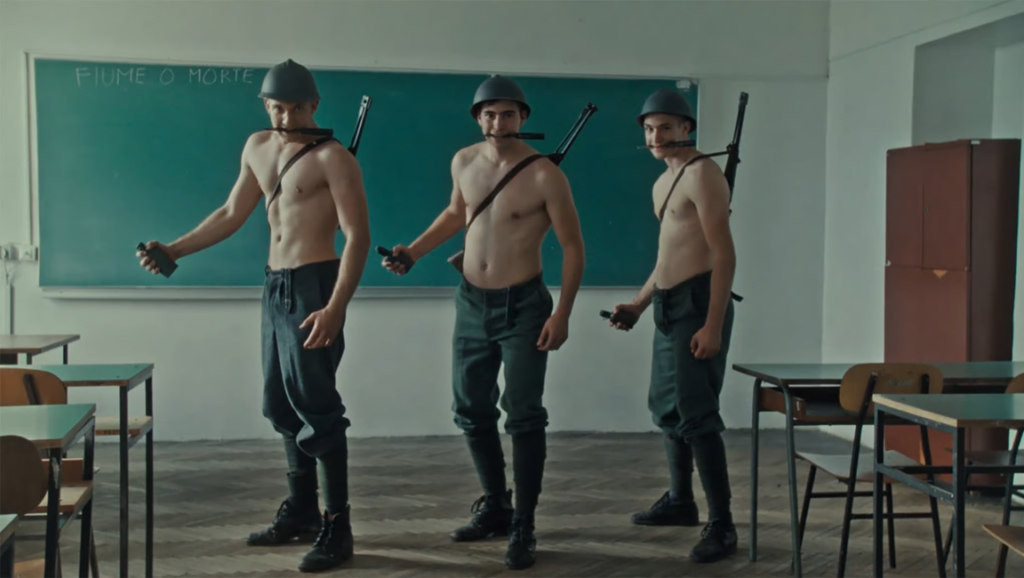
Bezinović’s domineering impulse is also too civic-minded to be truly solipsistic. With one apparently throwaway remark he admits to being from the “very last” generation of Josip Broz Tito’s “pioneers” (as were called the children who made up Yugoslavia’s socialist spin on the Scout Movement). It seems a knowing wink; like the multi-ethnic state’s dictator, Bezinović endeavors to keep apparently disparate groups of people united under a common project. Accordingly, the film is dotted with reminders of how nationalism might upset hard-fought social harmony: a real veteran of the Croatian War of Independence — one of several brutal conflicts that followed the socialist republic’s collapse — plays a “D’Annunzio,” and there are scrupulous accounts of how Fiume/Rijeka changed hands between various powers following the collapse of Habsburg rule.
In reality, the society Tito presided over was not always harmonious, and the “benevolent dictator” label that some apply to him is a clear contradiction in terms. It’s a testament to the film’s seemingly inexhaustible desire to do the right thing that it finds time to address even this, mentioning the post-WW2 exodus of Italians from the newly Yugoslavian city as the tables of cruelty turn.
It looks as though Fiume o morte! has covered all bases. It has found a way through fascism’s obfuscations and won back its setting for the forces of good, flirting only obliquely, and largely unselfishly, with the vocabulary of strongmen in doing so. Within the confines of representational art, it would be difficult to think of a more resounding political triumph. But those confines, it must be said, are the reason that even a film as clever as this can only ever provide much needed kindling to Shklovsky’s fear, cannot remove the actual threat behind it. This machine does not really kill fascists. In Eternal Fascism, Eco describes how, to the followers of an idea that lacks any real doctrine, that respects violent “action for action’s sake,” thoughtfulness is anathema. “Culture is suspect insofar as it is identified with critical attitudes,” he continues, before drawing on an apocryphal line from Göring: “when I hear talk of culture I reach for my gun.” There is something hopeless, when faced with an enemy that answers only to force, in attempting the “study of fascism” regardless, in bringing culture to what that enemy makes quite clear will only ever be a gunfight.
It was at the reception of the European Film Awards in Berlin that the theoretical world of Fiume o morte! came up against a real world it was not quite prepared for. “It’s fascinating that it’s happening here because Germany invested so much energy to educate people about the problems that war brings,” mused Bezinović as he collected the prize for best documentary. He was speaking against the host country’s “militarization,” apparently unalert to the fact that Germany’s current shift in defence policy is a reaction to the threat posed to Europe by Russia, a country currently pursuing a war of aggression in Ukraine. The concept of German rearmament is of course painful, but it serves as a reminder that those who wield real political power are pressed to make tough decisions for the greater good, tougher by far than those that face an artist. No amount of masterfully rendered fear will ward off war if it remains set on finding you anyway.
Yet even if Fiume o morte! will not repel violence on its own, it perhaps offers a formula for how good and effective resistance might be conducted. The Guardian‘s Phillip Oltermann uses Bezinović’s disappointing remarks in Berlin as a springboard to ponder whether the time has come for Europe’s artists to adopt the paradoxical notion of “armed pacifism,” a term borrowed from former Ukrainian foreign minister Dmytro Kuleba. This, Oltermann implies, would amount to creatives somehow guarding themselves against aggression while not forsaking the peaceful ideals they are proud of in the process. The idea is as compelling as it is paradoxical, yet Oltermann stops short of connecting it with the content of Bezinović’s film itself. But why not let a film for which no paradox is too intimidating have a crack at just one more?
The concept, both passive and active, seems well at home in a work that makes the spectator wield with wisdom and agency that “organ” which would otherwise do all the work for them, that frustrates their “recognition” of things as they appear so that they may “see” them for what they are. At a time where the signs around us are more and more confusing — where the “Leader of the Free World” is betraying that role, and where the rearmament of the country that birthed Nazism, confoundingly, is a moral imperative — a little ocular autonomy can go a long way toward making sense of it all. As wars now unfold in real time on social media, we also find ourselves the desensitized recipients of horrific imagery on a daily basis — a scale of passive “recognition” that is unprecedented but not, the film attests, indestructible.
Those who seek to resist this rot, especially those in power, might need to dust off more dangerous tools than their furniture to do so, the Bundeswehr being one of them. It will be better for us all if they approach the solemn task as mindfully as possible. Art, at its best, can provide a blueprint for clear-sightedness. Here is a film that fits the bill, that reveals “legionnaires” to be corrupted young men, betrays cocky auteurs as impressionable former boy scouts, and renders cities not as prizes on a map to be won come death or glory — the title, “Fiume or death!” is a D’Annunzio original – but as living patchworks, home to everything worth fighting for in the first place.
Comments are closed.