

Liminal spaces are all the rage these days. You can’t scroll for five minutes on any given social media app without seeing an image or video depicting a room that seemingly goes on forever. These are usually malls or children’s playplaces; we love our nostalgia, but a liminal space can be anywhere. These eerie, abandoned voids with few, if any, people often have lore attached to them. Maybe there’s an unseen creature lurking around the corner, just don’t make eye contact with it. Maybe the posters on the wall change every time you circle back. These creations create a sense of unease because they’re all so familiar and mundane, yet they couldn’t feel less like home.
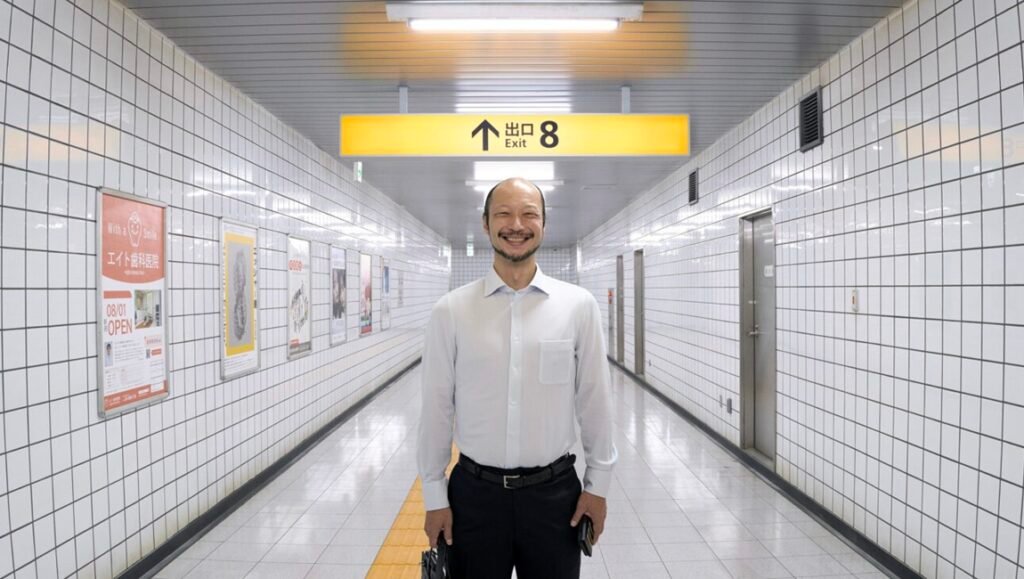
This idea is perfect for a video game. Imagine it: you spend hours and hours, turning corner after corner, trying to find an end to the level. An unseen force hot on your tail. Japanese game developer Kotake Create obviously thought the same, and in 2023 released the now highly-popular Exit 8. In Exit 8, you play as a person lost in an endless loop of a subway tunnel. Starting at Exit 0, you’re given a series of instructions, including spotting “anomalies.” If you successfully traverse each level, you’ll eventually find your way out at Exit 8. It’s a fairly simple concept, but one that allows for hours and hours of gameplay, as one mistake shoots you back to 0. It doesn’t immediately suggest an easy translation to cinema, which is why its new adaptation, also titled Exit 8, working as well as it does is a small miracle.
Taking the bones of the game, director Genki Kawamura not only successfully recreates the eerie thrill of being stuck in a liminal space, but also attaches a compelling story to it. Beginning on a packed train, a passenger (Kazunari Ninomiya) witnesses a man scream at a woman and her crying child as people watch but do nothing. Hurrying off at the next stop, the passenger, known only as The Lost Man, gets a call from his girlfriend telling him he’s going to be a father. Their reactions suggest that neither is on the same page, with The Lost Man clearly panicking at the news. Hanging up, he rounds a corner and finds himself at Exit 0. Here, the film largely follows the game’s mechanics as the Lost Man tries to make his way out of the endless loop.
Building a warped recreation of the Japanese transit tunnels, Kawamura uses real sets to enmesh you and The Lost Man into this creepy world. It lends an air of reality to the proceedings and helps ease you into the unease. As The Lost Man races through the tunnel, desperate to escape, his shortcomings — as not just a partner, but a man in the world — come into focus. Unsurprisingly, the maze is a metaphor for his inability to escape himself. It’s a fun wrinkle to a game with very little story, and it keeps you invested far more than if Kawamura had adapted the game 1:1.
As Exit 8 hits theaters, I sat down with Kawamura to discuss the film, “anomalies,” and making video games cinematic.
Brandon Streussnig: There’s a world in which adapting a game like this, one where a man essentially walks in circles, could be repetitive. How did you approach making this cinematic?
Genki Kawamura: In order to do that, I first abandoned the idea of trying to take a video game and adapt it into a movie. Rather, I took the approach of blurring the boundaries between the video game medium and the film medium, and I got clues to that when I was on a panel with Nintendo’s Miyamoto Shigaru, who said that really great video games obviously entertain the players, but they also have to entertain the people watching the players and what’s on the screen. So I wanted to take that idea and then really recreate that phenomena that’s happening in the video game industry at large, where there are video game players and there are streamers and people watching the streamers, and I thought that that sort of connection and parallel would help this film go into the film festival circuit and beyond.
BS: It’s interesting because watching someone play a game is a passive experience, and you sort of map that onto The Lost Man. He’s passive from the very beginning of the film, ignoring a man screaming at a woman and her baby. How did you decide on that as your inciting incident, as it were?
GK: I commute on the Tokyo Subway Network every day to go to work, and there are a lot of people on the train, but we’re all on our smartphones. So it feels very isolating to the point where we might not even notice a crying baby in the same car as us, and even looking at what we see within our smartphones, the violence, the wars that happen on our timeline, I think no one on the train is guilty of killing someone, but we’re all guilty of the sin of pretending not to see what’s happening. So what if that guilt manifested itself within this corridor and was reflected back at these people as anomalies? I think our protagonist is a rather selfish person and certainly doesn’t have the level of responsibility he would need to become a parent, and similar to the video game’s mechanics, he either notices the anomaly and turns back or ignores it, pretends not to see it, and goes forward. So he’s presented with a choice. I thought it was a bigger metaphor that kind of links daily life with what’s happening in the game.
BS: Liminal spaces are ever-present in our current moment. I think they can represent many things, but here it’s clearly a representation of The Lost Man’s inner thoughts and failures as a person. What was your approach to visualizing that?
GK: There are a lot of predecessors in the Japanese animation space that came before me, and I think a lot of these legends of the industry were really good at taking human memories and what happens within the human mind and expressing it through an audiovisual expression; I myself as an animation producer, but [also] directors like Kon Satoshi and Oshii Mamoru were really good at projecting the human mind externally. So I thought about how I could do something like that in the live action medium, which I found a very interesting challenge. I was also intrigued by what’s happening within our own minds and the idea of blurring boundaries in a similar way. I think with a lot of that, the spectrum is becoming gray. So, where does the video game end and the movie begin? That’s something we wanted to do with this film, but the same is true of AI and reality. Where does that boundary exist? I wanted to try to dig deeper and express that very subtle boundary.
BS: The idea of fatherhood is a heavy one for many men of our generation. I’m 34, and I still don’t know if it’s something I’ll ever be ready for…
GK: You are also The Lost Man [laughs]
BS: I mean, it’s apt! Where did that, as your central motivating factor for him, come from?
GK: The video game itself is quite simple, where if you notice an anomaly, you turn back, and if you don’t, you carry on, and I think that this is something that happens in our daily lives where there are anomalies all around us, and whether we choose to carry on or notice them and turn back is up to us. I think that is sort of a big driver of what’s going to change our own lives and also extend to a more macro level in the geopolitical space and perhaps the entire world. That’s how we affect change. So my hope is that from before people see the film and after, it will slightly change their perspective or add another lens in how they view the world.
BS: What can you tell me about building the sets that recreate the Japanese transit tunnels? It’s astonishing how real they look.
GK: With regards to the set, we had actually built two identical corridors and connected them with a joint in the middle. So it was like a copy and paste of the same corridor, and that’s how we were able to physically go into a loop and take those extremely long shots that you see. The Walking Man played by Kôchi Yamato, he actually had to, in one scene, walk past the camera, go to the end of the corridor, get on a bicycle, ride to the beginning of the other corridor, catch his breath, and begin walking again, which is how we created that illusion of him looping through this space. Because we had two identical sets, the cast and crew would also get lost. So I decided to name both of our sets. We gave the name Hitchcock to one of them and Kubrick to the other.
BS: None of this works without a compelling lead, and you have that here in Kazunari Ninomiya. The entire film rests on his shoulders. How did you land on him?
GK: He had performed in Clint Eastwood’s Letters from Iwo Jima, where he delivered a really stellar performance. His character didn’t have much dialogue, but I think the facial expressions made him a really attractive character in that film. Similarly, in Exit 8, a lot of the acting and performance needed to be delivered through body language and facial expression because there wasn’t too much dialogue in the film, so I thought he would be the perfect person to play that role. Likewise, he is also an avid gamer, so every time we would call cut on set, he would pull out his smartphone and start playing video games. So I think he really understood the concept we were trying to achieve, which was to blur the experience between video games and movies.
Comments are closed.