
Corpses are sliced open during an autopsy. Cult members devour fresh human organs before engaging in an orgy while still smeared with blood. A group of diners whack a trapped monkey on the head with mallets before savouring its brain. These are just a few of the graphic, gruesome images in John Alan Schwartz’s infamous mondo-horror film Faces of Death (1978), a compilation of depravity introduced and contextualised by a narrator (Michael Carr) as having been accumulated over the years from around the world. In the decades after its release, the film gained notoriety for its shock value — “BANNED in 46 countries!” reads the VHS packaging.
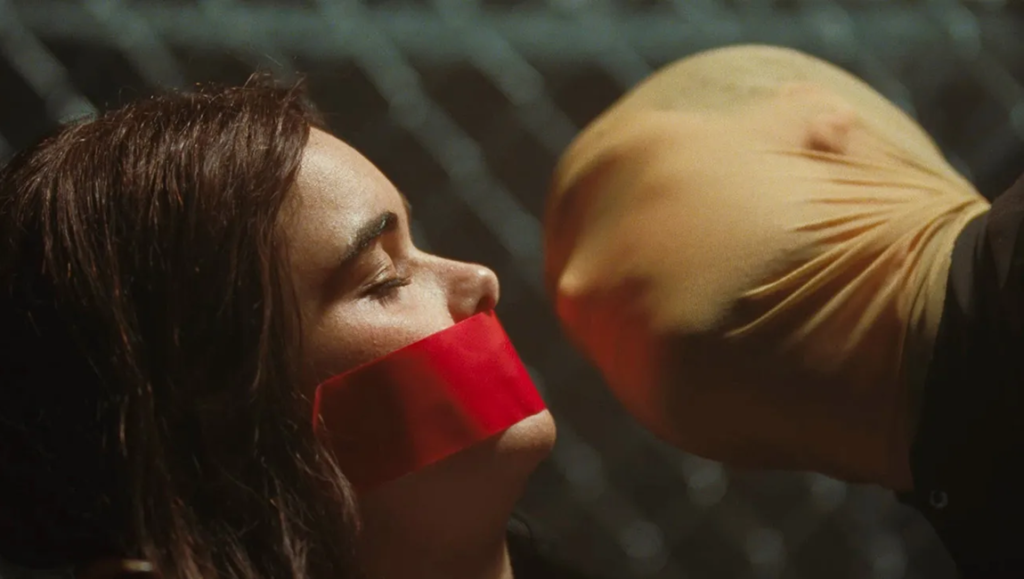
By contrast, director Daniel Goldhaber’s intelligent reboot is reflective of a world in which such violent imagery is everywhere, on the news and in our phones. Introducing a gripping narrative tension missing from the original documentary-style film, this new Faces of Death unfolds as a cat-and-mouse game in which social media content moderator Margot Romero (Barbie Ferreira) stumbles across recreations of the 1978 film’s death sequences online, becomes convinced these are real murders being shot, and scrambles to identify the serial killer posting them (Dacre Montgomery), unaware that he’s tracked her down first. On the Internet, no one is who they appear to be, and yet it’s never been easier to pinpoint exactly who people are and where they live.
Most chilling, however, is what the new Faces of Death does with the original’s climactic contemplation of whether life after death exists. In the Internet age, the film points out over and over as Margot’s horrific past tragedy follows her around in the form of a viral video, nothing is ever gone forever.
Goldhaber and his co-writer Isa Mazzei, who’ve previously collaborated on the 2018 psychological horror film Cam and the 2022 thriller How to Blow Up a Pipeline, spoke about the Internet rabbit holes they went down as part of research for this film, crafting an unnerving antagonist for the Extremely Online age, censorship hurdles, and working with pop musician Charli xcx.
Gayle Sequeira: Despite the vast majority of its footage being fake, the documentary style of the original had viewers back then convinced that everything they were seeing was real. What I really like about your version is how it reverses this approach by having characters who are cynical about whether anything they’re seeing is real, given the prevalence of deepfakes and AI. You’ve built a thriller around a content moderator attempting to convince her colleagues and the cops of the urgency of what she’s seeing online. How did you crack that approach?
Isa Mazzei: It came pretty organically from digging into the original. We hadn’t seen it, but when we did finally watch it, we realized there were clips from it we’d seen earlier, but entirely online. So it became this question of: where are the Faces of Death in the modern era? They’re on the Internet, they’re on [American shock site] rotten.com, they’re on all these websites we grew up with. From there, this story of a killer emerged quite naturally.
GS: While the original film was about the horrors that human beings inflict on each other, you introduce robotic executors, which ties into larger ideas of dehumanization.
IM: Screens have a way of causing us to depersonalize each other, you know? We call it “social media” because we’re using it for some facsimile of a social interaction, but ultimately, I’m alone in my room, you’re alone in yours — are we really that connected? That’s one of the arguments Margot keeps having in the film, that there’s a real person behind the violence that the other characters are witnessing. It’s easy to forget that, especially in the modern day where we’re constantly being bombarded with so much imagery that it’s almost too much to process.
GS: Aside from the original, what other cinematic references were you drawing on?
Daniel Goldhaber: Our biggest reference was Peter Bogdanovich’s 1968 crime thriller Targets. It works as a kickass thriller, and is very scary, but at the same time, it ends up being a very powerful metatextual analysis of violence in American cinema and the alienation it’s caused. We were inspired not just by Targets’ structure and by how intelligent and original its filmmaking form is, but even dramatically, it’s a movie where you’re watching predator and prey circle each other. For the story we wanted to tell — about someone who’s an obsessive poster and another person who’s trying to take their posts down — that kind of dual narrative was something that really spoke to us.
We looked at Henry: Portrait of a Serial Killer [1986], especially for how violence is depicted in that movie — it’s very matter-of-fact, which makes it all the more disturbing. We also looked at Brian De Palma’s Blow Out [1981], at Maniac [1980] and other ’80s slashers, and at The Silence of the Lambs [1991] and Manhunter [1986] as films that really give you a chance to get to know the killer rather than his identity just being a big reveal at the end of the film.
GS: Could you speak about your approach to integrating screens and other social media into the film?
DG: One of the problems with the way that technology is ultimately represented in film is that people try to show a phone by shooting it over-the-shoulder. And that’s not how you experience being on your phone — the rest of the world disappears. And so on Cam, we started to develop this visual language where, when the character is having a digital moment, the audience is having a fully digital moment. That’s not just an accurate way of rendering the way we engage with the Internet, but it’s also creating this cool cinematic juxtaposition in which digital reality reshapes the reality around the characters, and their emotional reality, but you’re also showing that as two separate things — the thing that’s happening onscreen is not necessarily what’s happening in the room with the character. That’s a very powerful, basic way of using cinematic language to demonstrate how we think we’re connecting, but we’re actually just looking.
GS: What Internet rabbit holes did you go down as part of your research? I’m thinking of the scene in which the serial killer uses a trackable link to find Margot, which is chilling, but also the Reddit threads, and all of the social media videos you see — you’ve said [these] were real videos you licensed?
IM: The IP tracking thing is something I used to do in middle school. [Laughs] It was a lot easier back then because Internet service providers did not protect IP addresses and so I used to troll people on [virtual pet game] Neopets by spoofing their IDs.
Some of the content in the film was created, but the rest was sourced so as to feel authentic to the experience of being online. It was about building that disjointed experience of scrolling — you’re looking at a funny video, then a clip from a movie you recognize, then an ad for something, then a picture of a war crime, then your friend getting engaged, then someone doing a mukbang. We wanted to bring that weird experience into the film. We went down some rabbit holes in sourcing some of the darker content because we were going: okay, we want to put real death into the film, how do we go about finding those videos?
GS: Daniel, I know you’d spent a summer working as a content moderator at a social media startup years ago. How did that experience inform the one depicted in the film?
DG: My experience of working as a content moderator was very different from the one that’s depicted in the film. It was a much more low-fi operation. I was monitoring the whole social media feed and taking down bad stuff whenever I saw it. What I found so striking is all these horrible accident videos and grotesque things, which, at the time, would suddenly pop into my eyeballs, are now being served to me in the TikTok era. And it’s not something I’m supposed to take down. That highlighted for me how content moderation is, by and large, a bit of a smokescreen. It’s a liability shield for large companies, and also a way for them to control and censor news that they find undesirable, which you see demonstrated in the film.
One of the big things that changed between when I started working at that app and the present day has been the rise and proliferation of the infinite scroll and the recommendation algorithm. For a long time, you saw the stuff on your timeline from people you followed — it was what they reposted. There was a fundamental human-to-human interaction happening online. As we instituted these algorithms, it took that out of the equation. So what feels like person-to-person communication is really not. It’s robot-to-person communication. And that robot has been optimized for your engagement, to compel you to look at your phone. It’s going to, easily and conveniently, choose the lowest common denominator for content.
IM: For the film’s depiction of content moderation, we looked at what is actually restricted online. We saw that content related to sexual health or even harm-reduction, such as information about [opioid overdose-reversing spray] Narcan, tends to be censored more often than graphic violence.
GS: Cam begins with a camgirl staging her suicide, which generates enough buzz to drive up her ranking. Both that film and Faces of Death are about digital spaces that incentivize and popularize violence, with desperate characters driven to push back. Ultimately, however, the only way they can make themselves heard is by posting on the same platform. What does that say?
IM: I loved that you called out that moment from Cam. You’re the first one, and I deeply appreciate that. That’s exactly what we’re pointing to — that acts of extreme violence are what drive engagement on these platforms. The fact that both these characters find themselves returning is a reflection of the times we live in. We talk a lot about how an artist’s job is to hold a mirror up to society. This is what we are right now. I don’t necessarily have an exact solution to this problem. I’m caught in it myself — I find myself online, posting, trying to get engagement just like everyone else. I don’t want to moralize or say these characters are making a mistake. They’re trying to create agency in the only way they know how, with the tools they have at their disposal.
GS: How did you navigate your own use of violent imagery in a movie that’s otherwise a condemnation of how we’re either fascinated with or desensitized by such graphic content?
IM: The original film has real death in it, so does ours. The ways in which we’re served real death now is extreme. In 1978, you had to seek out real violence. Now, it’s just pushed to us online. We wanted to recontextualize some of these images by putting them onscreen — ideally in a movie theatre — so that if you became uncomfortable watching them, hopefully when you left the theatre and were looking at your phone, you’d realize how out-of-place violent content is. We’ve gotten so used to seeing it that it no longer feels abnormal, even though it’s incredibly abnormal to be able to take out a phone, which should function as a tool, and instead see violent acts.
GS: There’s such a great strain of humor in the film, like the scene in which the irate killer switches to an alt account to troll his unimpressed viewers in the comments section. How did you balance the heaviness of the subject matter with moments of levity?
DG: The original film is pretty funny, and that’s part of what makes it so creepy. They’re showing you these awful clips and then there’s this jaunty little tune playing in the background. When you watch the movie, it feels like it wasn’t made by anybody because you’re like, “Well, no one would do this. Only a deranged person would do this.” That’s part of what makes the movie feel so cursed. It’s not that we were necessarily trying to replicate that, but we understood that the humor makes the matter-of-fact presentation of violence so chilling. We’re not telling you, “Hey look, this is so fucked up.” We’re telling you a story and putting you into something that feels super relatable and then all of a sudden, you’re confronted with a murder. The humor amplifies the horror.
GS: Tell me about constructing the character of Arthur. He’s a serial killer who’s simultaneously really freaked out by getting blood on himself.
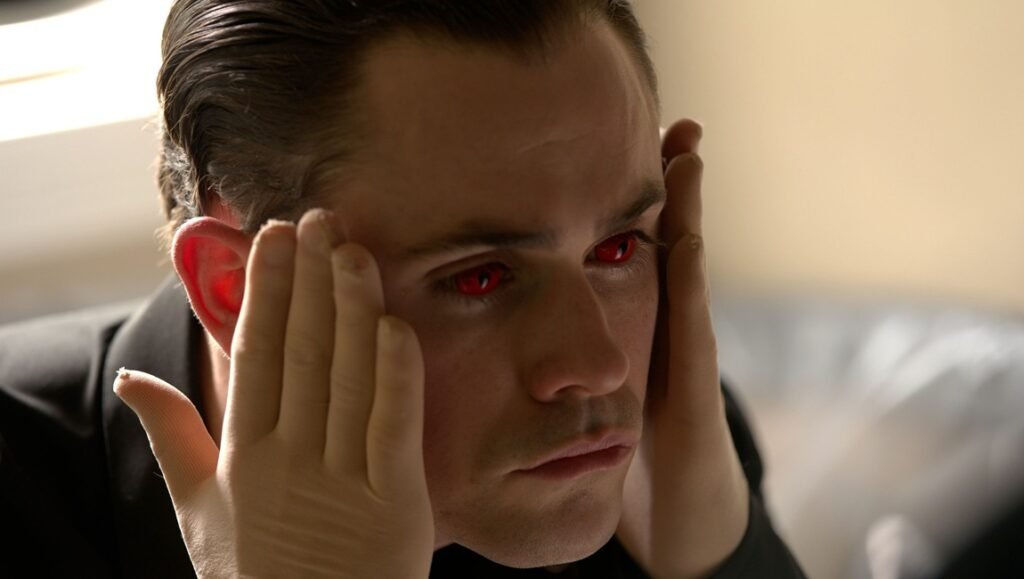
DG: Some of those things, like the aversion to blood — the character just tells you who they are during the process. A lot of the iconography of the character was done in collaboration with Dacre. He’s an actor who had a vision for how he saw himself in Arthur and how he would express his own obsessions, insecurities, and relationship to violence through this character. Arthur’s spandex suit was his idea. So it was a combination of us getting in touch with our own sense of alienation and Dacre bringing a real evocative specificity to those ideas.
GS: Arthur’s set up as the antithesis of Margot — he knows how to game digital spaces to his advantage, she’s suffered tragedy on account of engaging with them. The contrast between them comes through via this great use of splitscreen, in which she thinks she’s piecing together the case and getting closer to figuring out his identity, meanwhile he’s the one tracking her down. The only information she has is what he’s supplied her with.
IM: I love the splitscreen scene because it’s this moment of their two worlds colliding entirely in a digital space. The next time we see their two worlds collide in a physical space is during the film’s climax. Ultimately, they both have to become a bit more like the other in their journeys. Margot has to dive back into the internet world. She has to reactivate the parts of herself that know how the internet works. Arthur, on the other hand, has to engage with her in an incredibly violent, physical space.
GS: A common theme running through all of your movies is that of characters realizing institutions — the police, the government — can’t or won’t help them, and they have to act for themselves. All a cop in Cam can do is unhelpfully tell a camgirl to stay off the Internet after her identity is stolen and used in the creation of explicit content. Faces of Death seems like it’s building up to the cops discovering the bound girl on Arthur’s floor, but they don’t.
DG: There isn’t a lot of familiarity among police departments, cops or investigators with regard to tech crimes. Our systems are ultimately built by men who don’t believe women. Our movies do often deal with characters who are railing against a system that’s making them feel insane. We’re looking at all of the various ways in which the systems in the movie fail Margot and, by extension, all of us.
GS: Were there parts of the movie you had to cut or self-censor to get an R rating? Was there pushback?
DG: We absolutely had some issues with the Motion Picture Association of America, particularly with the hammerhead sequence and the moment the skull is peeled back. The MPAA refuses to tell you what to cut. They just flag a scene and go, “This is problematic for us.” So you cut a second and send it back and they go, “I think it needs to be cut down further.” And you keep going back-and-forth with them and cutting more until they say, “Okay, we can give you an R rating.”
They kept pushing us to cut down this moment where a brain is cut into, specifically the moment when the scalp flops down in front of the eyes — this was part of a video Margot was meant to be watching as part of her job as a censor. But the exact same thing that they forced us to cut out of this moderation sequence is actually still present in the film when Charli xcx’s character shows her phone to Margot later and this video is playing on it. So what MPAA ultimately doesn’t like is the context of the audience being forced to think about the inherent hypocrisy of a culture that will allow violence but will disallow sexual content. We faced the same issue with our posters, which had Margot’s bloodied face in the background and a censored image over it. The MPAA wouldn’t let us put up the censored image. You go to the theater and there’s plenty of blood-covered heroines on posters. But when you draw the audience’s attention to how there’s hypocritical censorship around those images, all of a sudden the MPAA has a problem.
GS: You’ve mentioned Charli and she’s great in the film as a content moderator who’s so desensitized to death, she giggles at it. What did she bring to the role?
DG: Charli reached out to us about being in the movie. She was a fan of the original Faces of Death, and of our work. We had just that role left to be cast and so it worked out. She’s a big horror fan and a big movie buff. The big reference she came up with for her character was Marla Singer from Fight Club (1999), a totally black-pilled, nihilistic vibe and you really feel that in the costume and in her voice. It’s a really fun and funny performance.
Comments are closed.