
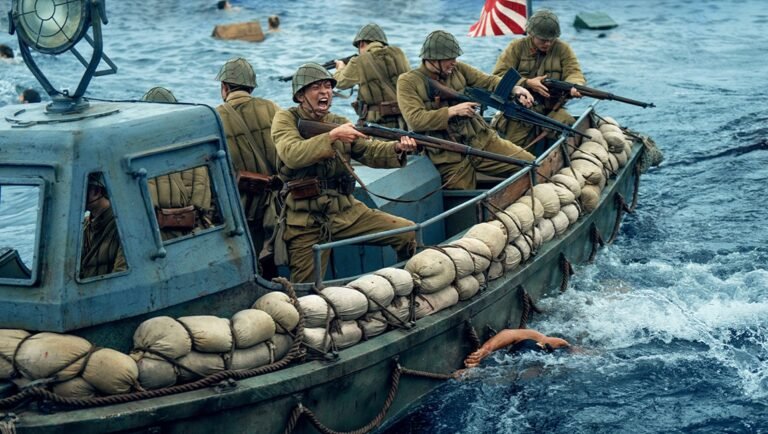
“We can’t stay down anymore!” This line from war-victim acting veteran Ni Ni is delivered as Ah Hua captures the galvanizing and inspirational spirit of Dongji Rescue, a dramatization of Chinese island fishers bravely fishing 384 British POWs left at sea to die by the Japanese after the sinking of cargo liner Lisbon Maru in 1942. An American submarine torpedoed the Lisbon, unaware of Allied prisoners in the brig. Japanese soldiers shot at those escaping the sinking ship and likely would have killed them all had the local Chinese fishers not broken the blockade and defiantly saved the drowning men amidst gunfire. Most of those fishers came from an island called Dongji. (There are two islands with the same name off China’s east coast. The one where the boat sank is part of the Zhoushan archipelago; the other is administered by Taiwan.) More than 800 of the POWs died either by Japanese gunfire or drowning.
Big-budget historical Chinese films with monstrous Japanese antagonists are nothing new. Director Guan Hu is perhaps most known for The Eight Hundred, his 300-ization of the Defense of Sihang Warehouse in 1937, while Ni Ni’s breakout role was as the leader of a group of prostitutes in Flowers of War, Zhang Yimou’s dramatization of the Rape of Nanjing in the Second Sino-Japanese War (also known as the War of Resistance Against Japanese Aggression). Steven Spielberg’s Empire of the Sun, about an English boy and an American soldier stationed in Shanghai during the invasion, can also be folded into this conversation. The whole of this subgenre is filled with dark material, and there’s simply no way around it when labor camps, city-wide rapes, and Geneva Code transgressions were standard operating procedure for the imperial Japanese army. Dongji Rescue still falls onto the darker side of the spectrum for these films.
In the film’s most brutal moment, Japanese occupiers put several bullet holes in a young child’s chest. Child murder is something most directors normally only suggest with the camera, but Guan Hu and Fei Zhenxiang make sure we see the dead body. The living conditions of the POWs on the Lisbon could be translated from Renaissance painter Fra Angelico’s crowded and vertical horror in The Last Judgment. The bodies of the pale-skinned Brits pile on each other like ants and leave no negative space between them. Japanese authorities burn a Chinese man alive for resisting the oppression of the soldiers keeping an eye over the island. As he burns, he cites the mythical nationalistic poem “Full River Red,” fully tying in the oppression on screen with a larger political vision. Zhang Yimou’s Full River Red from a few years ago climaxes with a communalistic recitation of the same poem, and both moments do a good job of being unabashed agit-prop while still serving the immediate needs of their respective stories.

Said agit-prop of Dongji Rescue occasionally crosses the line into generalizations. The first words heard from the Japanese are a screaming “Banzai!” and the Japanese soldiers are humanoid facilitators of Sino destruction. Most of the time, though, Dongji Rescue is a tear-jerking celebration of humanism, one that is far less concerned with the invaders than with the survivors and the resistance. Two brothers, Ah Bi (Zhu Yilong) and Ah Dang (Wu Lei), both of whom are excellent swimmers and are jokingly called pirates, emotionally anchor the rescue and also allow for the screenplay to flesh out its politics. One brother begins with a firm conviction in empathy — that all lives are worth saving, regardless of their nationality or political beliefs — while the other is inclined to lend a helping hand to the Japanese if it will save his life. Their fraternal love eventually corrects course, and the two end up doing the right thing together. It’s difficult to be against the message of a film that erases differences in communal encounters with the fragility of mortality.
It’s also anti-imperialistic. The great moments of Dongji Rescue tend to be collective: the chorus of English voices singing “It’s a Long Way to Tipperary,” the collective uprising of unarmed POWs (and a handful of Chinese civilians) against the machine-gun armed Japanese soldiers, and an entire island risking their lives to save soldiers who speak another language. And the heroes never act alone. The final sequence of the rescue to save the farthest out boat from being pulled into the whirlpool created by the sinking Lisbon Maru is a threat to make even the driest of eyes wet with feeling. Guan and Fei fictionalize the event in a way that never doubts that a small group of regular people can repel militaristic authoritarianism.
Cinematographer Gao Weizhe’s excellent eye is marred by a few elements likely outside of his control. The opening of the submarine’s missile hitting the boat and the finale of the sinking ship clearly demanded an unhealthy majority of the project’s budget, which means that while Gao effectively makes the ocean into a daunting presence and does a lot to sell the big emotions, two brief sequences distract with their poor (likely rushed) CGI renderings. The lighting also doesn’t fully match the darkness of some of the events depicted. In one comical technical gaffe, one of the brothers dims a light that’s supposed to give him the edge in a fight by turning the space into a nightly black, but when he puts out the light, the viewer’s field of vision doesn’t darken enough; it seems that Gao is trying to keep things light enough for the events to be legible to viewers, while also asking us to imagine that they aren’t so visible to the soldiers. It’s an unfortunate and ultimately forgivable misstep in a film with otherwise solid visuals, and such distractions don’t much register in the face of the film’s considerable strengths.
DIRECTOR: Guan Hu & Fei Zhenxiang; CAST: Zhu Yilong, Leo Wu, Ni Ni, Yang Haoyu, Chen Minghao; DISTRIBUTOR: Well Go USA; IN THEATERS: August 22; RUNTIME: 2 hr. 13 min.
Comments are closed.