
Italian filmmaker Paolo Sorrentino is back on terra firma with La Grazia, his second film to premiere in less than 18 months, following on the heels of the disappointing Parthenope. Reunited with his longtime leading man Toni Servillo — the actor has appeared in seven of the director’s features — Sorrentino finds himself revisiting a couple of familiar subjects: how the sausage is made in Italian politics and the inescapable weight of regret. What makes La Grazia a slight departure from Sorrentino’s previous works however is that while those themes often repeat themselves, they’ve never really coexisted within the same film before. A maximalist whose films are frequently prone to leering at earthly delights and engaging in almost Fellini-like levels of onscreen excess, La Grazia finds the filmmaker in a milieu that again lends itself to all the trappings of decadence and stylistic overkill, yet Sorrentino’s approach is notably reined-in and residing in a comparatively austere, almost exclusively self-reflective register. At only 55 years old, Sorrentino would still be considered a youthful filmmaker, yet his new film unmistakably has the feel of an older artist contemplating the endpoint of their vitality and relevance while pondering what sort of a legacy they might leave behind.
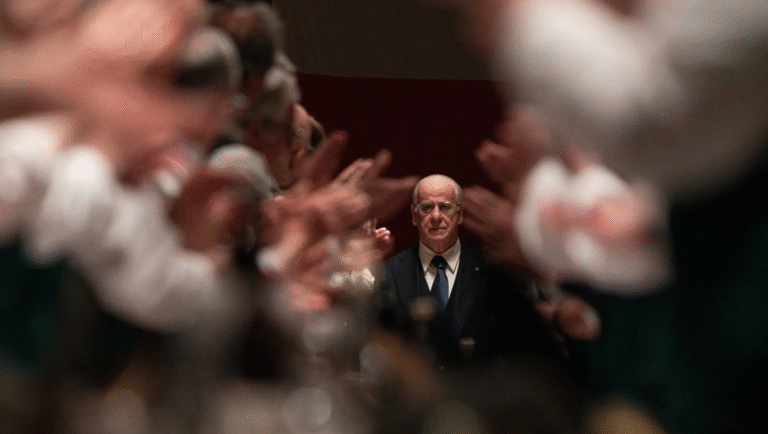
Having previously appeared as real-life Italian Prime Ministers Giulio Andreotti and Silvio Berlusconi in earlier Sorrentino films, Servillo takes on the challenge of embodying a fictional, and far less corrupt, head of state in La Grazia. Servillo plays President Mariano De Santis, a former conservative jurist riding out the final six months of his sole seven-year term. A lame duck whose official role has largely been reduced to ceremonial responsibilities such as hosting foreign dignitaries and fielding puff-piece interview requests, Mariano is also resigned to stand by and observe subordinates and statesmen jockeying for his current job. In the dying days of his presidency, he is torn between yearning for a return to the quiet solitude of the private sector and the desire to make a lasting impact while he’s still in a position of influence. The most pressing matter on his dwindling docket is deciding whether to sign a bill that will legalize euthanasia in Italy, something Mariano believes is likely in the public’s interest but is in conflict with his deeply held faith in Catholicism and his caution over capriciously overturning the status quo. He’s also been asked to consider the clemency of two convicted murderers that conveniently dovetails with the widowed Mariano’s thoughts of his long-deceased wife, Aurora: one an abused spouse (Linda Messerklinger) who stabbed her husband in a crime of passion, and the other is a beloved music teacher (Vasco Mirandola) who claims he killed his Alzheimer’s patient wife to ease her suffering. And as if all these thematic echoes weren’t already deafening, there’s the matter of Mariano’s beloved horse, Elvis, who we are told is dying of an agonizing, incurable disease, though the president will not allow the veterinarian to put the poor animal out of its misery.
Mariano’s indecision on all matters is at the heart of La Grazia, with the film presenting the president’s dithering less as cowardice and more a paralyzing form of prudence — the result of trying to think through every possible consequence and legal implication. A legal scholar revered in his previous life for his thoroughness, Mariano has been bequeathed the less-than-stirring nickname of “Reinforced Concrete,” a tacit acknowledgment of how difficult it can be to move him either off of or onto any given position. Somewhat appropriately then, Sorrentino structures the film as a series of digressions and circuitous avenues to be explored by his protagonist. Even as ostensibly the most in-demand man in the country, we regularly find Mariano shuffling through the executive offices of Quirinal Palace like a housecat, slinking from room to room as though he were in search of someone who might briefly distract him from his official tasks. We observe Mariano sneaking off to the rooftop to partake in the one cigarette a day he allows himself, always accompanied by his head of security and trusty confidant, Colonel Labaro (Orlando Cinque), or using his “executive time” in the palace’s residence to indulge his nascent interest in hip-hop music and EDM. And, as a nod to the character’s roiling inner life and atypical interests, Sorrentino will occasionally puncture the stately proceedings by placing throbbing techno under scenes of otherwise stuffy official government business. However, mostly Mariano allows his mind to wander to thoughts of his dead wife, gone eight years now, who he envisions walking through fog-covered, Elysian-like fields. Rumor has it that four decades earlier, when they were both in university, Aurora allegedly had an affair with one of Mariano’s friends; in spite of what should really be water under the bridge at this point, the President of Italy is determined to get to the bottom of this unforgivable transgression, even if means interrogating assorted senior citizens who have been in his social circle for nearly half a century. Will Mariano belatedly arrive at some measure of peace if he can learn the truth? Or perhaps it’s easier to dwell in the past than act decisively to ensure the future.
This sort of restless inaction and gently feeling around for a greater truth are par for the course with this filmmaker. Sorrentino historically makes long, leisurely films that allow the director ample space to follow his own muse, be that contemplating the great mysteries of spirituality, appreciating the randomness of existence, or simply ogling buxom Italian actresses in varying states of undress. La Grazia is uncharacteristically sexless, but otherwise it could be mistaken for the filmmaker concertedly “playing the hits” in its scene construction, painterly shot compositions, and absurdist tangents which serve to tweak the power structure. Mariano takes a private audience with the Pope (Rufin Doh Zeyenouin) in a scene where the takeaway is less what the head of the Catholic Church actually thinks about euthanasia and more the fact that the pontiff is of African descent — complete with a head full of long dreadlocks — and that he navigates the gardens of the Vatican on the back of a motorcycle. Mariano’s oldest friend is a bellicose art critic (Milvia Marigliano) who curses up a storm and alone seems capable of cowing the president through sheer truculence; it helps that she’s the only person in his orbit who’s willing to speak the truth without a filter, and also seemingly knows where all the bodies are buried. And speaking of orbit, we also bear witness to odd perks of the job like Mariano attempting to greet an Italian astronaut aboard the International Space Station over a video link. Floating in zero gravity and stymied by technical difficulties with the telecommunications, the astronaut, unaware that he’s being observed on a television monitor, unexpectedly begins to cry — a single teardrop is suspended, weightlessly in the air, while a transfixed Mariano follows the undulating ball of liquid’s path with his finger.
What does any of that actually mean? In truth, it’s fair to question whether it means anything at all. Sorrentino presents Mariano’s final months in office, and more pressingly, his decisions about the commutations as well as the euthanasia bill as being informed by a series of seemingly disparate events that have a cumulative effect with no single moment possessing greater prominence than any other. It’s remarkably lifelike in that respect, but a little exasperating as drama. It’s very much a “still waters run deep” kind of film, grounded by Servillo’s ever placid performance. The actor’s mouth betrays nothing, rarely so much as smirking, and yet his eyes remain wonderfully expressive throughout; giving us flashes of longing, impish glee, and profound despair while always maintaining the face of a stoic senior citizen who refuses to share his innermost thoughts with anyone. Mariano may be reticent to decide anything, but we’re never not aware of how much Servillo is processing each new, potentially contradictory, argument and data point.
It also helps that Sorrentino prevails as one of cinema’s preeminent stylists, and his ethos remains “what if this scene were actually the best scene of the film?” — an ethos that is applied across nearly every scene of the film. Even scaled back some due to the subject matter or perhaps a self-imposed edict to behave himself, Sorrentino still builds out a series of extravagant, mini set pieces that underscore the ridiculousness of power and affluence while sending his camera careening to and fro. In one scene, the director shoots the reception of a visiting president being in high-frame-rate slow-motion and sets it against an unexpected torrential downpour; elsewhere, he stages one of Mariano’s chilly, silent confrontations of a political adversary amidst what appears to be an interpretive dance performance scored to a throbbing beat, with the whole thing filmed in an elaborate unbroken Steadicam shot. The filmmaker has always been playfully inscrutable, benefiting from expansive canvases and seemingly unlimited resources, which, if absolutely nothing else, precludes Sorrentino’s rather languid films from ever actually becoming boring — the late, entirely unaddressed, introduction of what appears to be a robotic, dog-shaped sentry leading a somber procession through the streets of Rome remains one of the odder things to turn up in a film in quite some time. And all the while we’re presented a version of politics built upon reason, temperance, compassion, and guided by our better angels. More than anything, this is what truly pushes La Grazia into the realm of the fantastical.
DIRECTOR: Paolo Sorrentino; CAST: Toni Servillo, Anna Ferzetti, Orlando Cinque, Massimo Venturiello; DISTRIBUTOR: MUBI; IN THEATERS: December 5; RUNTIME: 2 hr. 11 min.
Comments are closed.