
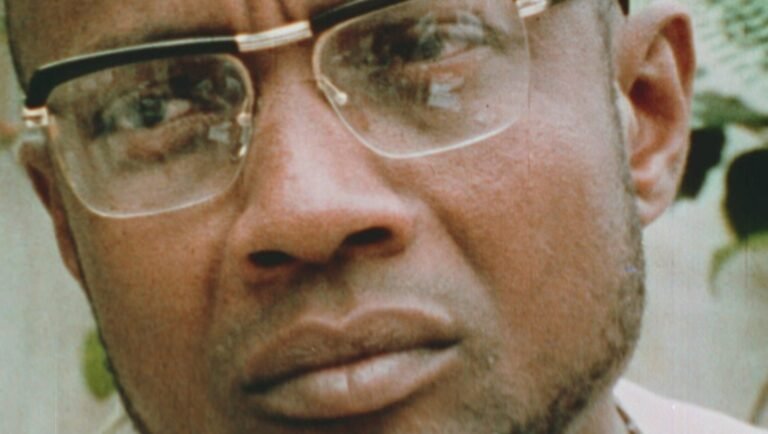
Succeeding the opening text of Amilcar is a close-up on a man’s face depicted in ultra-slow speed, soon revealed as interview footage, amidst a disorienting sound design. He wears a pair of angular spectacles and turns his gaze away from the camera. He dons a puzzled and pensive visage, creasing his forehead. It’s Guinean and Cape Verdean revolutionary Amílcar Cabral, the subject of Spanish filmmaker Miguel Eek’s documentary Amílcar. “Independence, to what end?” asked by an unseen interviewer, as the lens slightly pans out. “For us, above all, to be ourselves,” Amílcar responds deftly. “To be African men, with all that characterizes us, but on the way to a better life and that we can identify ourselves every day with the rest of the world. We want independence to do in our country what others have done in theirs.”
Constructed out of vast material, including Portuguese colonial archives, revolutionary films, and original 16mm footage, Amílcar proceeds to replicate the mindset of its titular subject, which allows for a compelling ode to the radical figure and a critical examination of colonial and imperial violence across Africa. Spanning three decades, the documentary is a pseudodiaristic gold mine for Marxists and socialists, as well as students of the revolution and history at large. It’s narrated in voiceover by Nuno Miranda as Amílcar himself, invoking the freedom fighter’s spirit through his personal letters, poems, and political writings, which form the foundation of the screenplay, co-written by Eek and Alba Lombardia.
Whereas the film chronologically uses years in which Cape Verde and Guinea-Bissau was under Portuguese colonization as narrative coordinates, it’s far from exhaustive, moving in fragments and skipping Amílcar’s childhood. Instead, it begins two decades later, when Amílcar was still a student — the only Black one — at the Lisbon Institute of Agronomy, where he would come across the only female student named Maria Helena Rodriguez, who would soon become his first wife and to whom he would write private letters, at least until he met Ana Maria, his second wife. However, the documentary refuses to neatly mythologize its subject as a Great Man — for one, we rarely see Amílcar on screen, at least until over an hour into the movie — but rather uses him as a complex anchor of a larger anti-colonial rhetoric, of what it truly looks like to decolonize the African continent. As Amílcar puts it: “The revolutionary petty bourgeoisie must be able to commit suicide as a class. To be reborn as revolutionary workers, and identify with the aspirations of the people it belongs to.”
As Eek’s fluid work wends onward, we follow Amílcar’s many selves: the bright student who studied his homeland’s brutal history, the proud lover, the diplomat, the sharp political thinker under the nom de guerre Abel Djassi, and the charismatic freedom fighter who founded the African Party for the Independence of Guinea and Cape Verde (also known as PAIGC) in September 1956 and organized the Portuguese colonies toward a greater cause, which he describes as not just a fight for free territory, but for complete humanity. What is impressive here is that the Spanish director hardly relies on talking heads, though his vision still defaults to interstitial information, as is so often the case in many documentaries — at times, all one gets are scanned surveillance documents against the black screen, accompanied by translated subtitles.
By reconstructing Amílcar’s memories via documents that were both used to celebrate and hunt him, Eek paints an impressionistic portrait of Portugal’s imperial project, in which every African person, to be considered an “assimilated,” and therefore a “civilized,” citizen, must learn how to live the “European way,” from dressing and styling their hair the “proper” way to reading and writing Portuguese correctly. “Re-Africanizing the spirits is not about going back to the past. It’s not about folklore or romanticism, but reclaiming the people’s ability to express themselves from within,” says Amílcar at one point.
Elsewhere, the film exhibits a feverish form, featuring clever match-cuts as well as grainy 16mm compositions and shifting from vibrant colors to monochromatic ones. Despite the historical markers, its sun-drenched images, to some degree, feel fascinatingly spectral and out of time, neither here nor there, at once embodied and disembodied. In this way, Eek’s vision burns into the viewer’s mind. The most prescient bit in the documentary are, undeniably, the sequences depicting Portugal as a genocidal state, sending squadrons of planes to drop bombs on the liberated zones, primarily targeting children. Sound familiar?
As with many a story of radical movement, Amílcar’s life, and therefore Eek’s documentary, ends in the internal conflicts suffered by the revolution, Cabral’s assassination in January 1973, the independence of Guinea-Bissau that soon followed and its eventual separation from Cape Verde seven years later, and the toppling of the Salazar dictatorship through the Carnation Revolution in 1974. That this doc is movingly experimental yet still grounded not only makes it all the more potent, but speaks of the spirit of the guerrilla warfare that Amílcar helped build from colonial scratch and toward true African emancipation. Amilcar is a film of defiant montage and eternal narrative, one whose specters loom large to this day.
Published as part of Doc Fortnight 2026.
Comments are closed.