
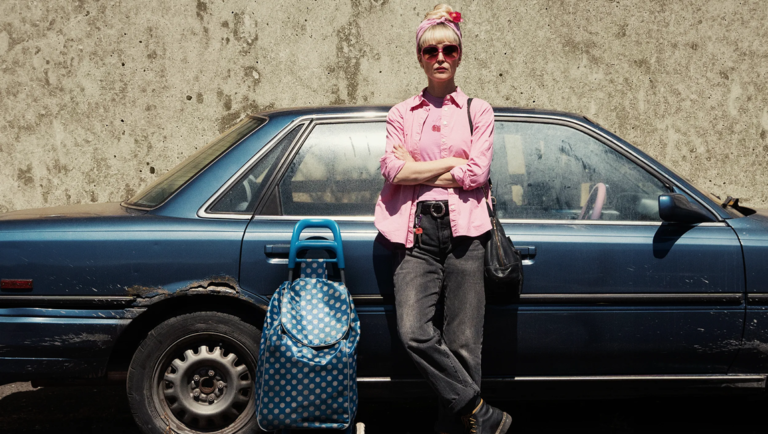
Stop me when you’ve heard this one before: Rose Byrne plays a frazzled, confrontational mom who feels that she’s constantly coming up short in supporting her daughter. She is besieged by a series of small indignities that are downstream of her self-defeating choices, as well as an uncaring universe that has seemingly placed her in its crosshairs. And what if I also told you the actress was appearing in a scrappy, American indie where her character gets into a screaming match with a glorified bureaucrat over where she can park? In an amusing coincidence, both If I Had Legs I’d Kick You and Tow premiered at U.S. film festivals in 2025 (the former at Sundance where it fired the starting pistol on Byrne’s year-long Oscar campaign, the latter at Tribeca to considerably less attention) and they draw upon similar muscles from their star in pushing the limits of how much an audience will sympathize with an abrasive personality. Alas, the ways in which the two films deviate is instructive about the pitfalls of portraits of flawed characters that employ a heightened, occasionally manic tone to dramatize Kafkaesque circumstances. When it works, as it does in Legs, subjective filmmaking places us in the jittery headspace of someone fighting a losing battle with their sanity, transforming quotidian inconveniences into a bleary-eyed hellscape of disquieting, shameful impulses. On the other hand, Tow is attempting to tie a pretty bow around systemic inequities and late-stage capitalism, reducing sweeping societal problems to decent people who try hard and meanies standing in their way. It’s one hard-headed woman who refuses to take “no” for an answer bringing down “the man.” Tow is like if the Dardenne brothers attempted to make a sitcom.
Inspired by a true story, Tow stars Byrne as Amanda Ogle, one of the “one to three million vehicular residents” living in the United States at any given time (in plain terms, she’s unhoused and sleeping in her car at night). With her hair wrapped up in a bleached beehive held in place by a bandana and introduced in unflattering close-up that lays bare every hard-earned wrinkle and blemish on the actress’ face (arguably the final similarity to IILIKY), the brassy Amanda trudges from one job interview to another, stopping in her local coffee shop to wash out her one good collared shirt in the bathroom and charge her cell phone, in the desperate hopes that someone will take a chance on her. We learn that Byrne’s character developed a substance abuse problem some years earlier after being in a car accident, and everything subsequently went to shit: in short order, she was fired from her job as a veterinary tech, lost her daughter Avery (Elsie Fisher) — whose dad moved them from Washington state to Utah — and eventually found herself living on the streets and attempting suicide. In that context, living out of her cramped, ‘91 Toyota Camry and being awakened from a dead sleep at night by glorified meter maids enforcing “vehicular loitering” laws constitutes Amanda’s life being, if not on the upswing, then at least manageable in its awfulness.
But when someone’s already teetering, it doesn’t take much to kick the stool out from underneath them and knock them flat on their ass. After sweet-talking her way into a job at a bougie pet boutique, Amanda’s elation is short-lived when she discovers her car has been stolen. Things perversely become worse when the car is quickly found but becomes impounded by a tow truck company contracted with the city. What would be a day-ruining nuisance for most people becomes existential for Amanda as she lacks the funds to pay the nominal fee ($273) to get her vehicle-cum-domicile out of lockup; adding insult to injury, the tow company charges a daily storage surcharge, so the meter is perpetually running. Broke, friendless, and fighting a daily battle to maintain her sobriety, Amanda is bounced from one overcrowded shelter to the next — in a dispiriting detail, we learn that even public spaces aren’t free and that Seattle’s longtime unhoused have installed themselves as de facto landlords, bartering “desirable” park benches for cash, goods, or sexual favors — before securing an open bed at a facility run by Barb (Octavia Spencer), a recovering addict herself who rehabilitates others through tough love. As Amanda tries to adjust to life at the shelter, forming tentative bonds with fellow residents Denise (Ariana DeBose) and Nova (Demi Lovato), she never waivers from the belief that she’s been wronged. And with the assistance of Kevin, a young consumer protection lawyer doing pro bono work (Dominic Sessa), Amanda undertakes a year-long legal battle just to get her car back.
Tow was directed by Stephanie Laing, a veteran of Apple TV shows such as Your Friends & Neighbors, Palm Royale, and Physical (where she previously worked with Byrne), and at the risk of being reductive, the film feels like streaming television. There’s a glib, oddly sanitized quality to the squalor where even predatory figures have a clever quip at the ready. The film shoves provocative-sounding but ultimately facile talking points in the mouths of its characters; for example, having DeBose’s character say “you’re homeless and that’s about as bad as being black or brown in this country” is the sort of thing that probably requires a follow-up question or clarification, but none is forthcoming (and this is in fact the first and only mention of race in the film). Tow traffics in pure schmaltz, such as a scene where Lovato’s character performs “Have Yourself a Merry Little Christmas” (why else would you cast a musician for the role?), and drops a whimsical, plinky score–co-credited to rock star Este Haim — over every scene. Perhaps anticipating its own future being viewed primarily at home while people play on their phones, the film regularly underlines itself, repeating its points and running its motifs into the ground. In a particularly egregious example of this, Tow tracks the passage of time by flashing the number of days that have passed on screen, in addition to presenting consecutive interstitials denoting what month it is (we get both a sad-looking Christmas tree dressed up for assorted non-Yuletide holidays, as well as cute dogs dressed up in costumes for assorted seasonal photo shoots).
Laing’s film attempts to cut through the treacle by amplifying Amanda’s lack of social graces and her “cut the crap” rhetoric (and occasionally both at the same time, as when she addresses defense counsel in court as a “fucking asshole”). Yet one senses the film bending over backwards to indulge a character who is, in many respects, the architect of her own misfortune. She is pugnacious and confrontational, proud to a fault and quick to blame others while denying responsibility for her own actions. But the framing is always the same: someone else has wronged Amanda or failed to live up to their obligations, and the only recourse is for her to browbeat them into showing either pity or deference toward her. Amanda may be a hard-luck case, but watching the character read others the riot act, it’s difficult to not interpret her behavior as unearned entitlement — something the film is entirely uninterested in interrogating.
It spoils little to note that Tow concludes with a sequence featuring the real Amanda Ogles (alongside the real Avery and Kevin) appearing as brash and larger-than-life as the way Byrnes portrayed her. Films often do this sort of thing as a way of highlighting how close its actors came in capturing the unique spirit or distinctive look of the people they’re embodying, but it can often be employed as a means of insulating a performance from criticism that it’s too garish or simplistic, or that the events of a film are too contrived to be believed. Regardless of how closely Tow purports to adhere to the official story, it registers as straight hokum. Byrne plays Amanda as a perpetual screw-up, but the film stacks the deck so heavily against the character that it risks transforming the character from an underdog into a martyr. It also functions as a low-stakes David vs. Goliath, with the latter embodied by Corbin Bernsen as a callous, high-priced attorney for the towing company. His character serves as a stand-in for all that is unfair with the world, blithely ignoring a court order requiring that Amanda’s car be returned to her gratis (we literally see his character skipping court dates so he can hit the driving range), deflecting culpability, and dragging out legal proceedings for months in the hopes of breaking Amanda’s spirit. The film never offers up an actual perspective as to why the tow company would incur what’s assumed to be hundreds of thousands of dollars in legal fees (to say nothing of the time and energy spent defending itself in court) when it could easily rid itself of the headache by just “doing the right thing” and returning the vehicle. In the absence of anything else, we’re left to infer it’s some combination of arrogance and pettiness: that an evil business is getting off on extracting blood from a stone.
Tow is under no obligation to present a scummy company in a sympathetic light, but this approach is telling of its regrettable tendency to flatten its drama out into a binary of “good” and “bad.” In truth, Amanda is a symptom of a larger societal problem: one where an unanticipated expense of a few hundred dollars could leave a person destitute and a college degree is considered such a necessity that failing to have one stands in the way of securing employment “sticking a thermometer up a dog’s ass.” Where social services have become so starved for resources that people have to beg for a spot at a homeless shelter and getting to resume a routine of sleeping in the backseat of your car represents a restoration of dignity. Tow employs tunnel vision to focus on one specific, very relatable miscarriage of justice with hissable villains because it lets the film of the hook from having to grapple with how on earth we even ended up in this awful place. It’s an Erin Brockovich-esque legal crusade about one irascible, uncouth woman striking a blow against the system while completely missing the forest for the trees. It’d be like making a film about a catastrophic plane crash and spending two hours focusing on how much the airline charged for an audio headset.
DIRECTOR: Stephanie Laing; CAST: Rose Byrne, Dominic Sessa, Demi Lovato, Ariana DeBose, Simon Rex ; DISTRIBUTOR: Roadside Attractions; IN THEATERS: March 20; RUNTIME: 1 hr. 45 min.
Comments are closed.