
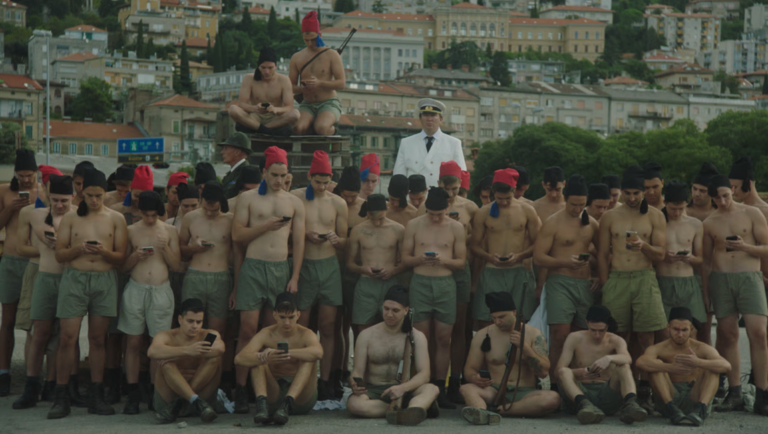
The most frustrating thing about Igor Bezinović’s Fiume o Morte! is how quickly the novelty of re-creation wears off. The sight of three soldiers staring into the camera and jostling with each other for dominance within the frame is followed, seconds later, by its archival mirror: three other soldiers, filmed just over 100 years prior, similarly vying for the camera’s attention. Likewise, a bald, middle-aged man dressed as Gabriele D’annunzio, the one-time fascist dictator of the titular city-state, Fiume, poised assuredly at the apex of two lines of soldiers that flank him on either side is, in fact, a precise recreation of a photograph taken during the real dictator’s reign.
Each instance of fealty to the past produces, at best, mild amusement. Set often to upbeat classical music (Vivaldi dominates), the mimicry feels insubstantial. Unfortunately, it represents Bezinović’s dominant mode of engagement with the past — and each mannered tableau or lively re-enactment produces less of an impact than the one that came before it. One is overwhelmed by a desire to be shocked, jostled, like those soldiers living in the aftermath of World War One, a new international order forming at their feet, out of the pleasant complacency Fiume o Morte! peddles in.
Bezinović’s film takes as its subject a small stretch of history beginning just before the first World War, when the famous poet Gabriele D’annunzio first set foot in the city of Fiume as a guest of a local theatrical company that was staging one of his plays, and ending in the wee hours of 1921, after a five-day battle against Italian troops attempting to wrest control of the city-state out of his hands. In a matter of 16 months, as Fiume’s fascist dictator, oppressor of free speech, this self-aggrandizer etched his name into history.
What do these 16 crucial months of the occupation tell us about the world we live in today? Perhaps that fascist takeovers, such as the one Bezinović and his local collaborators recreate — replete with period-accurate costumes, props, and a few choice anachronisms — will eventually fade into the shadows of history as dark but hopefully inconsequential footnotes. The impression Fiume o Morte! leaves is that D’annunzio’s occupation was mostly the failed experiment of an eccentric egomaniac. His legacy is surprisingly ambivalent, depending on who you ask. To Italians, he’s a romantic and poet, to Croatians, a fascist oppressor; he’s cast in bronze in the former, but forgotten, even ignored, in the latter, where whatever impact he and his dictatorship has had seems to be limited to the loss of a regional dialect (Fiumerian Italian), an obscure bas-relief, the faded panels of a long-since forgotten mural, and some underground graffiti.
Whether D’annunzio’s reputation in Fiume’s current iteration, Rijeka, now part of Croatia, is down to deliberate or accidental cultural amnesia is up for debate. Bezinović digs for scraps of his legacy during man-on-the-street interviews early in the film, where his future collaborators are merely anonymous passersby, shopping for produce in the market or on a walk with a loved one. His findings are a mixed bag. A few have heard of D’annunzio, many have not. One man who works in the local museum knows who he is, but was slightly off on the dates of the occupation. He will be one of the several citizens of Rijeka tasked with embodying the late dictator (along with dozens of other figures both prominent and nameless); in the scrappy troupe’s imagination, he is more a jovial uncle with controlling tendencies than a dealer of death and destroyer of democracy.
That ambivalence is the most instructive part of Bezinović’s vision. Today fascism spreads around the world like a mucky infection, but, as ever, its origins lie in a kiss rather than a phlegmy cough. Comparisons to Trump are especially inevitable, given D’annunzio’s penchant for self-aggrandizement and systematic crushing of dissent (both have shown a fondness for punishing newspapers for expressing even potential opposition). As the world too painfully knows, the jovial uncle can, and does, also deal death. D’annunzio’s long-time admirer Benito Mussolini allegedly said, after removing him from his post in Fiume in 1921: if you have a rotten tooth, you either pull it out or cover it in gold. One hopes the vacuum left behind in the mouth can be protected from something even worse taking root. For all its bubbly, communal spirit and occasional pathos, Fiume o Morte! is unlikely to play a part.
DIRECTOR: Igor Bezinović; CAST: Gabriele D’Annunzio, Izet Medošević, Ćenan Beljulji, Albano Vučetić; DISTRIBUTOR: Icarus Films; IN THEATERS: April 10; RUNTIME: 1 hr. 52 min.
Comments are closed.