
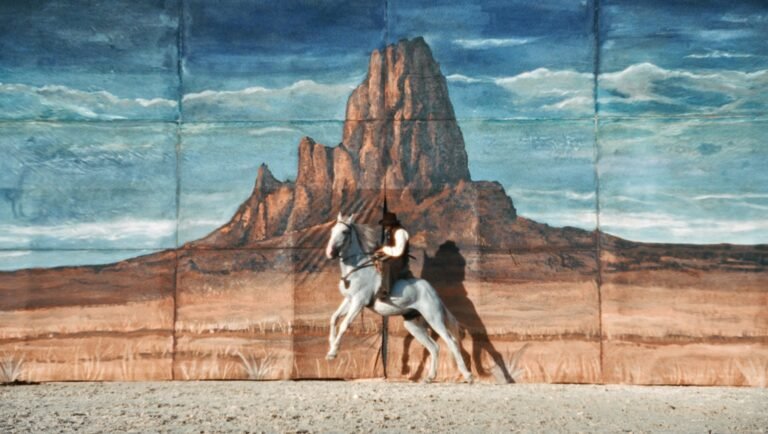
Few people are immune to the power of a tale thrillingly told. So says Buffalo Bill Cody, narrator of Alessio Rigo de Righi and Matteo Zoppi’s latest film, Heads or Tails? What we’re about to see should be “quite the story”; at stake is no less than the endurance of the myth of the American West — at least in the imaginations of a few turn-of-the-century Italians. Our heroes are Rosa (Nadia Tereszkiewicz), a Frenchwoman woman trapped in an abusive but financially secure marriage to an Italian railroad tycoon, Ercole Rupe (Mirko Artuso); and Santino (Alessandro Borghi), a stoic buttero — Italian cowboy — caught in the wake of a murder after he refuses to throw a friendly horsemanship contest between him and the visiting Buffalo Bill Cody’s (John C. Reilly) cowboys, there to spread the gospel of American freedom and progress to the Italian gentry. Their sudden partnership and budding romance are the background to a lightly surrealist dressing down of myth and imagination.
Rosa’s husband bets against his own horsemen, Santino in particular — who wins (or loses, depending on how you want to read it) a coin toss to represent the tycoon’s butteri in the contest — because he has a vested interest in maintaining the hold American Manifest Destiny has on his recently unified country. The film’s first major surprise, then, comes when Rosa, not Santino, murders her furious, now poorer, husband, finally fed up with enduring his stream of misogynistic, classist invectives. Santino and Rosa abscond into the Italian countryside, never to be more than a day or so ahead of a money-hungry search party and, by order of the railroad tycoon’s vengeful father (Gianni Garko, a veteran of Spaghetti Westerns), Buffalo Bill himself.
Zoppi and di Righi seem to have cast their film, literally, by eye. Tereszkiewicz and Borghi bear two pairs of the most luminous blue and blindingly white eyes you’ll find in a film this year, and their performances make ample use of their power. Rosa, doe-eyed like a child, is besotten not only with Santino the man, but by the romance of the mythical cowboy he represents. Every gaze she throws his way is the innocent plea of a fan not to abandon her. Santino’s baby blues, on the other hand, bear a Newman-esque clarity, beckoning Rosa toward him almost against his will, stoic and outwardly unmoved as he is in the first few days of their escape.
That Santino evokes Paul Newman is no coincidence. He would be just as wary of the ’70s screen icon’s interpretation of Buffalo Bill as much as he is of John C. Reilly’s, all bloviating showmanship and self-aggrandizement, a huckster of nationalist propaganda. The myth of the American West holds no sway for him. A cowboy like him is unbeholden to pomp and circumstance, or the weight of dime store novel legend, unless desperate men hoping to make use of his symbolically loaded profession make him so.
Zoppi and di Righi are less interested in the granular political dimensions of their story — intertwined with the expansion of Italian railroads are the sometimes equally dubious revolutionaries bent on stopping them (the rail workers’ leader is an Argentinian radical with a taste for publicity) — than they are in telling a good story and deconstructing the genre’s means of doing so. The leftist sympathies of a Once Upon a Time in the West are not as potent here, nor is there the queasily patriotic bent that defines John Ford’s Fort Apache and The Man Who Shot Liberty Valance. Where those Ford classics and Heads or Tails? do intersect, however, is in a preoccupation with myth as nationalist forces. Ford maintained a white-knuckled grip on them throughout his career so that an artificially wrinkled Jimmy Stewart could trundle back to Washington on the newly constructed railroad, phony reputation intact. Rosa’s journey, occasionally made trivial thanks to a rote, girl power arc, is nevertheless bent on wrenching those calcified joints free from both personal and national destiny.
In this winking, elbow-to-the-ribs mode, Reilly’s narration as Buffalo Bill also takes on an ironic twang, setting up Rosa and Santino’s romantic journey of narrow escapes, imprisonments, and dances with death as a faux-mythical yarn. Chapters like “Kidnapped,” “To The Rescue,” and “So Long and Farewell” — written down in a little red book not by Buffalo Bill, but his sidekick Johnny — are misleading checkpoints in a trumped-up story that serves as much needed color in Buffalo Bill’s fading reputation than as a true document of events. The wanted posters that dot the forest also misconstrue what the viewer has seen with their own eyes, marking Santino, rather than Rosa, as the murderer. Around every turn, the assumptions placed upon Rosa — as subservient, passive, fanciful — are fuel for her growing disillusionment with the myth of the American West.
The final nail in the coffin, so to speak, is hammered during a drunken night of revelry with a group of revolutionaries who break Santino out of jail. Having seen the wanted posters, they proclaim Santino as the hero of their burgeoning labor movement, a label against which the stoic, apolitical cowboy chafes goodnaturedly. Only when he’s drunk himself into a self-aggrandizing stupor does he invent a story about his daring murder of the evil boss to fit amongst the rest of the militants’ songs of mythical import. Rosa, once Santino’s greatest admirer, has a front row seat to his shallow performance and shuns him in disgust.
It’s worth preserving the film’s turning point under a veil of mystery — though it’s hardly concealed in the film — because it helps to signal a break not just in Rosa’s worldview, but in the largely realist mode of Zoppi and di Righi’s filmmaking. Without the security of Santino’s presence, Rosa, more than ever, has to keep her head on straight and evade Buffalo Bill’s capture. Their inevitable meeting, a fable-like encounter of philosophical and existential proportions, is the axis upon which Zoppi and di Righi’s revisionist aims turn. “I must bid farewell to my imagination,” Rosa laments — literally and figuratively. They suggest we do the same.
DIRECTOR: Alessio Rigo de Righi & Matteo Zoppi; CAST: Nadia Tereszkiewicz, Alessandro Borghi, John C. Reilly, Peter Lanzani; DISTRIBUTOR: Samuel Goldwyn Films; IN THEATERS/STREAMING: April 10; RUNTIME: 1 hr. 56 min.
Comments are closed.