
Much digital ink has been spilled over whether now, more than ever, we need positive queer images in popular media. As the world skids further and further into the dank crevices of reactionary culture, quaint affirmations like Heated Rivalry and Heartstoppers seem increasingly like liberal fantasies meant to keep society in sludgy, lethargic equilibrium, instead of true representations of our shared experience. It’s refreshing, then, when a film like Adrian Chiarella’s debut feature, Leviticus, arrives to throw us off-balance.
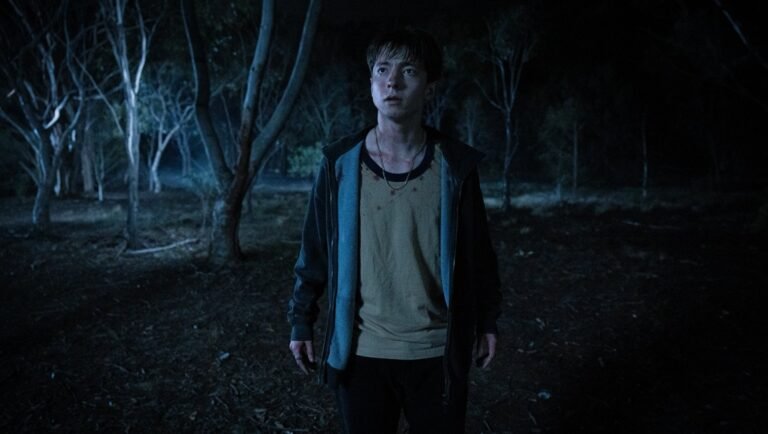
Teenagers Naim (Joe Bird) and Ryan (Stacy Clausen) find love in the outskirts of their quiet, suburban Australia neighborhood. Where Naim, a recent transplant with his single mother (Mia Wasikowska), is gentle and almost wilting, Ryan is brash and brimming with rage. His targets are either meaningless or cruel, hurling objects onto the floor of their secret hangout spot in an abandoned warehouse, or taunting a snake in the field outside. In typical queer drama fashion, Ryan has bro-ish bravado; he’s the kind of bully-adjacent boy who doesn’t speak to Naim unless outside of school, not unlike Connor Swindells’ character in that other reassuring television fantasy, Sex Education. Together, in the relative peace of their hideaway, Naim and Ryan achieve a tenuous balance between them, sweetly and tenderly coalescing their feelings into the kind of romantic whoosh emblematic of the coming-of-age genre.
Chiarella, however, is interested in the isolating forces within Naim and Ryan’s Christian fundamentalist community, specifically conversion therapy. Amidst this present-day Mount Sinai, anyone experiencing or exhibiting same-sex attraction is subjected to a barbaric, ritualistic exorcism by an aging priest that renders the person they love the most into a violent, bloodthirsty hallucination that only they can see. It’s the most pernicious kind of punishment to make someone distrust their own feelings, much less their own eyes; and all the more devastating for the viewer given the ease of Bird and Clausen’s chemistry as Naim and Ryan, a bright spot in Chiarella’s thoughtfully rendered world of dogma and dashed desire.
Delicately articulated, however, is the fact that victims of this ritual are not being followed by a demonic incarnation of their guilt, but by a vengeful Old Testament God; a pointedly external force meant to mimic their internal sin. This distinction places the ensuing horror, in which paranoia replaces faith, and anger amplifies shame, in a surprisingly logical register. To remain safe, one must avoid at all costs the person one loves the most; that, or brave the reality that you’re one impossible-to-predict turn away from a violent death. Your path to choose.
Leviticus is low on traditional jump scares, and instead traffics in the kind of clawing dread borne out of conscious uncertainty. There’s a sequence, for example, brief but agonizing, when Naim and Ryan have to choose between avoiding eye contact in the halls at school or slipping into the bathroom for a quick fuck — the reality lurches somewhere violently between these choices. The film’s treacherous climax occurs when Ryan shows up unannounced at Naim’s house while he’s alone, deep in his confusion about whether to trust anything he sees. They play a game of identity cat-and-mouse, during which Ryan’s malevolent, taunting double taps shocking wells of trickery and deceit, as deep as the ones emptied against him.
Chiarella is thoughtful enough not to deprive a story so steeped in religious fundamentalism of its capacity to provoke and titillate. A ballsy public hook-up session during a long-haul bus journey sees a kiss on the neck quiver on the edge of a vampiric thrashing of the jugular; later, that late-night climax features sexually charged imagery that… let’s just say, even in a film of gay themes, you’re probably not prepared to see what Chiarella makes a fist do. Clandestine and violent sexuality are part and parcel of Naim and Ryan’s lives — one begets the other; the images of, and physicality behind, them are valuable contributions to a film that could so easily shy away from what makes taboos of all dimensions so thrilling and vital. The unstoppable urge to do what one knows one shouldn’t finds every imaginable outlet in Leviticus.
The nod toward conscious uncertainty, one could call it ambiguity, is well-placed at the film’s close. Mercifully, you won’t find a whimpering “kill your gays,” nor does everyone hold hands and skip into the sunset. “We need fear. It’s how we survive,” says Naim’s mother the morning after his and Ryan’s violent confrontation. When faced with the choice to leave everything behind, knowing nothing is certain, even the person sitting next to you is, perhaps, an unexpected comfort.
Published as part of New Directors/New Films 2026 — Dispatch 1.
Comments are closed.