
Why are filmmakers today so afraid of melodrama? Many’s a recent feature, from the acclaimed (Celine Song’s Past Lives) to the less so (Luca Guadagnino’s After the Hunt), that has taken an emotionally charged premise focused on interpersonal relationships and rendered it in hushed tones, with understated performances and plainly picturesque imagery. Yuiga Danzuka’s debut, Brand New Landscape, is another such feature: gentle, placid, and a little too staid, it’s a stylish exploration of the scars worn by members of a broken family, but it’s far from a substantial one.
Whether this is lamentable, due to Danzuka’s obvious talent, or forgivable in light of said talent, isn’t a debate the movie quite reconciles — there’s no shortage of smart, interesting choices made in Danzuka’s handling of his own material here, yet it remains a fundamentally poor handling at heart. The prologue is enough to convince the viewer that he knows what he’s doing, despite his inexperience as a filmmaker — astute blocking, enveloping environmental sound design, and a beautiful pan/tilt shot are all lovely touches, followed by a time jump that’s abruptness adds a most compelling mystery. A family of four visits a rural vacation home, only for the father to gingerly announce to the mother that work has called him back to Tokyo. Distraught but sullen at his apparently chronic prioritization of work over family, she asks that he spend one more afternoon with his children, as she retreats to lie on the couch. The others depart, and the movie skips a decade ahead.
Now, the two children, older sister Emi (Mai Kiryû) and younger brother Ren (Kodai Kurosaki), are living separately in Tokyo. We learn eventually, in the slow, patient style of the movie, that their mother Yumiko (Haruka Igawa) died some years ago, after which their father Hajimi (Kenichi Endo) left for Singapore, though he has since returned. Emi is unwilling to meet with the man she feels destroyed their family; Ren is less reluctant, though a chance encounter with the man provokes in him a mixed reaction: a combination of shock, resentment, and curiosity. Hesitant, though also determined to restore some part of what bond they once had, he makes an attempt, though all three harbour deep wounds that years of isolation from one another have barely healed.
Danzuka never betrays these characters, limiting their emotional development in a manner that feels authentic, if somewhat dramatically mundane. The melodrama that exists within the narrative, albeit steadfastly avoided, isn’t forced upon them, but rather arises from within them and their circumstances. But those limitations immobilize Brand New Landscape. There’s a quasi-Bergman-esque quality to scenes in which one feels as though there are infinite possibilities to what any given person may say next, but Danzuka fails to explore the breadth of those possibilities, instead choosing relatively safe options. There’s an excess of control; the solemn, detached silence of these people has metastasized their grief over the years, and it does something similar to the movie’s dramatic progression.
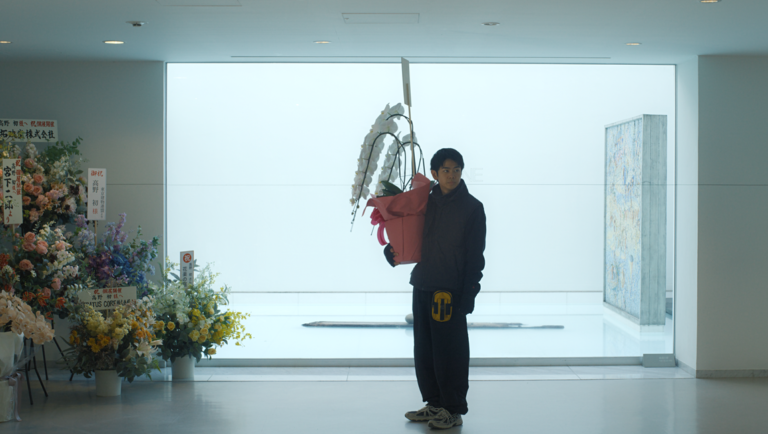
Where Danzuka tries to compensate for this, he really only ends up preventing it further, but at least he makes some interesting creative decisions in the process. Hajimi is a highly successful architect, and Brand New Landscape is an appropriately canny study of physical spaces — how people influence them and how they influence people. Kôichi Furuya’s cinematography situates its human figures in various environments with a supple, unfussy grace. In a quiet way, it’s a visually arresting work; Danzuka’s stabs at social commentary through this study of environments, however, are thin and feel incidental. An intermittent though repeated tendency to veer away from the central trio to linger on secondary characters, or even minor details like Internet videos, shows an intent to build a sense of a wider world around them, though the style is once again too manicured, too set on instructing rather than implying meaning for the movie to come off any less hermetic for it.
And all the while a melodrama simmers beneath, only finding release in rare emotional outbursts, themselves still captured with a slightly haughty remove. A physical fight occurs out of view, one character’s breakdown is met with another’s smirk, and even the exact cause of Yumiko’s death is never openly stated, just heavily implied. Danzuka only toys with the intense emotions that fuel his narrative, acknowledging them no further than he must to maintain the stoic stillness of his overall scheme. The early time jump that then seemed intriguing finally seems avoidant — like much else in Brand New Landscape, it’s a cute choice stylistically, but little more.
Published as part of New Directors/New Films 2026 — Dispatch 1.
Comments are closed.