
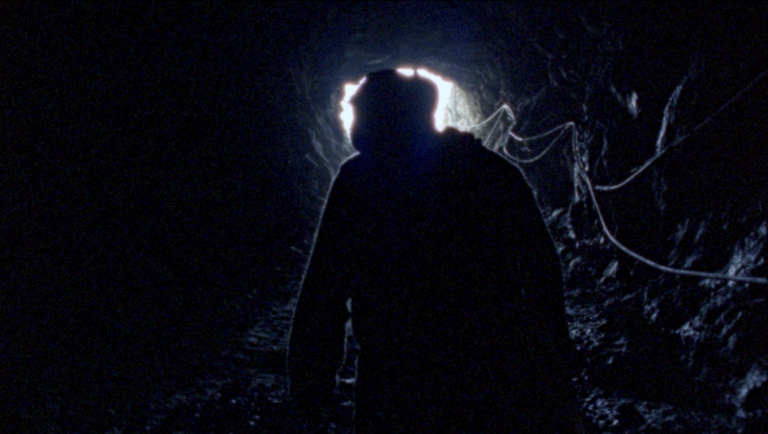
Clemente Castor’s Cold Metal is a difficult film to wrap one’s head around. It’s a small-scale, profoundly opaque object that rejects traditional narrative in favor of elliptical movements and poetic allusions. But even as its pseudo-narrative undulates across multiple individuals and various discrete vignettes, it very much takes place in our corporeal world. It’s a concrete, materialist object as much as it is a poeticized meditation, leading to a fascinating, productive tension between form and content. Alternating between 16mm color photography by Miguel Escudero and black-and-white 8mm footage shot by the director and Emilianna Vazquez, the low-gauge cinematography lends everything a lo-fi, almost industrial flavor. Everything becomes a sort of interstitial scene, as if we are only witnessing the connective tissue between other, more lucid segments that we somehow aren’t privy to. If this sounds frustrating, it’s not, not really. Rather, it results in a lovely, mysterious object that compels one’s attention even as we might struggle to make sense of it. Call it dream logic.
Cold Metal begins with a brief prologue, a young man and woman gambling at a street vendor’s makeshift roulette table. It’s the first of many games we will witness, a kind of structuring conceit that suggests a playfulness on the part of the filmmakers but also a cryptic formulation — this is a film of secret codes and obscurant gestures. As far as the story goes, we mostly follow Mario (Mario Banderas) and his brother Óscar (Oscar Hernández). A remarkable optical effect shows Mario laying down in bed; while his body is still prone, he “wakes” up and fully emerges standing from his own body. It’s a literal out-of-body experience, and while the film never really suggests any sort of supernatural phenomenon, the proceedings do take on the qualities of a spectral journey. Mario visits various people, occasionally referring to himself as a “her” and stating that he has access to memories that aren’t his own. An encounter with a man named Lázaro, who seems to know Mario, leads to an extended sequence of a rock-paper-scissors type game, a series of strange hand movements that appear to have some sort of spiritual significance. Throughout this, Castro occasionally cuts away to a series of dark rock formations and caves, as if Mario is traversing a parallel nocturnal journey into a subterranean space. We then eventually return to Óscar and learn that he has run away from a rehab center, and spend some time with other patients as they recount their experiences with addiction in a group therapy session.
This brief description makes the film seem more linear than it actually is; for every bit of coherent narrative dramaturgy on display, there are long documentary interludes of street scenes, a music festival, and young people lounging in sparsely appointed interiors seemingly awash in their own ennui. The jittery, sometimes jarring editing rhythms create a constant present tense — there’s no sense of time, just everything happening simultaneously. Rivette is an obvious touchstone for this sort of thing, but while a film like Le Pont du Nord plays like an adventure film, Cold Metal is a study in melancholy. Everyone is displaced, no one has a home, and cultural memory has become a confusing albatross anchoring these characters to a life of searching and yearning. In many ways, Cold Metal makes a compelling companion piece to Rhayne Vermette’s recent Levers, another film composed of loose narrative touchstones and occasionally inscrutable symbols. As critic Alex Fields has written about Vermette’s film, “we’re invited to make meaning of what little we can see in this… world, but not to consider meaning as something settled or determined.” Castor invites audiences to enter into his artistic practice and move around in it, unencumbered by preconceived notions of what we should expect from a movie. It’s freeing, even if the characters in Castro’s film are trapped. Cold Metal is a wonderful achievement.
Published as part of New Directors/New Films 2026 — Dispatch 1.
Comments are closed.