
In This Dispatch
Leviticus
Much digital ink has been spilled over whether now, more than ever, we need positive queer images in popular media. As the world skids further and further into the dank crevices of reactionary culture, quaint affirmations like Heated Rivalry and Heartstoppers seem increasingly like liberal fantasies meant to keep society in sludgy, lethargic equilibrium, instead of true representations of our shared experience. It’s refreshing, then, when a film like Adrian Chiarella’s debut feature, Leviticus, arrives to throw us off-balance.
Teenagers Naim (Joe Bird) and Ryan (Stacy Clausen) find love in the outskirts of their quiet, suburban Australia neighborhood. Where Naim, a recent transplant with his single mother (Mia Wasikowska), is gentle and almost wilting, Ryan is brash and brimming with rage. His targets are either meaningless or cruel, hurling objects onto the floor of their secret hangout spot in an abandoned warehouse, or taunting a snake in the field outside. In typical queer drama fashion, Ryan has bro-ish bravado; he’s the kind of bully-adjacent boy who doesn’t speak to Naim unless outside of school, not unlike Connor Swindells’ character in that other reassuring television fantasy, Sex Education. Together, in the relative peace of their hideaway, Naim and Ryan achieve a tenuous balance between them, sweetly and tenderly coalescing their feelings into the kind of romantic whoosh emblematic of the coming-of-age genre.
Chiarella, however, is interested in the isolating forces within Naim and Ryan’s Christian fundamentalist community, specifically conversion therapy. Amidst this present-day Mount Sinai, anyone experiencing or exhibiting same-sex attraction is subjected to a barbaric, ritualistic exorcism by an aging priest that renders the person they love the most into a violent, bloodthirsty hallucination that only they can see. It’s the most pernicious kind of punishment to make someone distrust their own feelings, much less their own eyes; and all the more devastating for the viewer given the ease of Bird and Clausen’s chemistry as Naim and Ryan, a bright spot in Chiarella’s thoughtfully rendered world of dogma and dashed desire.
Delicately articulated, however, is the fact that victims of this ritual are not being followed by a demonic incarnation of their guilt, but by a vengeful Old Testament God; a pointedly external force meant to mimic their internal sin. This distinction places the ensuing horror, in which paranoia replaces faith, and anger amplifies shame, in a surprisingly logical register. To remain safe, one must avoid at all costs the person one loves the most; that, or brave the reality that you’re one impossible-to-predict turn away from a violent death. Your path to choose.
Leviticus is low on traditional jump scares, and instead traffics in the kind of clawing dread borne out of conscious uncertainty. There’s a sequence, for example, brief but agonizing, when Naim and Ryan have to choose between avoiding eye contact in the halls at school or slipping into the bathroom for a quick fuck — the reality lurches somewhere violently between these choices. The film’s treacherous climax occurs when Ryan shows up unannounced at Naim’s house while he’s alone, deep in his confusion about whether to trust anything he sees. They play a game of identity cat-and-mouse, during which Ryan’s malevolent, taunting double taps shocking wells of trickery and deceit, as deep as the ones emptied against him.
Chiarella is thoughtful enough not to deprive a story so steeped in religious fundamentalism of its capacity to provoke and titillate. A ballsy public hook-up session during a long-haul bus journey sees a kiss on the neck quiver on the edge of a vampiric thrashing of the jugular; later, that late-night climax features sexually charged imagery that… let’s just say, even in a film of gay themes, you’re probably not prepared to see what Chiarella makes a fist do. Clandestine and violent sexuality are part and parcel of Naim and Ryan’s lives — one begets the other; the images of, and physicality behind, them are valuable contributions to a film that could so easily shy away from what makes taboos of all dimensions so thrilling and vital. The unstoppable urge to do what one knows one shouldn’t finds every imaginable outlet in Leviticus.
The nod toward conscious uncertainty, one could call it ambiguity, is well-placed at the film’s close. Mercifully, you won’t find a whimpering “kill your gays,” nor does everyone hold hands and skip into the sunset. “We need fear. It’s how we survive,” says Naim’s mother the morning after his and Ryan’s violent confrontation. When faced with the choice to leave everything behind, knowing nothing is certain, even the person sitting next to you is, perhaps, an unexpected comfort. — CHRIS CASSINGHAM
Kika
Social realism is alive and well and living in Belgium — but you knew that already, given that it’s the Dardennes’ home court. It may surprise you to find, however, that they aren’t the only ones playing the game anymore. Indeed, out from under the bleachers has emerged Alexe Poukine with Kika — her first narrative feature following a string of documentaries — and it s`ignals the arrival of a confident, if somewhat confused, social realist voice.
The film’s opening is quietly electric and clearly cut from the Dardennes mold: eponymous Kika is a social worker getting by in contemporary Brussels, when one day she strikes up an affair with bike mechanic David. Long takes and handheld frames place us right in the muck with our hero, and the meet-cute between Kika and David — a blessing-in-disguise lock-in after she accidentally breaks the front door of David’s shop — builds with a natural sense of small grievances giving way to real connection. Things get steamy more quickly than she expects, and she becomes pregnant during one of their lunch-hour trysts, only to have her entire world turned upside down by David’s sudden death.
All this happens in about 15 minutes of screentime, but the extreme reversals of fortune work thanks to of Manon Clavel’s subtle performance as Kika, whose gigantic childlike eyes take in the whole universe while a hardened exterior belies her essential vulnerability, as well as Poukine’s attention to the humanity on the margins of the story. For much of its runtime, Kika feels like it could spiral out in any direction, but while Poukine will often steal a glance at another person — like holding on an old man leaving the red-light hotel Kika and David had their affair in — she always returns her gaze back to Kika’s environment and travails. Poukine has great instincts for character and place.
But she does not have great instincts for narrative time — at least not yet. The liberties she takes by employing ellipses to add fuel to the story’s forward progression can lead to striking juxtapositions, like when Kika talks about getting a second job and then in the span of a single cut works the fish market at a grocery store, but largely they lead to enormous confusion about the macro problems Kika is dealing with. It’s unclear from the outset, for example, how long she had been with David before he died, or how much time passes between his death and the major upheavals in her life that arise as a result. We’re often left to wonder whether Kika’s journey is happening over the course of days, weeks, or months. Moment-to-moment, though, Poukine establishes believable verisimilitude as Kika succumbs to financial pressures resulting from her loss.
Taking a cue from that other giant of Belgian filmmaking, Chantal Akerman, Poukine pushes Kika toward sex work to make ends meet. Inspired by a client she meets at the beginning of the movie who sells her dirty underwear to pay the rent, Kika slowly — Or quickly? Who’s to say? — submerges herself in the world of BDSM. What follows is a prismatic look at dominatrix as vocation, touching on its many indignities, annoyances, and pleasures; the community one can find within it; and the psychological component of the gig — how it affects the mind, and what a person can and can’t handle once she gets the hang of it. In other words, it’s treated as a job like any other. The framework is useful because it can be applied to any work environment, and because it can be applied to any work environment it’s a better critique of the system that would push someone like Kika to the edge than finger-wagging and pedantry would be. Backed into a corner and in over her head, Kika’s in a desperate position necessitated by fiscal circumstance. We can fill in the blanks.
All the particulars are well and good — and then it comes time to pay the past due bill that comes with skirting huge chunks of Kika’s story. Toward the end of the film, and again inspired by a client (whatever happened to work-life balance?), Kika decides to take a beating by a BDSM colleague in an attempt to regain control of her pain. It’s rightfully upsetting, but since Poukine largely left the map of Kika’s emotional arc undrawn, we only understand it’s the climax of the movie because of the scene’s proximity to the closing credits: it’s out of touch with the more delicate timbre of the rest of the film. Inevitable, perhaps, but also conspicuously insincere.
She may pratfall as the movie draws to a close, but Poukine still thankfully dodges the quicksand of misery porn for the most part. Yes, Kika occasionally spills into the self-consciously artful (rooms are often depicted in one bold uniform color) and the narrative rhythm is wonky, yet the debut-movie placenta smell is sufficiently offset by the warmth emanating from its core. Kika has problems, but it nevertheless suggests it was made by a filmmaker worth paying considerable attention to going forward. — ETHAN J. ROSENBERG
Strange River
If, with Call Me By Your Name, Luca Guadagnino set a 21st century standard for leisurely, sun-dappled, queer coming-of-age films, then, nearly a decade later, Jaume Claret Muxart has proposed a new one. His debut feature, Strange River, is another story of a summer holiday, though where Guadagnino’s aesthetic sensibilities were clamped down by respectability, Muxart’s are blown out, oversaturated with glowing greens, vibrating oranges, and blinding blacks, as if the velvety 16mm on which it was filmed was left out in the sun to bake. The sensational colors complement a seemingly naturalistic story of a nuclear family’s summer holiday down the Danube river that, in Muxart’s imagination, quietly enters the realm of fantasy.
The mother, Mónika, a working actress, once made the same trek down the Danube 25 years ago. She was swept up by her first love on that trip, as she explains to her eldest son, Dídac, who is still smarting from a recent rejection by his crush, Gerard. As in Call Me By Your Name, Dídac’s parents are of that quality rarely found in the coming-of-age film: understanding. They know of Dídac’s queer inclinations — his father, Albert, even sweetly inquires about his status with Gerard — though are no less immune to that sting of teenage defensiveness when Dídac reaches his capacity to divulge his feelings.
Dídac’s fickle nature is emblematic of the whole family’s dynamic, which, over the course of their trip, swings wildly between cohesion and disruptive conflict. As often as he tenderly holds hands with his mother, strolling through a sleepy campsite, Dídac wrestles his younger brother, Biel, each of them beholden to inexplicable adolescent rage. Muxart captures this instability with a sensitive eye, alighting on bodies in motion as often as he does on those in repose.
During the family’s periodic rest stops, Dídac encounters a teenage boy who materializes, out of nowhere and in the nude, under the river’s murky water. Faceless at first, he entices and eludes Dídac like a siren, gliding in and out of his view before disappearing into the depths. Later, while resting on the river bank, he’s taken hold by a disembodied hand and pulled into the river, where he comes face to face with the boy for the first time. The occasion doesn’t inspire fear, though, later, when night falls, the empty buildings and unlit recesses of the camp grounds seamlessly transform into a cruising site for vacationing young men. Suddenly, budding sexuality mutates into furtive glances and hushed whispers from the shadows, forming a potent churn of paranoia and carnality in their wake. In teasing the imaginative capacities of a yearning heart, Muxart articulates the dimensions of Didac’s sexuality as not only fluid, but unburdened by logic.
The family makes further stops at the School of Design in Ulm, where Albert expounds on the architecture that fuses rationality with emotion, and his memories as a young student carrying a three-legged stool. Later, in a nearby modernist neighborhood, Mónika meets a fellow actress with whom she connects over a shared role in Hölderlin’s play The Death of Empedocles, and fawns over like a lovestruck teenager. The brief interlude marks a notable departure from Didac’s perspective, affording Mónika a sense of inner life that acts as more than just a counterbalance to her son’s, but almost an intimation. Their multilingual exchange, too, resembles the family’s borderless vacation, marked by the intuitive bends of their literary passions rather than by social propriety. The result is a palpable erotic charge that informs the final act’s ambiguous, fantastical trajectory.
Muxart pulls at the seam between imagination and reality as hard as he can. When the mysterious boy from the river materializes at the university, he calls silently to Dídac, who follows him around the campus like a cat would a mouse. While Albert and Mónika play a duet of the third movement of Clementi’s Sonata in G Major, Opus 36, the boys meet in the empty cafeteria, the distant piano reverberating through the building, gaining speed until it becomes the score to an erotically charged exchange of glances and mirrored choreography. The scene recalls the thrill of the waltz in Minnelli’s Madame Bovary, where the sexual possibilities of being seen in a new way floods the ingénue like music fills a room.
Suggestion is one of Muxart’s most powerful tools, and in the ambiguity of the boy he finds its most moving application. Even as he and Dídac escape the already idyllic setting of the family holiday for something more remote, Muxart never precludes the possibility that the once water-bound siren is still a figment of Dídac’s imagination. Thus, it’s possible the only thing Biel sees when Dídac races with with him through the neighborhood’s back alleys and down to the riverbank — a small boat waiting to whisk them off to who-knows-where like the lovers in Bergman’s My Summer With Monika — is a teenage boy who is entirely too understood, hoping to keep a fantasy just for himself. — CHRIS CASSINGHAM
Also Playing
Brand New Landscape
Why are filmmakers today so afraid of melodrama? Many’s a recent feature, from the acclaimed (Celine Song’s Past Lives) to the less so (Luca Guadagnino’s After the Hunt), that has taken an emotionally charged premise focused on interpersonal relationships and rendered it in hushed tones, with understated performances and plainly picturesque imagery. Yuiga Danzuka’s debut, Brand New Landscape, is another such feature: gentle, placid, and a little too staid, it’s a stylish exploration of the scars worn by members of a broken family, but it’s far from a substantial one.
Whether this is lamentable, due to Danzuka’s obvious talent, or forgivable in light of said talent, isn’t a debate the movie quite reconciles — there’s no shortage of smart, interesting choices made in Danzuka’s handling of his own material here, yet it remains a fundamentally poor handling at heart. The prologue is enough to convince the viewer that he knows what he’s doing, despite his inexperience as a filmmaker — astute blocking, enveloping environmental sound design, and a beautiful pan/tilt shot are all lovely touches, followed by a time jump that’s abruptness adds a most compelling mystery. A family of four visits a rural vacation home, only for the father to gingerly announce to the mother that work has called him back to Tokyo. Distraught but sullen at his apparently chronic prioritization of work over family, she asks that he spend one more afternoon with his children, as she retreats to lie on the couch. The others depart, and the movie skips a decade ahead.
Now, the two children, older sister Emi (Mai Kiryû) and younger brother Ren (Kodai Kurosaki), are living separately in Tokyo. We learn eventually, in the slow, patient style of the movie, that their mother Yumiko (Haruka Igawa) died some years ago, after which their father Hajimi (Kenichi Endo) left for Singapore, though he has since returned. Emi is unwilling to meet with the man she feels destroyed their family; Ren is less reluctant, though a chance encounter with the man provokes in him a mixed reaction: a combination of shock, resentment, and curiosity. Hesitant, though also determined to restore some part of what bond they once had, he makes an attempt, though all three harbour deep wounds that years of isolation from one another have barely healed.
Danzuka never betrays these characters, limiting their emotional development in a manner that feels authentic, if somewhat dramatically mundane. The melodrama that exists within the narrative, albeit steadfastly avoided, isn’t forced upon them, but rather arises from within them and their circumstances. But those limitations immobilize Brand New Landscape. There’s a quasi-Bergman-esque quality to scenes in which one feels as though there are infinite possibilities to what any given person may say next, but Danzuka fails to explore the breadth of those possibilities, instead choosing relatively safe options. There’s an excess of control; the solemn, detached silence of these people has metastasized their grief over the years, and it does something similar to the movie’s dramatic progression.
Where Danzuka tries to compensate for this, he really only ends up preventing it further, but at least he makes some interesting creative decisions in the process. Hajimi is a highly successful architect, and Brand New Landscape is an appropriately canny study of physical spaces — how people influence them and how they influence people. Kôichi Furuya’s cinematography situates its human figures in various environments with a supple, unfussy grace. In a quiet way, it’s a visually arresting work; Danzuka’s stabs at social commentary through this study of environments, however, are thin and feel incidental. An intermittent though repeated tendency to veer away from the central trio to linger on secondary characters, or even minor details like Internet videos, shows an intent to build a sense of a wider world around them, though the style is once again too manicured, too set on instructing rather than implying meaning for the movie to come off any less hermetic for it.
And all the while a melodrama simmers beneath, only finding release in rare emotional outbursts, themselves still captured with a slightly haughty remove. A physical fight occurs out of view, one character’s breakdown is met with another’s smirk, and even the exact cause of Yumiko’s death is never openly stated, just heavily implied. Danzuka only toys with the intense emotions that fuel his narrative, acknowledging them no further than he must to maintain the stoic stillness of his overall scheme. The early time jump that then seemed intriguing finally seems avoidant — like much else in Brand New Landscape, it’s a cute choice stylistically, but little more. — PADAI O’MAOLCHALANN
Cold Metal
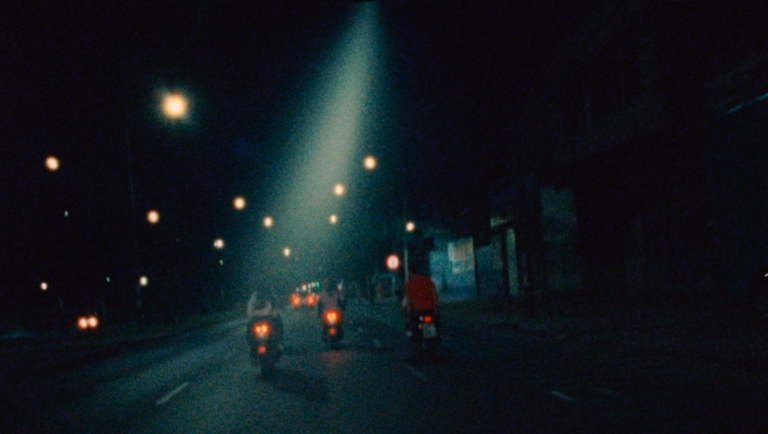
Clemente Castor’s Cold Metal is a difficult film to wrap one’s head around. It’s a small-scale, profoundly opaque object that rejects traditional narrative in favor of elliptical movements and poetic allusions. But even as its pseudo-narrative undulates across multiple individuals and various discrete vignettes, it very much takes place in our corporeal world. It’s a concrete, materialist object as much as it is a poeticized meditation, leading to a fascinating, productive tension between form and content. Alternating between 16mm color photography by Miguel Escudero and black-and-white 8mm footage shot by the director and Emilianna Vazquez, the low-gauge cinematography lends everything a lo-fi, almost industrial flavor. Everything becomes a sort of interstitial scene, as if we are only witnessing the connective tissue between other, more lucid segments that we somehow aren’t privy to. If this sounds frustrating, it’s not, not really. Rather, it results in a lovely, mysterious object that compels one’s attention even as we might struggle to make sense of it. Call it dream logic.
Cold Metal begins with a brief prologue, a young man and woman gambling at a street vendor’s makeshift roulette table. It’s the first of many games we will witness, a kind of structuring conceit that suggests a playfulness on the part of the filmmakers but also a cryptic formulation — this is a film of secret codes and obscurant gestures. As far as the story goes, we mostly follow Mario (Mario Banderas) and his brother Óscar (Oscar Hernández). A remarkable optical effect shows Mario laying down in bed; while his body is still prone, he “wakes” up and fully emerges standing from his own body. It’s a literal out-of-body experience, and while the film never really suggests any sort of supernatural phenomenon, the proceedings do take on the qualities of a spectral journey. Mario visits various people, occasionally referring to himself as a “her” and stating that he has access to memories that aren’t his own. An encounter with a man named Lázaro, who seems to know Mario, leads to an extended sequence of a rock-paper-scissors type game, a series of strange hand movements that appear to have some sort of spiritual significance. Throughout this, Castro occasionally cuts away to a series of dark rock formations and caves, as if Mario is traversing a parallel nocturnal journey into a subterranean space. We then eventually return to Óscar and learn that he has run away from a rehab center, and spend some time with other patients as they recount their experiences with addiction in a group therapy session.
This brief description makes the film seem more linear than it actually is; for every bit of coherent narrative dramaturgy on display, there are long documentary interludes of street scenes, a music festival, and young people lounging in sparsely appointed interiors seemingly awash in their own ennui. The jittery, sometimes jarring editing rhythms create a constant present tense — there’s no sense of time, just everything happening simultaneously. Rivette is an obvious touchstone for this sort of thing, but while a film like Le Pont du Nord plays like an adventure film, Cold Metal is a study in melancholy. Everyone is displaced, no one has a home, and cultural memory has become a confusing albatross anchoring these characters to a life of searching and yearning. In many ways, Cold Metal makes a compelling companion piece to Rhayne Vermette’s recent Levers, another film composed of loose narrative touchstones and occasionally inscrutable symbols. As critic Alex Fields has written about Vermette’s film, “we’re invited to make meaning of what little we can see in this… world, but not to consider meaning as something settled or determined.” Castor invites audiences to enter into his artistic practice and move around in it, unencumbered by preconceived notions of what we should expect from a movie. It’s freeing, even if the characters in Castro’s film are trapped. Cold Metal is a wonderful achievement. — DANIEL GORMAN
Comments are closed.