
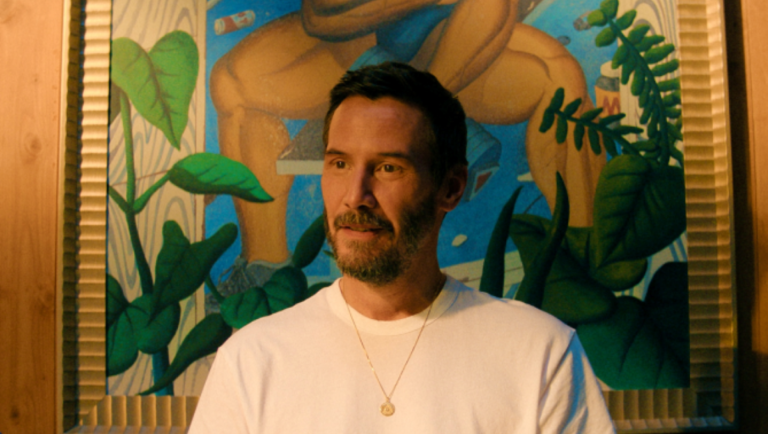
In the new Apple TV original film Outcome, Keanu Reeves stars as Reef Hawk, a hugely successful actor emerging from a five-year hiatus that found him disappearing from the spotlight to “find himself,” which is code for kicking a nasty heroin habit he hid from the public. Now back on the promotional tour (although it’s never entirely clear why as he doesn’t appear to be shilling a new project), Reef remains obsessively image-conscious and views any potential chink in his nice guy persona as an existential threat to his career and person. But Reef has a couple problems to contend with. The first is that he’s secretly been “a dick” and has a list of people he’s allegedly wronged — like most accused jerks, Reef is utterly oblivious to how people actually perceive him — as long as his arm. The second, which may not be unrelated to the first, is that his team has caught wind of a damning tape that’s quietly being shopped around with the implication being it would be ruinous for Reef if it were ever made public. A plan is put in place by Reef and his two space cadet best friends and hangers-on Xander and Kyle (Matt Bomer and Cameron Diaz, respectively): he will make amends to everyone he has aggrieved, abandoned, or insulted over the last 40 years in the hopes that one of these people is the anonymous blackmailer and perhaps they’ll have a change of heart. Of course, Reef doesn’t know what’s actually on the tape or even necessarily why he’s apologizing — he has to be told by his snarky assistant who his enemies are as he doesn’t think he has any — which does call into question the level of sincerity in the exercise. Perhaps as a “bad person” it’s his obligation to sit and be berated by others, and only through being chastened over and over again can he be redeemed.
Outcome was directed and co-written by Jonah Hill, who also appears in the film as Reef’s lawyer and professional fixer, Ira Slitz. A few years ago, Hill found himself on the receiving end of some bad press after he was accused of assaulting a teenager while he was in his 20s, in addition to an ex-girlfriend going public with her complaints about him, including calling him emotionally abusive and a “misogynist narcissist.” Assuming cause and effect, Hill’s kept a relatively low profile since then, starting a family and throwing himself into therapy (he even directed a documentary about his sessions with the psychiatrist Dr. Phil Stutz who, with his bald head and grey beard, shares a certain physical resemblance with Hill’s character here). Knowing all that, it’s hard not to interpret Outcome as a roman à clef of sorts, with Hill addressing his possibly deserved reputation as a bad boy as well as what it feels like to be cancelled. As if to underscore the latter, the walls of Ira’s office building are none-too-subtly adorned with photographs of Kanye, Kevin Spacey, and Rosanne Barr amongst other “undesirables.”
Hill’s film is steeped in the language of therapy as well as addiction; the entire apology tour is essentially the eighth step of AA. But Outcome skips over some important parts of “doing the work,” particularly all that pesky business of taking a moral inventory. The ruinous structural flaw to the film, which runs a brisk 83 minutes but feels twice as long, is that it conceives of Reef’s journey toward redemption and grace as a mystery where he needs to realize what a giant schmuck he’s been his whole life. The film is essentially The Hangover but instead of comedic misadventures involving home dentistry, shotgun weddings, and Mike Tyson’s tiger, it’s the affable Reeves repeatedly walking into buzzsaws as assorted former loved ones open up on him in a series of two-hander exchanges which Hill stages like an emotional flaying. Time and again, Reef is forced to sit and be confronted by his past callousness and lack of loyalty, which seemingly is as much of a surprise to him as it to the viewer. Either unwilling or unable to defend himself, Reef smiles and nods as a who’s who of random cameos made up of the filmmaker’s famous friends turn up to rip metaphorical chunks from the character’s carcass.
First, there’s Reef’s first manager Red (Hill’s Wolf of Wall Street director, Martin Scorsese, giving the most soulful performance in the film). Red plies his trade from a booth in a bowling alley and absolves Reef for firing him once he’d outgrown his rinky dink operation, but still wishes Reef would take more of an interest in people even when they can’t help his career. Then there’s Reef’s mother, Dinah (soap opera legend Susan Lucci), who parlayed Reef’s celebrity into her own career as a reality TV star and is primarily concerned with her son’s vulnerability being appropriately staged for the cameras. And there’s Reef’s ex, Savannah (Scorsese regular, Welker White), who in spite of having since moved on with her life and started a family still unloads both barrels on him, calling him indifferent and distant while stealing the best years of her life. Of course, none of these people would be so low as to extort Reef, but it nonetheless paints a pretty damning picture of a cad and professional user of others. And yet none of it lands as genuine. It’s a ceremonial display of sacrifice and punishment no different than acting out the stations of the cross during an Easter church service. There’s a disconnect between what we’re told about Reef and how Reeves portrays him. Hill has cast as his de facto avatar an actor who is, by all accounts, one of the true good guys in the industry; a performer who radiates decency and inner balance. Even his most famous creation, John Wick, kills a thousand hardened criminals but only after a smarmy nepo-baby murderes his puppy dog (you couldn’t impanel a jury that would convict). We’re repeatedly told what a lout the character is, but none of it registers as genuine as the actor’s attempts to appear self-involved or cruel are as credible as an SNL sketch. On the rare occasions where we actually do see the character lash out or register resentment, that’s the bit that feels performative. We’re repeatedly told that Reef is egotistical and disingenuous, but the actor is incapable of appearing authentically as the sort of shallow heel who googles himself several times a day. It’s hard to imagine an actor less thin-skinned or concerned about what strangers on the Internet say about him than Keanu Reeves, and Outcome never figures out how to circle that square.
Of course, the answer was staring Hill in the face the whole time. Who Reef resembles, in how he weaponizes the passive aggressive “touchy-feeliness” of mental health, crisis management, and enlightenment while using his persona as a happy-go-lucky clown to obscure distasteful personality traits, is Hill himself. And it’s not as though Hill hasn’t leaned into the more abrasive sides of his persona in the past: the actor gamely sends up his reputation playing “himself” in This is the End. Even here the actor portrays Ira as a braying, motor-mouth with the attention span of a goldfish, catastrophizing every situation and invariably making himself the center of attention (we learn the character helped “produce” Jussie Smollett’s fake hate crime as a career move, inspired Weekend at Bernie’s while partying with Mel Gibson and a corpse, and insists that Reef maintain eye contact with him from only a few feet away while Ira takes a shit). Hill is comfortable making himself appear as a garish buffoon because it affords the filmmaker emotional distance; his character is a lightning rod to draw our scorn while at the film’s center is a fundamentally likeable guy who just needs to be more present in the lives of the people he surrounds himself with. The whitewashing tactics couldn’t be more obvious.
As the film progresses, and the nature of both the tape and the extortionist becomes clearer, a sickening rationalization starts to take hold. The film implicitly argues that no matter how hard you work to project the image of being a good person, there are people in the world who will try and bring you down — the important part is to not let the haters get to you. It all has the distasteful air of victimization in light of the context, and as the culmination of the quest at the film’s center, it’s as dramatically unsatisfying as it is self-aggrandizing. Taken alongside how barndoor broad the film’s skewering of the industry at large is — the film makes something like the incessantly elbowing-you-in-the-ribs Apple TV series The Studio seem restrained — and the film’s hideous-looking digital cinematography (Benoît Debie) that makes every exterior shot look like a High Dynamic Range screensaver, and what you end up with is a mirthless, interminable apologia for “misunderstood” terrible people. At one point, Hill cuts to an insert shot of a bumper sticker that reads “Honk if you can separate the art from the artist.” Outcome failed to consider that both can be awful.
DIRECTOR: Jonah Hill; CAST: Keanu Reeves, Jonah Hill, Cameron Diaz, Matt Bomer, David Spade; DISTRIBUTOR: Apple TV+; STREAMING: April 10; RUNTIME: 1 hr. 24 min.
Comments are closed.