
In my day job as a college writing instructor, there is a lot of talk about “multi-modal composition.” This simply means that instead of remaining strictly within the bounds of the written argumentative essay, students are often encouraged to employ digital media to produce audiovisual argumentation. This can take many forms, including PowerPoint, annotated slide shows, or essay films that bolster the main argument with moving or still images and even a soundtrack. Multi-modal writing is a logical outgrowth of desktop media production, and it is often encouraged as a way to get students to think about the different kinds of material that can count as evidence.
In viewing the films in the 2026 edition of Toronto’s Images Festival, I found myself thinking about this a lot. Many of the films in this year’s selection would receive an A+ in a writing course, since they are primarily driven by clear, cogent verbal or written arguments. In many cases, the sounds and images are fully subordinate to the filmmakers’ use of language. According to an older set of criteria, these films are not always satisfying as works of art. Instead of bringing together text, audio, and visual materials to comment on each other or to create productive ambiguity, many of these works use the text to explain exactly what it is we are seeing and hearing. Thus, the actual filmmaking can sometimes feel illustrative of a point that is being made elsewhere.
In his 1964 essay “The Rhetoric of the Image,” Roland Barthes (who has a cameo of sorts in one of the festival’s films, Dayna McLeod’s FoUBARthes: Death of the Author) argued that the relationship between text and image tends to fall into two categories. “Anchorage” is when the text captions an image. It is designed to foreclose the polysemous capacities of an image, making sure the reader knows exactly what the image is supposed to mean. “Relay,” the other function, occurs when text and image are mutually defining a third term, which is some kind of narrative meaning. In both cases, the author does not permit the reader infinite freedom of interpretation. There is a preferred meaning that the image is there to facilitate.
In a lot of newer media work, one sees this playing out, and this means that the unique communicative possibilities of the image are in danger of being severely limited. One almost always gets the feeling that the text came first, giving these works the appearance of an illustrated essay. In many cases, no doubt, the creator was working with the images and figured out what they wanted to say about them based on that encounter. But this kind of filmmaking has the curious effect of making the text feel primary, even if the writing of said text was a direct result of the filmmaker having engaged with the images we’re seeing. This may be because most of us have greater facility with analyzing words than images, with sound representing an even more obscure venue for meaning. However, this awareness that language tends to supplant image and sound ought to be taken into account, resulting in a practice that prioritizes imagery and sound, all the better to compensate for our lopsided understanding.

A very good example of a film that critically engages with this situation is [pink noise] by Clint Enns. This is a silent, almost imageless film, comprised of a disconnected series of subtitles shown on a black screen. Enns is referring not only to conventional subtitling practice, but more specifically to the .srt files that accompany digital cinema files. Enns’ titles describe obscure sounds we are not hearing, and while they often hint at some kind of narrative cohesion, they never coalesce into a clear meaning. [pink noise] alludes to subtitles as an anchorage text by presenting them in the absence of any images or sounds to anchor. It also engages with the material specifics of watching a film online, something one probably notices even more strongly when seeing it in a theater.
Another interesting entry in this regard is Renèe Helèna Browne’s Sacred Disease, a film that uses its lack of photographic imagery as a means to explore themes of incorporation and expulsion. In its opening moments, Sacred Disease consists of a yellow cylinder shape which Browne likens to a body with an expanded mouth and anus. We then see this cylinder from above, meaning that the film’s only subsequent image is that of a circle, which alternates between yellow on a black/brown background or black on a yellow background, a flag shape roughly in the style of Bangladesh or Palau. The narrator’s words appear in the lower left-hand corner of the screen, and we initially take them to be captioning for the hearing impaired, which has become fairly common in independent media in recent years. She compares an episode of Sex and the City to the story of Acontius and Cydippe from Roman mythology. But at strategic moments, the titling vanishes, and this allows Browne to create a distinction between public and private knowledge, shared versus intimate meaning.
But the critical formalism of Browne’s and Enns’ films is the exception. Instead, too many works are content to let the words do the heavy lifting. As many have been observing for some time now, experimental documentary has become the dominant mode in that area of production that was once called avant-garde film. But even within this substratum of independent production, significant changes can be seen. The artists who initially inspired this development, such as Benning, Chantal Akerman, Peter Hutton, and Kevin Jerome Everson, were notable because they always led with images and sounds. In some cases, there was no text or speech whatsoever. It seems as if many younger filmmakers are struggling to find the best way to continue this tradition. Those who grew up with the Internet, and are now faced with AI and deepfake technology, obviously operate with a very different set of assumptions. One result is that these younger makers can never take the indexical quality of the image for granted. If anything, they are drowning in a cascade of decontextualized sounds and images, and are scrambling to fix some form of shared meaning even as it appears to be slipping irretrievably away.
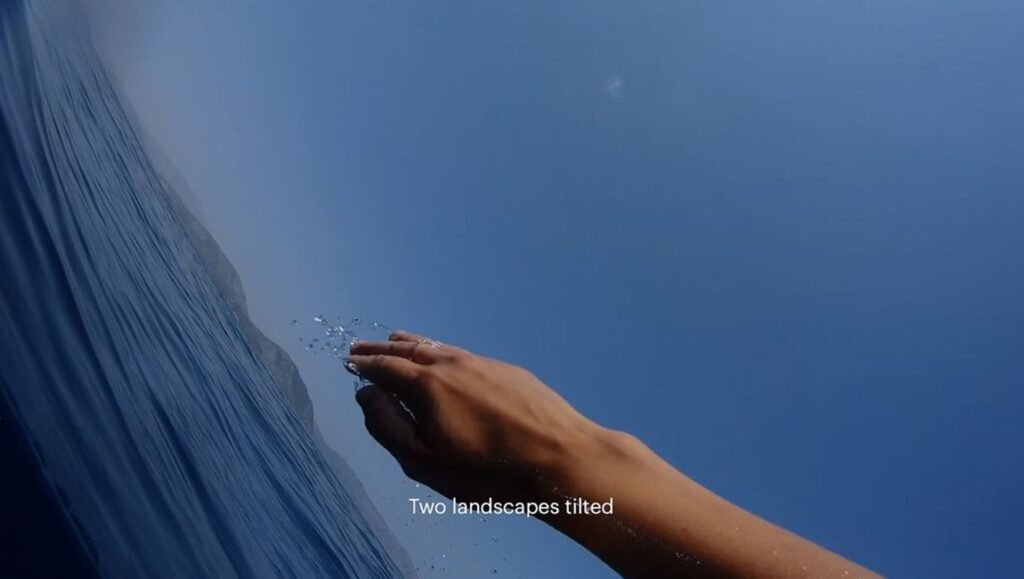
For now, language, and particularly the artist’s own voice (metaphorical or literal), seems to be a preferred mode of anchorage. Zeynep Dadak and Çiçek Kahraman’s Weird Absurd Whatever and Sofia Dona’s Katarakt, both in the program entitled “Unstill Image,” use subtitled narration to explain in great detail what it is we are seeing and hearing. In the former case, the filmmakers are showing us fragments of the life and activism of Çiğdem Mater, an imprisoned filmmaker in Turkey. In the latter, we are observing the sea along the border between Greece and Turkey, as viewed from the village of Katarraktis. In both cases, the works make impassioned pleas for justice and equality, in both Erdoğan’s Turkey and by extension everywhere refugees exist.
However, their impressionistic character as films seems to obviate any counterargument. Like several other films in the Images Festival, these experimental documentaries avoid the slippage and uncertainty one finds in the most resonant artworks, while also lacking the argumentative rigor that we expect from more conventional nonfiction filmmaking. This is perhaps even more evident in Patricio Escartín’s El ruido del tiempo (The Noise of Time), a film about gentrification in Xoco, Mexico. When the film moves from a small, traditional village to the urban shopping mall, the ominous minor chords on the soundtrack tell us exactly how to feel about what we are seeing. Anchorage and relay are the order of the day.
In addition to many films that rely heavily on explanatory text, this year’s edition of Images features a great many works that stanch cinematic movement altogether, or at least slow it down dramatically. Where the moving image was revelatory in the 20th century, it now seems to represent bombardment, and filmmakers are responding by arresting or dramatically slowing down that movement in order to make room to breathe. An Archive of Disappearing Sounds by Michaela Michalak works with footage shot in both the western United States and in Morocco, and her step-printing of the landscape recalls the analytic found-footage projects of Yervant Gianikian and Angela Ricci Lucchi. Both share a sense that the moving image requires a frame-by-frame refutation of cinema’s hypnotic power. However, Michalak uses a text drawn from anthropologist hagwil hayetsk to explain her anti-colonial intentions to the viewer. The landscape itself suggests specificity, and yet it is mostly used as an example of a settler-colonial problematic that unfortunately exists nearly everywhere.
By contrast, the films that seemed willing to dive more directly into the wreck of our contemporary digitized world also struck me as the most effective, politically as well as aesthetically. Images is a festival that has long supported work on Native and Indigenous topics, and while watching some of these films, I was impressed by both their rigor and their facility in making meaning musically or even geometrically, communicating with the viewer in waves and motifs rather than relying on linear explanation. Fox Maxy is a key exponent of this nonlinear, networked form of filmmaking, and her film Gathering Dust is a highlight. Using the vertical format of the iPhone, Gathering Dust operates like an extremely complex Instagram Reel, as the narrator speaks very casually about her relationship with her grandparents and how her peers think it’s odd that “old people” play such an important role in her life. Using her rapid-fire collage method that jams landscape alongside everyday activity and social interaction, Maxy communicates the relationship between young people and elders by demonstrating the audiovisual coexistence of the timeless with the ephemeral.
Similarly, Karthik Pandian’s feature documentary Surrendur (a world premiere) provides a nonlinear analysis of contemporary Indigenous protest movements, centered on one key historical image, that of a statue of Christopher Columbus being pulled down from its pedestal. An initially disorienting film, Surrendur (as the title implies) gradually instructs its viewer on how to access its meanings. It follows an essentially musical structure, with an opening scherzo followed by two longer biographical adagio sections. Most of the first movement and many parts of the remainder of Surrendur feature film images that are blurring and jumpy, the analog effect that happens when celluloid has slipped off the sprocket holes in the projector.
This “mistake” gives Pandian’s material a volatile charge, almost an electricity, suggesting that the sequential regularity of film images moving through the gate represents a false stabilization of the world recorded, arguably a domineering Western technology we have come to take for granted. The second part of the film involves Pandian’s encounter with American Indian Movement activist Mike Forcia of the Bad River Anishinaabe, one of the people instrumental in toppling the Columbus statue. After an extended entr’acte in which a young man articulates his emotional and political awakening through collective action, we meet Ta Pe’juta Wičháȟpi Win (Hunkpati Dakota Oyate), a woman who was transformed by witnessing the collapse of the statue, describing it as an moment that catalyzed her freedom from forces she had previously only partly understood.
Pandian describes Surrendur as a mandala, and a circular shape is one of the film’s recurring motifs. Forcia describes political consciousness as the opening of the third eye, like a fiber optic cable whose data transmission goes from blockage to free-flowing. (The pulling of rope, and the fall of great trees as their roots exit the earth, is another repeated image.) The film uses the iris shape to concentrate its audiovisual flow, as if its deluge of information is designed to overpower our mental and spiritual defenses. This use of formal intensity is meant to realign the viewer’s assumptions about how meaning is actually produced. Pandian neither explains away his images nor arrests their free movement. Instead, one gets the sense of being witness to centuries of thwarted impulses and ideas rushing into the mind all at once. Where so many other filmmakers are offering us illustrated lectures, Maxy and Pandian have gone into the deep end, and are inviting us in for a swim.
Comments are closed.