
Achingly personal films, theoretically, should be everywhere. Technology for the production of moving images is available to more people now than ever before. If one is willing to dig a little deeper than the offerings at your local multiplex, auteur-driven and artisanal cinema is right there for the taking. But the films of Chris Sullivan are striking in their vulnerability. They represent “personal filmmaking” of an entirely different order. The Orbit of Minor Satellites, Sullivan’s second feature film, is by no means “outsider art.” Sullivan is a skilled artist who understands film history, and in particular, the history of his chosen medium, animation. And yet, his new film offers viewers a rare and often disturbing sensory journey, akin to the music of Daniel Johnston or the paintings of Forrest Bess. It is stark and unforgiving, an experience from which many viewers will recoil in horror. But for a select few, it will feel like an emanation from our strangest half-forgotten dreams.
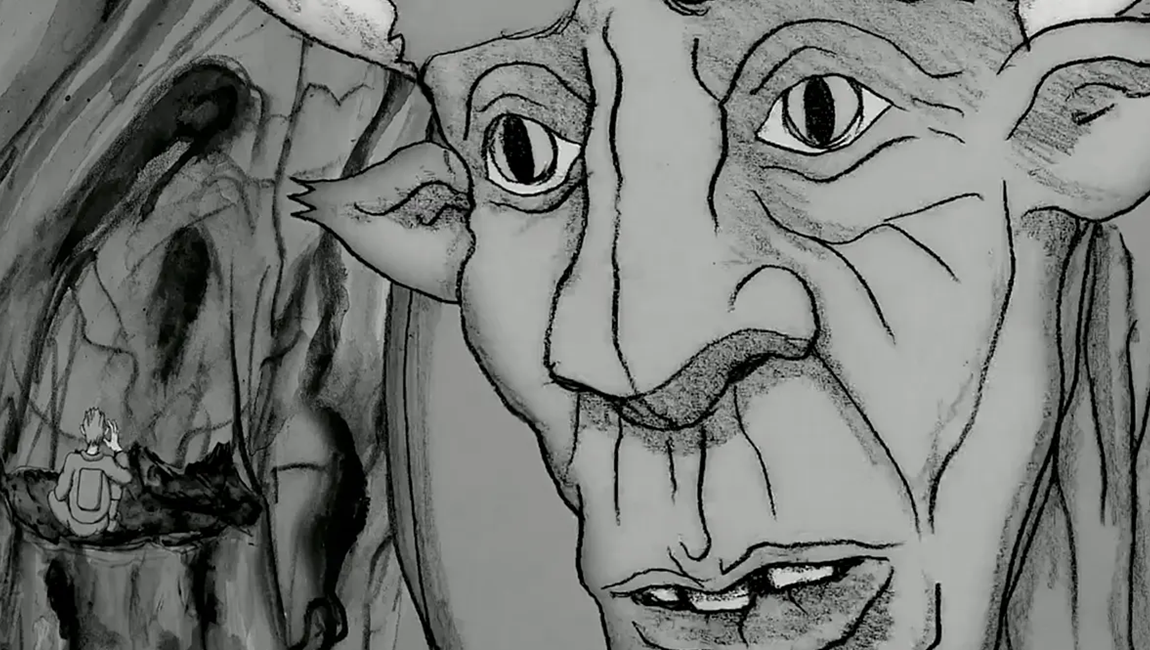
Sullivan’s first feature, 2012’s Consuming Spirits, was an obsessive and often grotesque examination of alcoholism and generational trauma, rendered in a bulbous, fantastical visual style that is equal parts Chris Ware and Lynda Barry. On the surface, Minor Satellites appears a bit more polished, but ultimately this only adds to its uncanny ambiance. Sullivan uses digital formatting, rotoscoping, and hand-drawn animation to produce an ever-shifting hybrid world. For the first time, he also includes live-action performances, but the actors are so stilted and subdued that they seem no more “real” than any of the non-photographic material swirling around them.
Describing the plot of Minor Satellites runs the risk of making it sound more linear than it actually is, but it does provide a set of touchpoints for understanding Sullivan’s overall project. There are two main characters in the objective-reality thread. The first is a psychiatrist named Derwood Richards (T.J. Jagadowski), who runs the low-security mental hospital founded by his late mother in suburban Chicago. Much of the film consists of his sessions with Rosemary Hamm (Silvia Abelson), a schizophrenia patient who has been under Richards’ long-term care. Their awkward banter gradually reveals darker elements, a low-key battle of wills, and the eerie intimation of transference and countertransference.
In order to cope with the death of her sister, Rosemary has invented an alternate universe involving the joint U.S.-Soviet colonization of Maelstrom, a seldom-seen minor moon of Saturn. In this fictive reality, Rosemary is known as Olga, a scientist and cosmonaut who is also a mother. During their sessions, Rosemary regales Richards with tales of current activities on Maelstrom, which involve major tragedies, including the death of all the colony’s children and the camp’s eventual abandonment by authorities on Earth. There is one creature native to Maelstrom, a giant talking buffalo named Roger, whose speech Sullivan created by using the voice of Boris Karloff, excerpted from his radio plays.
There is a slow, dolorous tone throughout Minor Satellites. Less “a film about schizophrenia,” it is truly a schizophrenic film. Sullivan leaves Richards and Rosemary behind for very long stretches, focusing exclusively on the goings-on on Maelstrom. Sometimes these stories reflect the struggles in Rosemary’s actual life, similar to what we saw in Mark Hogencamp’s “Marwencol.” But at other times, the events have no real connection, suggesting that this universe is autonomous from its creator. We see several books authored by Richards, labeled “the Rosemary Hamm stories,” so we don’t know if the psychiatrist is producing fiction based on his sessions with his patient, or if she and the sessions are figments of his own imagination. We also get a few glimpses of Richards’ life with his wife and child, and there are small hints that he may be abusive, or that his wife may also suffer from mental illness. This, in turn, introduces the possibility that Minor Satellites is a reflection of Richards’ own savior fantasies about his wife, whom he is incapable of helping or fully loving.
The Orbit of Minor Satellites presents certain challenges for a critic. It unquestionably deserves to be seen. But any recommendation must be a qualified one. Lots of people will really hate this film. It provides very little in the way of a firm conceptual footing. It proceeds by exhibiting the flat affect often associated with schizophrenia. The dialogue is usually circular, and Rosemary’s word choices are just ever so slightly off, in a way that can be almost physically painful to listen to. The only concession Sullivan makes to his viewers is in a brief conclusion, when Rosemary has left the hospital, and we see her making her way in the outside world.
But what is most likely to rankle some viewers is Minor Satellites’ ideological indeterminacy. What does this film want from us? As it progresses, we are shown many more instances of Richards acting from a place of mental disturbance, in ways that even threaten to derail Rosemary’s recovery. We cannot help but observe that Richards might well have been the patient in another scenario, and that his professional privilege offers him cover that Rosemary lacks. But this is no R.D. Laing anti-psychiatry tract. Sullivan stirs a cauldron of anguish and complication but provides no clear conclusions. Minor Satellites is an inarticulate cry of unresolved pain, not for the faint of heart.
Comments are closed.