
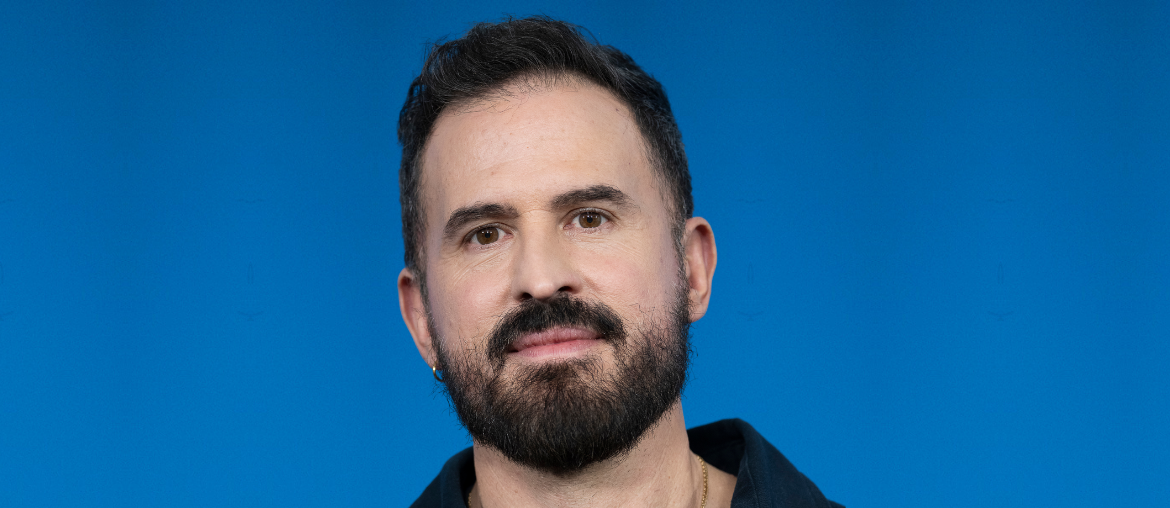
Argentinian filmmaker Lucio Castro likes it when you don’t quite know what you’re looking at. His first feature, End of the Century, was a time-travel story of sorts, a tale of fleeting and enduring romance that spanned decades, yet could plausibly have occurred over a weekend. The trick Castro plays on the viewer isn’t malevolent or even mischievous. His instinct is to get the viewer to lean in, to be as open to discovery as his often youthful characters.
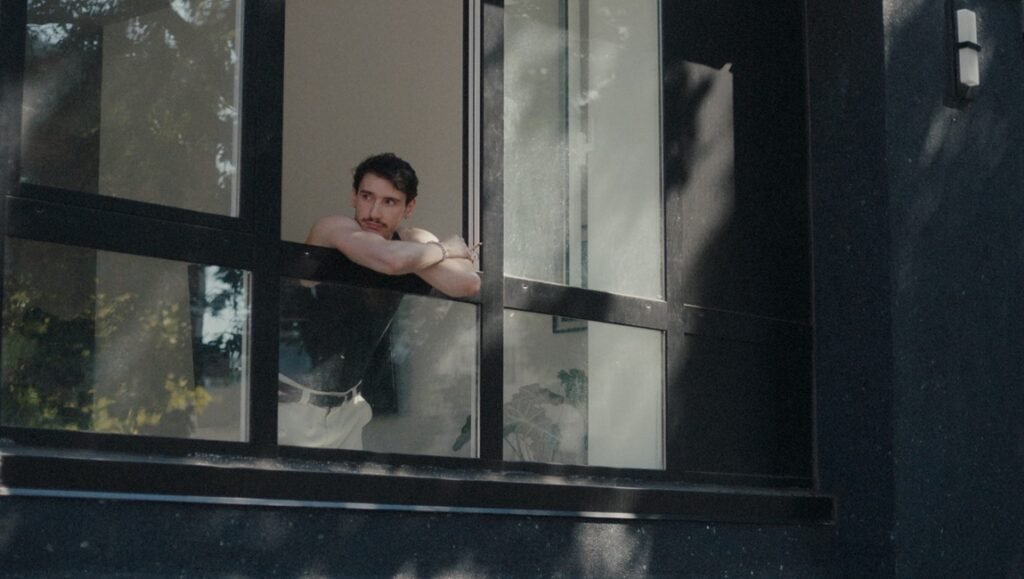
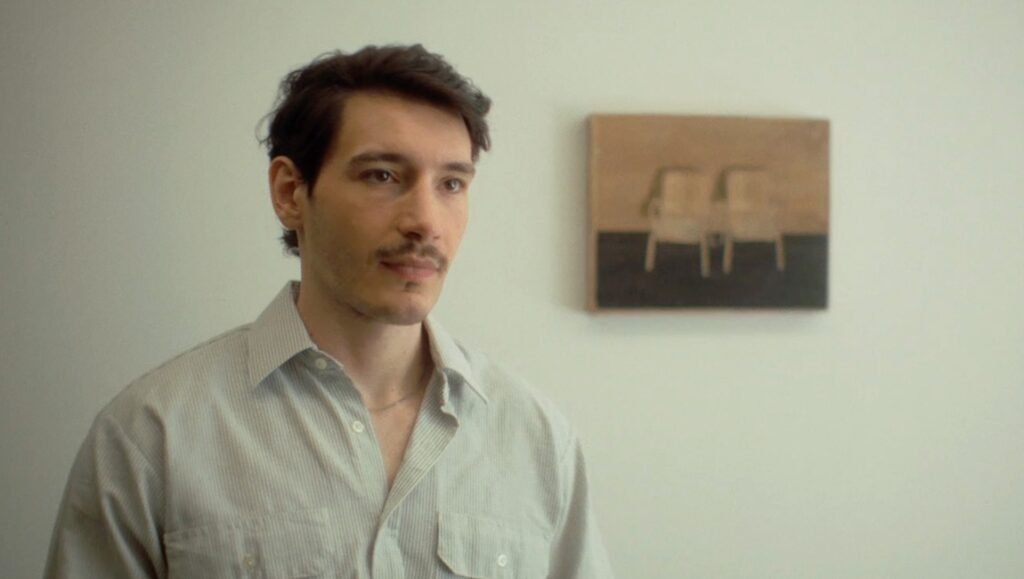
Castro continues in this mode in his latest feature, Drunken Noodles. At the beginning — or so we assume — of this four-pronged story, young art student Adnan (Laith Khalifeh) has arrived in New York City for a summer internship at an art gallery. Adnan is hard to read, an enigma of erotic impulses and artistic curiosity. He’s the kind of young man you might find in an Edmund White novel, whose maturation in the arts of sex and, well, art, is not only simultaneous but contingent upon each other.
As Castro brings us into the film’s four chapters, each with their own narratively satisfying blend of self-containment and openness, we come to see Adnan as a product of his experiences. A chance encounter with an aging erotic artist named Sal, troubles with an emotionally raw boyfriend, and an orgy with a group of delivery bikers/poets give Drunken Noodles an energizing cumulative effect. The simplicity of its narrative conceit belies a film that is, perhaps, a bit of a fairy tale. Do the encounters we have in the dark leave the strongest impression? Castro leaves the answer up to you.
Ahead of Drunken Noodles’ theatrical release via Strand Releasing, I got coffee with Castro so I could pick his brain about translation glitches, our beloved Edmund White, and his upcoming projects.
This conversation has been edited and condensed for clarity.
Chris Cassingham: We can start as the film starts, with Sal’s work. You’ve talked about meeting Sal and wanting to make a documentary about him, but didn’t quite find an idea. What did a narrative approach unlock in Sal’s work or in whatever ideas you were thinking about?
Lucio Castro: I realized I like people and characters, fictional or real, that are in between states. I like this idea of an older man, late 70s, who is switching to this more erotic art. So I went to interview him with the idea of making a short documentary, not super realistic, but maybe something that would combine his imagery with his answers. But when I was talking to him, what I realized is that, because I’m not a documentarian, I was performing my questions and he was performing his answers. There was something in the transaction that wasn’t that interesting to me, because it was a sense of truth, but it wasn’t really true. I prefer to make up things, and then through that lie, maybe there’s a truth that emerges. So, after that [experience], I went home, and I didn’t know what to do with the material. For years, I thought that I would maybe still use that footage in some way. Then, after I finished my second feature, I wanted to take this movie, now that this distance happened, and ask, what would a fiction approach to his works look like? His work is pretty narrative, you understand the story, understand the situation, and see the characters. How would I approach this? I write in a very intuitive way, I say things emerge. I don’t really plan, I don’t make a treatment, I just go ahead.
CC: Do you remember what your first impression of Sal’s artwork was?
LC: Yeah, it’s pretty close to what the character Yariel says to the other delivery guys in the street. It’s this idea that it was all these crazy, really interesting contrasts, really bright colored and really childlike, but also a dark subject matter. And that actually was the first thing that I wanted to have in the movie. You know, the movie is a celebration of cruising, and there’s a tenderness — it takes away all the darkness of cruising. It actually brings a childlike nature to it, kindness, camaraderie between the people. I think it’s a really sweet movie, even between people that are fucking. So I was really impressed by that in Sal’s work, which wasn’t like dark, even though, you know, it’s…
CC: It’s provocative.
LC: Yeah, exactly. So, that I really liked. I also like that there was something between sex and sensuality. I’m really interested in the difference between the animal approach to sex or desire, whatever that means, but also what it is to be sensual, you know? So, I wanted to explore both. And with the DP, we talked about sensuality in the frame. For the color, we use a very specific filter, and there are plants in every scene, from the apartment, and upstate, and in the parks. But maybe what I like the most about Sal’s work, and it’s the most simple, he’s someone who is so comfortable showing something that is so private: his desire, like a very simple and basic desire. There was something there that I found really brave and simple. I think Drunken Noodles is layered and can be complex, but I think in essence it’s a real pleasurable movie. There’s poetry, sure, but it’s not an intellectual movie that they have to really think through. I think this movie allows you to feel it.
CC: I agree with what you’re saying about it not necessarily being an intellectual movie, but it does allow you to think a lot.
LC: Right, right, right.
CC: And maybe this is an extrapolation on the shift from documentary to narrative, but I’m curious, when in your intuitive writing process did you decide to tell the story in reverse?
LC: Oh, that was the way I wrote it. And, at first, there were going to be four different characters, four different main characters in the four separate stories, but then I realized, actually, it’s the same character that’s going through all these movements, so I connected them through Laith, the main actor. But the structure was in the script, it wasn’t something that I played with in the edit.
CC: I think there’s a pleasure in finding your own way to the connections between the stories, or how they’re connected, even if they’re simple.
LC: Yeah, and I also like the idea of being lost while watching a movie, and then being found.
CC: I think some of your answers have alluded to this, but why was it important for Sal to be a character in the film and not just someone who provided the artwork that frames the events? I mean, he’s not playing himself, but there’s an actor who is credited as Sal.
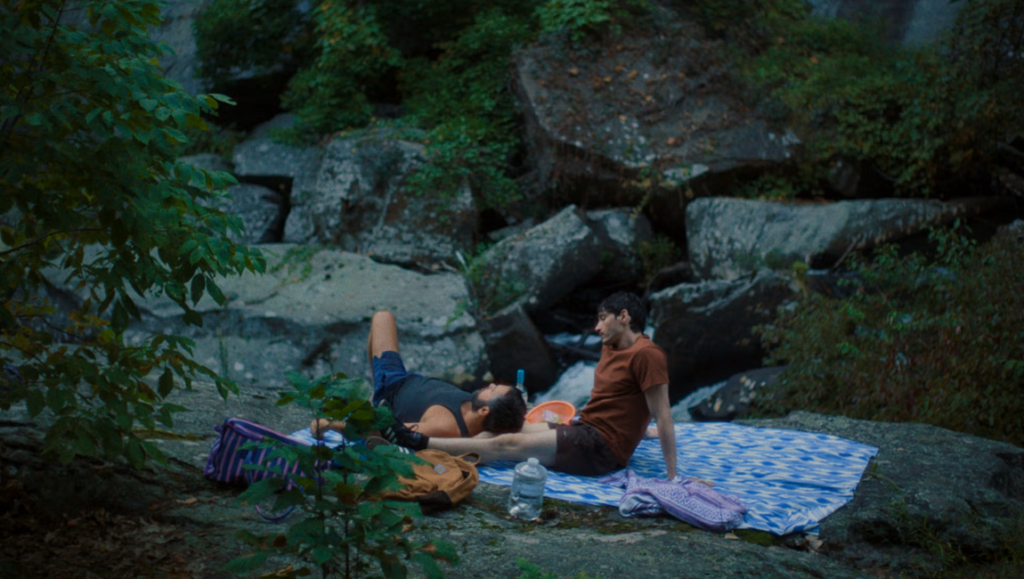
LC: Yeah, it’s an interesting question. Sal, the artist, is a very ambitious person, he wants to show his work, which is great. But I wanted an actor that felt more like an outsider artist, someone that’s fine making work on his own, someone that’s so happy and content with their own little world, making art in this little house. There’s something there that I find really cozy, or, I don’t know, beautifully contained. And I like this idea that Adnan, this character, goes into this world and is open to this little universe, because the movie is about what happens in the dark, the idea of cruising the parts of the city and the forests we don’t know — basically, where tales emerge. In the first story, the cruising area is in McCarran Park, in the second part, it’s the woods upstate, and the third part is what happened at night in the house and in conjugal life. There’s a secret door in that house that takes you to where things are a bit different. And in the fourth story, there’s a time travel element. I like these moments, doors that take you somewhere else.
CC: Speaking of these encounters we have in the dark that leave an impression, I clocked this little detail the most recent time I watched the film. Yariel leaves Adnan a note at the gallery, and Adnan uses his Google Translate app to overlay the English words over the Spanish, but there’s a little glitch as it’s translating, which changes the question Yariel had written, about whether the encounters we have in the dark leave an impression, into a statement. I thought that was really interesting, and struck me as the kind of thing a character like Adnan would not question. He would be like, well, of course. He wants some confirmation that every experience he has is important and meaningful. Whereas the fact that the question turned into a statement only made me question it more. Can you talk about that detail, or even what went into orchestrating that little glitch?
LC: I lived in China for 10 years, and I was always using my Google Translate, and it was amazing, of course, because the world changes. I thought that was another portal, you know, but between two languages. So I wanted to have a moment where he uses his phone to translate, but then to also have that glitch. That was a really nice thing that happened, honestly, but I didn’t control it.
CC: But was that your hope that it would transform it from a question…
LC: Yeah, which they usually do.
CC: Those imperfections and mistakes can open up possibilities that you I hadn’t planned for.
LC: And that’s the nice thing of making a move of this size. You can really be permeable and open to all these things as well.
CC: How did you first meet Laith and start working with him?
LC: This was very different in this movie than the rest. I first found the actors, and then I wrote the movie, because I wanted to write the movie with people in mind, and I wanted to work with actors that were new, that were all game to make a movie, not on a big scale. I looked on Backstage at all these faces, faces, faces. Laith is amazing, I love Laith — and also a really beautiful filmmaker — but I never understand what he’s thinking about. There’s something very closed off or hermetic in his expression. He’s definitely not expressionless for me, but there’s something that I don’t fully understand, and that makes me interested as a director, as a viewer, you know? I want to look at his face. What are you thinking about? So, when I saw his photo, I really was really interested in him. Then we had a conversation, and I really liked him. And then I said, look, I haven’t written the story yet. It’s based on this artist’s work, but I’m looking for some people to play his characters. So, yeah, it was really like just a photogenic approach.
CC: What catches your eye when you’re just looking at pictures and little bios on Backstage?
LC: I honestly don’t know, but it’s very precise. I mean, casting is everything, you know? I also don’t rehearse. The actor brings everything. I see them read my works and see how they move with their body and behave, and make little corrections on that. But it’s really just everything they bring, so it has to be someone that I’m really interested in looking at. For the character of Yariel, I wanted to make that class and culture border drastic. Joel Isaac was great, and also someone that’s really mysterious. I don’t really understand him, even now [laughs]. And then Ezriel Kornel, he’s singular. I emailed him, and he said I’m straight, but I don’t care about that part at all, and that already told me a lot about him. Sal also needed to be very warm, because the real Sal is very warm; he’s very tall, he has a big presence, so I wanted the actor to be very, very warm. Also, they happen to look alike.
Sal also appears, his hands, in footage I shot when I was sure that I was making a documentary. Even when I wrote the film. But I showed it to a few friends who said this is not a documentary at all, but in my mind, it was a documentary. Now I know it’s very far from that idea.
CC: This might just be my recency bias, but a lot of the things I’ve been reading, and some of the things I’ve been watching, have really reminded me of Drunken Noodles, especially when I was watching it most recently. The first thing that was strongest was The Farewell Symphony by Edmund White.
LC: Oh, I love Edmund White.
CC: Oh, I wish I had brought it. I finished it two days ago. Normally, I have it in my bag.
LC: When was it written?
CC: The ’80s or ’90s. It’s the end of his trilogy with A Boy’s Own World and The Beautiful Room is Empty.
LC: I’m gonna write it down, I need a good summer book, because I love him. I was actually about to adapt his last novel. Thank you for that. What is it about?
CC: It’s about his life in New York and his sort of erotic and artistic coming-of-age or maturation. All the people he meets and writes with and sleeps with, ending with AIDS, and everyone he knows and loves dying off, and it’s never super clear to what degree the events are fictional or real, but what really struck me is this idea of someone figuring out what clicks with them sexually and what clicks with them artistically at the same time. Would you like to talk about that?
LC: Yeah. I think that has to do with the openness that I’m interested in in my characters. I’ve been married for many years, but I see it in my friends who are sexually open, and I find it fascinating, this relentless drive — the movie is full of stuff that is told from friends. So there’s something in this idea that sex takes you places, and I think there’s something in art as well. Art to me, when I read or watch something that I really like, it clicks, it touches something, it’s a portal, and if I can fully understand it, I’m usually not interested. There has to be something that I don’t quite get, but there’s an uncanny effect, or a haunting effect, and that only happens if something that’s so inside of me, it’s so out of reach of my conscious self — that’s so exciting for me. There’s a similarity between encountering art and encountering good sex. It’s something that takes you somewhere else you almost don’t recognize yourself.
CC: Speaking about recognizing yourself, if my memory of your first feature, End of the Century, is correct, there’s this question of, are these people the same people, and what exactly is the nature of this time shift we’ve experienced? Whether it’s in the writing or it’s on set, how do you know when you’ve achieved that feeling you were just describing of not quite knowing what’s happening?
LC: It’s in the writing, and usually it’s very simple. I start with something that’s really concrete, something that you can see and grasp, a reality where you can go, “I understand this world and these characters”, and then gradually something starts shifting, and you’re lost for a little bit. You go somewhere else. And I like that cinema has the possibility to do that. It’s probably the only art form that can. Photography is so real, it allows you to really believe that these things in the image exist. So, when you start shifting that reality, I think it’s a really powerful thing, because then you’re like, wait, wait, what happened before, what was that, you know? Also, the way people watch movies, and this actually always surprises me — and usually it happens when I’m at a theater, playing one of my movies — but people are very aware of clues, you know? They’re decoding, they’re an audience of detectives because it is a language of symbols, and when that reality starts breaking the mind starts working. I love those shifts in those moments.
I also like when reality shifts in a way that feels slightly uncanny or not clear. There are beautiful dream sequences in the history of cinema, like in Hitchcock’s Spellbound, but I prefer when the dreaminess is not contained, when it seeps into the main story, because everything then becomes a little more unstable and more interesting to me. But that’s all in the writing; it’s commas and spaces and actions and costumes and all these symbols that indicate there’s a shift here or not, and it’s playing with that. If it’s too confusing, there’s no tension, people get lost and they forget, and if it’s too clear, there’s no tension, either.
CC: Speaking of those kind of shifts in reality having a place within the real world, two of them have very clear antecedents: the first being the orgy in tableau between Adnan, Yariel, and the other delivery drivers, which is modeled after Sal’s needlework; and the shift in the final story which is almost triggered by him reading a Chinese poem by Li Bai that he sees on a restaurant sign. The two in the middle, one in the woods with Sal, the other in the house upstate with Adnan and his boyfriend, have slightly murkier triggers and inspirations. They’re also the most out there, and in the case of the third story, the most unsettling. Was there anything that inspired them in the way the first two were inspired by something?
LC: For sure. The Wizard of Oz is one. The fairy tale is a perfect genre for me, and I love the fairy tale as a structure. That whole scene in the woods with Adnan and Sal, it’s like business, because it was shot very quickly using the light and the performance of the dance. I worked with a dancer in Argentina to give the actor a fun little dance. The scene in the house — it’s funny, that’s my friend’s house, and when we got that house, I went straight to the door in the back, and I was like, what is this door, what is this space? It had this stagnant sense. I wanted to use the door somehow — and I don’t want to interpret my own movie, because then I close off other interpretations — but to me, that whole thing is about how, in marriages, sex usually dies down because sex is powered by other things: the unknown, risk, a little uncertainty, the engines of our desire. So it’s normal that after time those agents change. I wanted to think of a way to reignite them by becoming someone else, by performing as someone else, and this is unlocked by Adnan’s memory of his grandfather when he was younger, which, by the way, is inspired by someone that I know — it’s a true story.
CC: Another very Edmund White kind of detail.
LC: Yeah, yeah, for sure. All of his work has that old and young dynamic. Very Edmund White. So it really came from that. There’s also a provocation in Sal’s work that I try to reflect by crossing boundaries. For example, especially since the pandemic, there are delivery guys all the time, and we never talk besides the transaction. I just assume they’re immigrants, that they’re just making money to send their families. But why can’t they also be poets? Why not, you know? So it was crossing that class boundary in that first story, and later crossing that boundary in Adnan’s story of this little boy kissing the grandpa, because it’s incestuous, it’s wrong, but it’s a boy doing it, so I don’t know what it is, but it’s still something that shouldn’t happen.
CC: I’m curious to know a little bit more about the production of the film. The impression I get is that it was a really small, scrappy, adaptive shoot. It is a film that feels like Adnan: very open to the world, and whatever it might offer you in the moment. Could you talk about that?
LC: The traditional way to make a film is you write a screenplay, and you look for financiers for years. It’s a great way, for sure, but sometimes you need a more direct approach. I really believe in the power of that. I believe, of course, some movies require the influence of money, and I love when people, and myself, get paid, so that’s totally fine. But there are some movies that are okay to make in this sort of manner. It allows for the freedom to try new ideas. I don’t think Drunken Noodles was a script that someone was going to give me all this money to make. It’s a really short script, like 45 pages. So, yeah, this was something that came together with the idea of: let’s make a movie. We don’t need anything, it doesn’t matter. We just need [cinematographer] Bart [Cortright], who has his own camera and his own lenses. We used only locations that we had. And then, what do we need to pay? We paid the cast, we paid the sound design, and then we’re working with a certain system of points.
CC: A lot of debate about that with the new Obsession film, right?
LC: Exactly!
CC: So it sounds like the film came together quickly, very intuitively. Did you know your cinematographer, Barton Cortright, beforehand?
LC: Yeah, he shot my second feature, After this Death.
CC: Oh, I hadn’t realized that was made first. How long was your shoot?
LC: There were seven days. We had scheduled eight, but we finished in seven. It was really easy once I had the cast and the locations and everything, you know. Also, yeah, this way of working requires a slightly different way of writing, because of course, I have to write with locations in mind. I can get someone’s house upstate? Great. Someone has an apartment building? Great. My friend’s gallery? Great. So it’s basically, what do I have, and then I write retroactively to fit these locations here. Locations and actors, I got in about two or three weeks.
CC: That’s amazing. How closely did you make this film to After this Death?
LC: After This Death I shot in the Fall of 2023, and I shot this in August 2024.
CC: And now you have the privilege of saying you released two films in the same year.
LC: Well, last year, After This Death opened in Berlin in February, and Drunken Noodles in May, so it was crazy. Three months apart.
CC: Can you tell me about the Da Vinci film you just shot?
LC: Last December, I went home in Argentina for the Christmas break, and when I landed, Phil Ettinger, who was one of the actors in After This Death, said, “Look, I’m making this movie. The director left, and we’re breaking for the holidays and coming back in January. Would you be interested?”
CC: Was that January of this year?
LC: Yeah, I shot it in January 2026. It was fun. I love Philip, too. He’s incredible, one of my favorite actors. The film was also on a big scale that I never had before — it’s a multi-million dollar movie with a big camera. And now we’re editing.
CC: Out of curiosity, what’s the process of being brought into a film that you had no involvement with prior? I understand Philip is the star, so perhaps he has some say over who gets hired, but was it him just texting you and asking if you were interested?
LC: Yeah. And then I met with the producers. It was as simple as that. And yeah, it was just as simple as that.
CC: I’m glad to have this extra context about it, because seeing this film on your credits and not knowing anything about it — I was curious, to say the least.
LC: Honestly, I really liked that there was a movie — you know, right now horror movies get financed all the time, and that’s great, but there’s very rarely a movie about an artist in crisis. And a multi-million dollar movie with Philip as a lead, to me, that’s amazing.
CC: That’s not a blockbuster budget, but that’s definitely some money!
LC: I know, exactly! I mean, these are risk-taking producers that loved the idea. It’s not a biopic, and the whole movie happens in one room, so I really like that. I think it’s a beautiful movie.
Comments are closed.