
Couture’s scenario reads like something straight out of the 1950s. Three women — an ingenue model from a humble background, a struggling makeup artist with dreams of becoming a screenwriter, and an American independent film director (that part’s maybe a little less ‘50s-coded — sub in magazine editor and it fits) — converge in Paris for Couture Fashion Week. Personal anxieties, professional dilemmas, and a shocking health emergency plague each woman respectively as they graft toward a common goal: executing one of the most important fashion shows of the year. But where a ‘50s approach might have been suffused with melodrama, such is not the style of director Alice Winocour, whose incisive portraits of women in crisis typically hew naturalistic, about as far from old-fashioned melodrama as from the perceived artifice of the fashion world.
Herein lies the primary problem for Couture. Winocour’s protagonists feel out of place, dissatisfied with their work — model Ada (Anyier Anei) was training to be a pharmacist in Kenya when she was scouted, and seems to have as little passion for modelling as she does experience; makeup artist Angèle (Ella Rumpf) interrupts well-paid gigs to take phone calls about her screenplay; director Maxine (Angelina Jolie) would rather be working on her next feature, or at home with her daughter, than putting together schlocky visuals for a runway show. But Winocour, too, feels out of place and is equally dissatisfied with her subject. She makes little use of the world of couture as the backdrop for her drama, observing it with an almost disdainful detachment, and diminishing the stakes as a result. Making the issue of whether your protagonist’s ankle will hold up or not during her runway walk the principal source of tension would carry much more import if it felt like the director was actually invested.
It’s harder still for the audience to care about any of Winocour’s three tangentially overlapping stories given the lack of depth their fragmentation affords them. Angèle is largely sidelined, while neither Ada nor Maxine’s storylines are imbued with enough narrative invention to be compelling. Ada battles with her inexperience, setting her apart from her colleagues, Maxine is hit with a devastating diagnosis of breast cancer, and both wrestle with separation from their families — and none of this is presented with much originality. Here, one sees the value that a more theatrical approach might have carried with such banal material, as in many of the formulaic old Hollywood films, but Winocour’s coolness renders said material as flat on the screen as it appears on paper.
Exacerbating this issue, and perhaps stemming from the aforementioned lack of interest Winocour displays in her subject, is a constant string of implausibilities running the entire way through Couture. A total newcomer is hired to open a couture show, and her outfit is being sewn by someone who’s never made a full look by herself before. Important meetings between Maxine and house executives last less than a minute. Maxine reacts blithely to the news of atypia in her biopsy results, then with painful alarm to her diagnosis. At an appointment, she’s told there are three people ahead of her in line, before almost immediately being called in. The eventual runway, held outdoors, is interrupted by a rainstorm, whereupon both models and audience attendees scatter and flee. And Jolie, with a visage sculpted by the gods and luscious golden hair straight out of a Loréal commercial, plays an indie horror director. Winocour’s scene here is one of fantasy, yet her approach is anything but fantastical, so these myriad unlikelihoods feel awkward and jarring.
Overall, Couture simply doesn’t work, but where it does work is precisely on the subject of work. Tucked between ostensibly more important scenes are a few lovely little asides featuring Christine (Garance Marillier), the seamstress putting together Ada’s crucial opening look. If only briefly, Winocour’s camera rests on her fabric, her needles, her hands, and the process of observing process in action is soothing and quietly captivating. In similar style, each of the protagonists is also viewed at work, whether practicing her walk, touching up models’ skin, or sorting out lighting and visual effects. These women may not want to be doing what they’re doing, but watching them do it, putting their skills to use no matter what their capability, is quite engrossing.
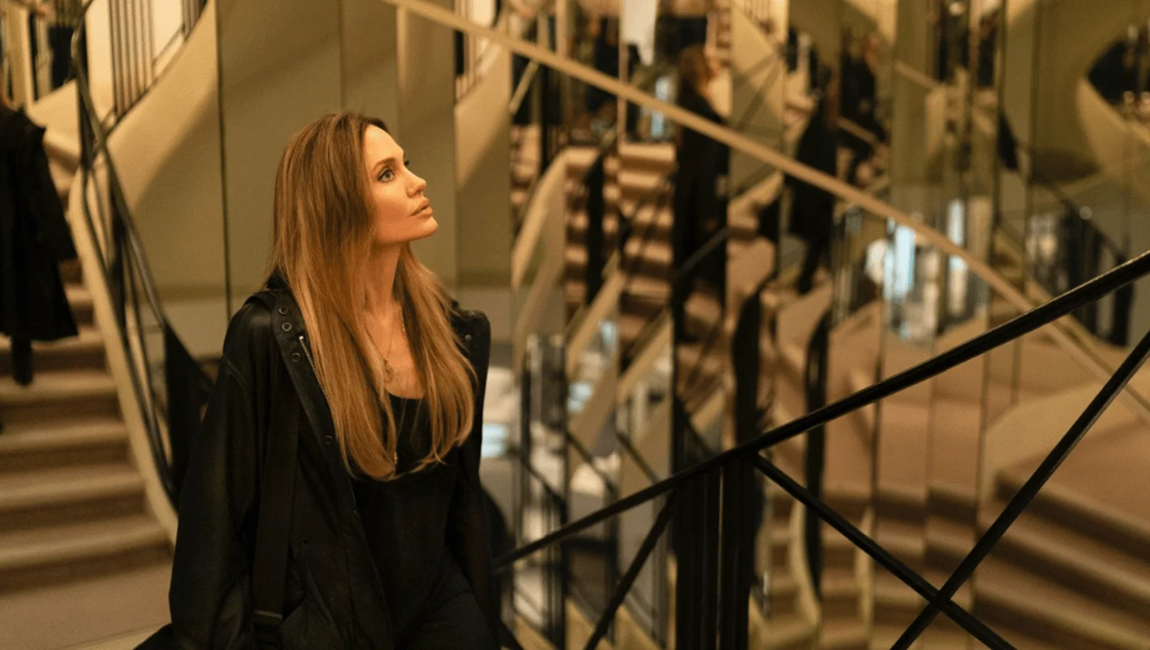
It’s of minimal significance, however, since still Winocour never lingers long enough to give these moments much impact. Her movie is a dull, uninvolving drift, its glassy monotony really only disrupted by Jolie’s impassioned frailty. Her wide eyes, often either lost in deep thought or filled with tears, invite the viewer into Maxine’s mind, as she contends with the startling delicateness of her mortality. Dressed in androgynous blacks — countering the ornate and diaphanous whites of the fashion show — and adorned with tattoos, her emotional fragility is disarming, and cuts through Winocour’s impersonal indifference with pointed power. You could make a whole movie out of her gaze alone, but this is a whole movie made out of too much else, and too little of it works.
DIRECTOR: ddd; CAST: Angelina Jolie, Anyier Anei, Louis Garrel, Ella Rumpf, Vincent Lindon; DISTRIBUTOR: Vertical; IN THEATERS: June 26; RUNTIME: 1 hr. 44 min.
Comments are closed.