
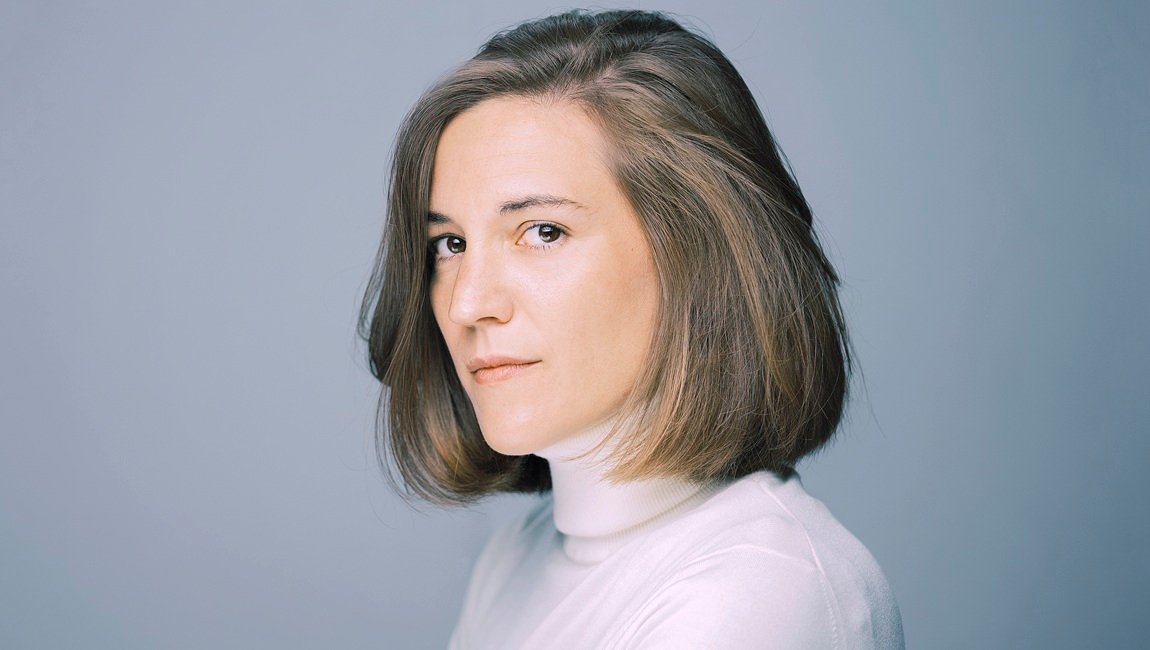
Carla Simón’s parents passed away when she was only six years old. As an adult, she’s spent her filmmaking career unpacking what that’s meant to her life. While she’s laced her first two features with aspects of her own biographical details — Summer of 1993 focuses on a six-year-old girl in 1993, and Alccaràs centers on a rural Spanish family — her third feature, Romería, finally lasers in on her parents.
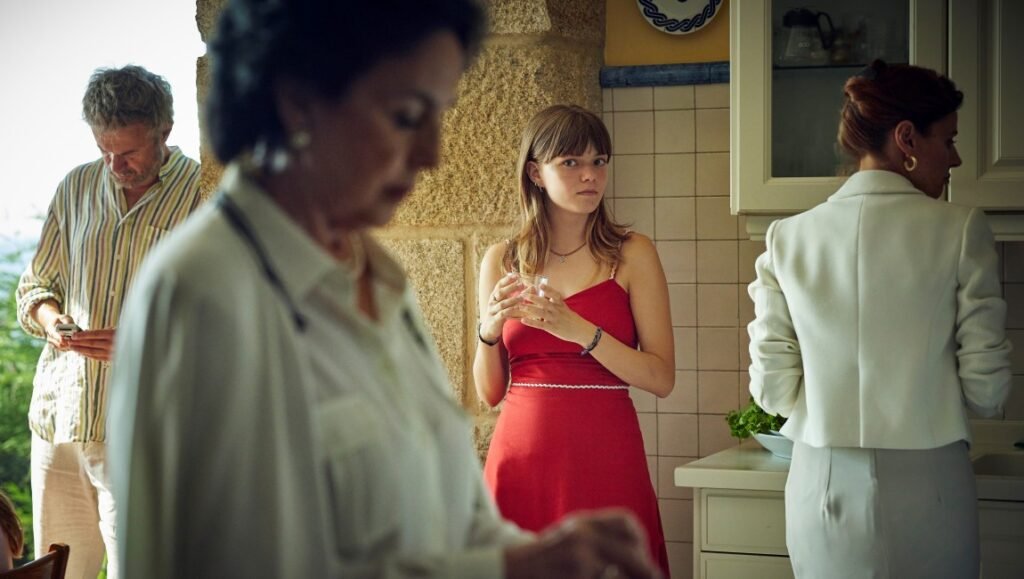
Set in 2004, Romería follows 18-year-old Marina (Llúcia Garcia). A stand-in for Simón, Marina is an aspiring filmmaker who travels to Galicia to uncover the secrets of her parents. Having passed, after a struggle with heroin and AIDS, when Marina was only six, the daughter has no real sense of who they were. Meeting various members of her father’s side of the family, she hears differing stories about their lives, their deaths, and who they were as people. Entirely mirroring Simón’s experiences (she took a similar trip to Galicia to seek answers about her parents), Romería is an attempt to reconstruct memories that were never had.
In a stunning break from Simón’s usual stabs at realism, Marina follows a cat to a small boat and suddenly slips into the past. This moment of fantasy, one in which Marina and her cousin become her parents, serves as a portal to understanding the parents she never knew. It’s a beautiful sequence that is less concerned with catharsis for Marina (or Simón) and more interested in extending grace to two young people who never had a chance. After being told interpretations of a story by jaded family members, one filled with judgment and a lack of care toward addicts, Marina creates her own. Its veracity isn’t important. It’s the one she needs to move on. In a year full of personal filmmaking using image to reckon with grief and memory, Romería makes a great companion to the excellent Blue Heron.
With Romería playing in select theaters, I sat down with Simón to talk about the film, giving her parents agency, constructing memories from ones that don’t exist, and M. Night Shyamalan.
Brandon Streussnig: Your work has always been personal, and you’ve always drawn direct parallels to it, but this one feels totally aligned with your experiences. What made you finally want to unpack your feelings about your parents and your own life?
Carla Simón: It was born of my frustration at not being able to get to know my past because my parents died when I was a kid. I think my need came when I was writing my first film, and I realized I couldn’t remember my mom. I couldn’t remember how she was, what she was like.
That started me on a quest to understand who she was and what kind of person she was, which then led to my questions about her relationship with my dad and what that was like.
Then, at some point, I realized it made sense to make a film exploring the time I went to meet my biological dad’s family for the first time, when I was around 18, like Marina. I wanted to talk about memory and how, when you lack memory, you cannot invent it. You try to kind of build it through other people’s stories. Because my parents died of AIDS and then they also had this time where they were addicted to heroin, their memory was full of stigma and taboo that made my family not talk about them. My family had to somehow transform their memories in their minds to cope with them. I realized that when I tried to put the pieces together through other people’s stories, it was really difficult. They didn’t fit.
So for me, the film was the chance to free myself, create new memories, and fill the gaps. To create the images that I was lacking, and create a possible story for my parents where I know it’s maybe not like it was, but at least it’s something that fulfills me.
BS: Cinema is such a great tool to reconstruct memory. Now that you’ve recreated memories that weren’t there, does your mind conflate them with images from the film?
CS: It’s a mix. Nobody’s memory is reliable because it works in strange ways. We don’t really remember facts. We remember the last time that we remembered something. So, in our minds, memory keeps transforming all the time. I think that nobody can say that their memories are faithful to reality.
Mine are even fewer because of the fictions I’ve created through my films. At some point, everything gets mixed. Sometimes I don’t know if it happened or if I just invented it for the film. I worked so much on it that now it has become real, or I feel it happened that way.
So I would say yes, that all the things that Marina imagines about her parents, I think that somehow they became part of my memory too. It was an exercise to try to create a possible story for them out of all the elements I had, which were my mom’s letters that I turned into a diary for the film, and some of the information that I got from my family.
BS: Hélène Louvart is such a prolific cinematographer with her own vision. What kind of conversations did you have with her about constructing these memories?
CS: We worked a lot on the differences between the parts where Marina is visiting her family and the parts that she is imagining. When she’s visiting her family, we felt that I was coming from a place of having made two films about family as well, where the camera was one more member of the family. I felt that this time it should be different because Marina was more of an outsider in this family, and we had to fill the distance between her and the characters and show how she was new to this world. The camera had to be colder, regarding the way that she was relating to the characters.
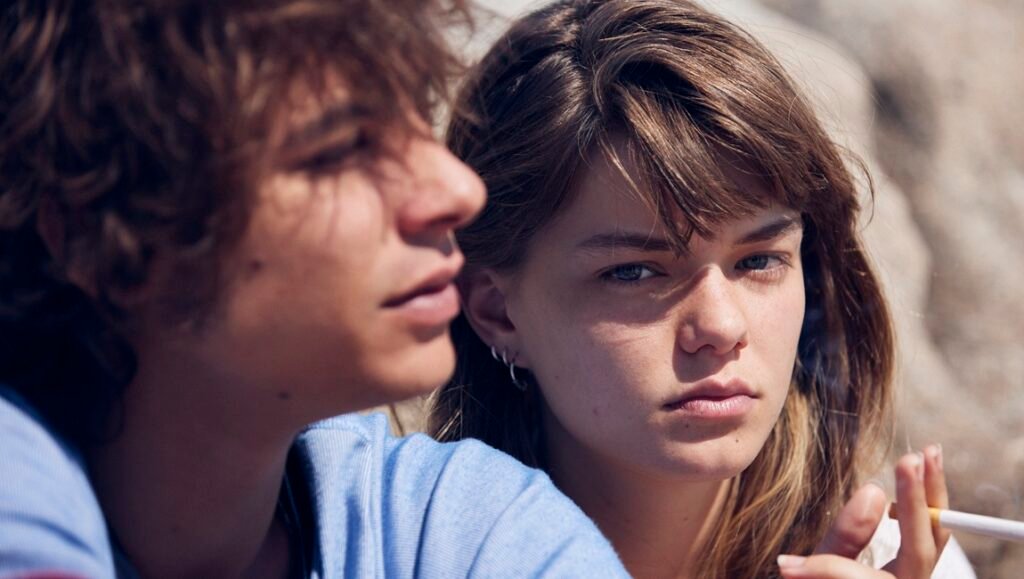
When we were creating the parts of her imagination, it became very organic. It was more like a handheld camera. We are portraying a kind of youth that was very playful and very in the moment. So this camera could be warmer, closer to the characters, and even more poetic. We decided that we had to change the texture, and we worked a lot on the colors to make sure that we were portraying a world of the ’80s that wasn’t an exact replica of reality. It’s her imagining this. We have to follow her into a journey, into something that we have to understand is not real. Then, once we are there, we can be playful in the way that we portray the characters.
BS: I really like that you say “playful” because it conveys real empathy to the parents. You present them as young adults, which is what they were. There’s a real grace around the lives they’re leading, even if they’re destructive.
CS: For me, it comes very naturally. I was raised in a family where we talked openly about that. I discovered that my parents died of AIDS when I was 12, and I decided that I didn’t want it to be a secret. It’s true that it was a secret in my family. My grandparents supposedly didn’t know that my mom died of AIDS, but obviously they did. I decided that it was my responsibility to change this, not to judge them, and to see that it’s also a generational problem. These kids were born and raised during the dictatorship of Franco with a lot of repression. They become adults, and freedom arrives, and that was a happy and beautiful moment to be young.
At the same time, it had a B-side where a lot of people got hooked on heroin. They didn’t know the consequences. Then, obviously, AIDS arrived. They didn’t know the consequences of that either. From my grandparents’ perspective, it was their choice to get into all this. But for me, when I think of them, they were victims. There was a big, big heroin crisis in Spain because a lot of heroin came into the country. Not judging them, seeing them as young people, trying to make a portrait of them where heroin is not the only thing that defines them, for me, that was very important. It was also an opportunity to give value to this generation and to be thankful. They were the ones changing all these conservative, Catholic, and fascist values that were installed in Spanish society at that time.
BS: Your films are generally pretty grounded. Talk to me about incorporating fantasy into this one. It isn’t just that Marina imagines her parents’ youth. She follows a mysterious cat into the past. It’s a lovely moment.
CS: She’s on a quest trying to understand her parents’ story through other people’s narratives. When she realized that she could not put the pieces together because everyone’s version is different, she decided to invent a possible story. At the end, that’s what she needs. It was beautiful to try to create a film in a film where she imagines, and imagination works much like how we dream. So everything she imagines is beyond what she knows. She doesn’t have information about her parents or how they moved or how they were because she has just a few pictures, so she imagines herself becoming her mom and her cousin becoming her dad. Then she imagines the whole story in the places she just visited, using the same shots she captured with her video camera. So everything is used to create and fill the gaps she lacks.
BS: You’re a Catalan filmmaker and your previous features were shot there. This one is shot in Galicia. What were the differences in shooting there?
CS: For me, it was a natural step to shoot in Galicia because my biological dad was from Vigo, Galicia. It was also magical to go back there and shoot in the places where I felt my parents lived out their love story. I always feel that the places stay and people pass; it’s a way to connect with them. My father loved sailing. So all the pictures that they have from there are in a sailboat. It was all just very natural.
In the ’80s, Vigo was a city with a lot of cultural movement, music, and parties. So it made sense, and it was organic to go there. It was beautiful, after making two films in the rural Catalan countryside, to go to the sea and be in another landscape.
BS: Romería premiered at the same Cannes as Sirāt. I think for many cinephiles, there’s one image of what Spanish filmmaking looks like, and it’s often influenced by Almodóvar. What do you make of this current wave of filmmaking coming from Catalonia, Galicia, and other corners of Spain?
CS: We are very happy. We feel very fortunate to be living in a moment when we feel there are different voices exploring different paths, taking risks, and not going to safe places. The cinema that was made in Spain has usually stayed in Spain. Lately, it seems the world has started paying attention to what we are doing there. This year at Cannes, there were three films in competition from Spain. Suddenly, it’s like the relationship with the world changed for Spanish cinema. I think it has to do with funding and trust in the finances. It makes sense to invest in cinema because it’s a way to export ourselves and talk about our country.
BS: This last question is purely selfish on my part, but there’s a great picture of you being presented with the Golden Bear for Alcarràs by M. Night Shyamalan. You’re both filmmakers I’m such a big fan of. What was that moment like?
CS: It was very, very beautiful because we make such different films, but he was very impressed by my way of directing children. Hearing him talk about Alcarràs, he told me that they were very surprised when they realized that, in the credits, all the family members had different surnames, so they were not a real family. He asked me questions about how I cast, and I was like, “I should be asking you questions!” His curiosity about my film was so beautiful to me.
Comments are closed.