
An opening shot of a bleeding, near-dead girl dragging herself across a tennis court in pitch darkness, only to be knocked out by a single serve from a ball machine, tells you immediately and exactly what kind of film is on the screen. Bloody Tennis, the latest feature from celebrated German-Greek director Nikias Chryssos, assembles overtly familiar genre parts and pours them into a sport as cinematically resourceful as tennis. The result is a visually pleasing, finely acted film that delivers no small amount of joy, strong enough to thrive even for those with an allergy to yet another citation of Suspiria.
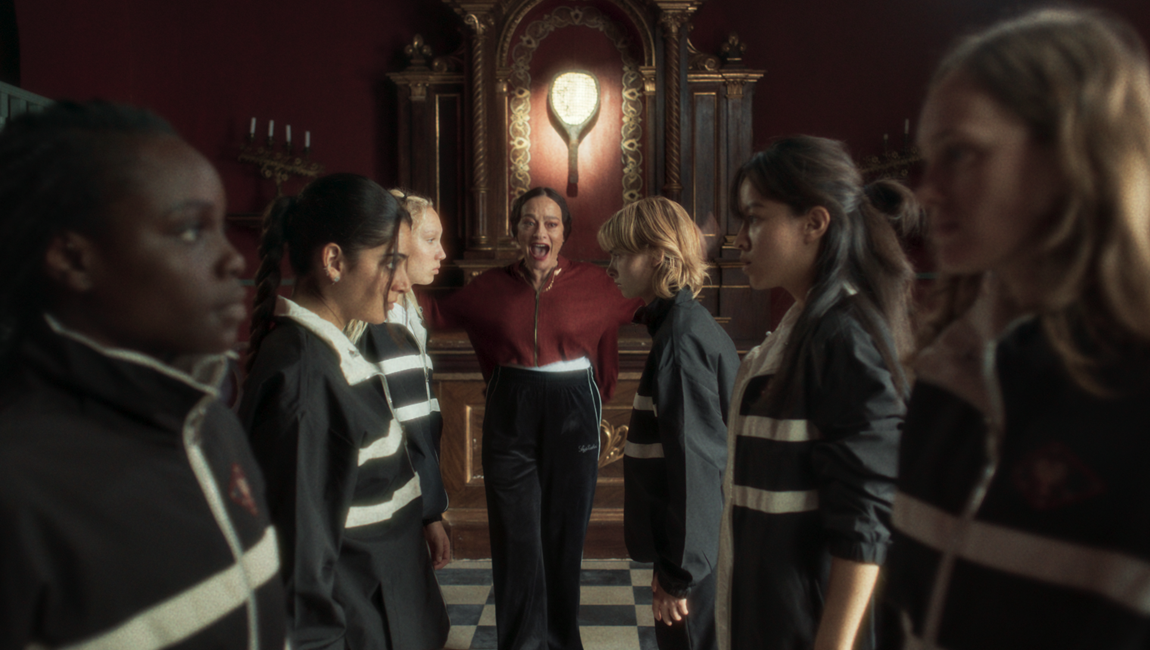
From that prologue, the film shifts to the beginning of its story without much exposition, to its credit, greeting us with aspiring athlete Sophie (Sandra Guldberg Kampp) on her way to an elite tennis academy, before plunging her straight into purgatory the moment she crosses the gate. She is greeted by Mary (Elina Löwensohn), the camp’s campy, mysterious queen, who demands her phone even though Sophie needs to stay in touch with her father. She is then introduced to the other girls — highly competitive on the court, they carry that dangerous mix of menace and horniness native to their age, sharpened by the strange energy of the place they absorbed long ago and now radiate. They give Sophie the apt nickname Bambi for her cropped blonde hair and big, curious eyes, though her apparent innocence proves deceptive when she fends off their first bullying attempt on the spot. Sophie has enough talent and rigor to become the ultimate athlete, but the academy pushes that ambition well beyond the court, as she must fend off plenty of evil besides tennis balls.
As Mary smokes in her office, monitoring the girls’ training sessions on surveillance footage, Sophie begins to taste blood while cleaning up her own. She exhausts herself on the court, only to discover afterward that her feet are bloodied from repeatedly jumping over something suspiciously sharp. Meanwhile, lunch arrives as a compulsory cocktail from an inedible menu, leeches are swallowed, rackets are crafted from freshly killed flesh, and the girls try either to sleep with her or kill her, driving her mad either way. But Sophie is no Bambi, not one to simply throw up and give in, instead meeting the academy’s excess with an appetite that matches the film’s own. As the plot advances and Sophie proves that only the hungriest survive, biting out her place quite literally, this escalating if wholly predictable dynamic remains a pleasure to follow, thanks largely to the cast. There is a wonderfully mixed assemblage of girls with different ethnicities and accents, but Zlatko Burić presides over them as a coach whose imperious personality and signature rough Eastern European accent make him fittingly threatening.
Bloody Tennis is unafraid of showing its hand when it comes to genre familiarity, piling up references to I, Tonya, Mean Girls, and Black Swan (which gets a particularly nasty echo in Sophie’s toe, seemingly rotting from trauma much like Portman’s), while openly flirting with the patterns of B-horror without pretending to reinvent the wheel. And it maintains that balance surprisingly well, working the way a good player does on court, squeezing plenty of fun and insanity from its tightly bound space.
Chryssos wrings tennis for all its expressiveness, cruelty, and sexuality, exploiting the sport’s peculiar mix of bodily choreography, grunts, and ritualized violence against the pristine beauty of sun-drenched courts, white training clothes, and manicured grounds. Shooting in picturesque Gran Canaria, he masterfully layers that charged tennis aesthetic over horror, producing a playful contrast between aristocracy and madness, with the latter vulgarly mocking the former. Jim Williams’ score deepens the sinister register, fittingly so given his work on Titane and Raw. All in all, everything a good tennis film demands is here: from smart editing to camerawork attuned to the choreography of space. It comes as little surprise from Chryssos, whose The Bunker and recent Rave On, co-directed with Viktor Jakovleski and filmed entirely inside a club during a real party, already showed such a command of rhythm and vibe. Bloody Tennis is worth watching for its technical finesse alone.
But for all its creative excesses and its debt to a well-worn genre, Bloody Tennis also knows when to underplay. The underdeveloped thread of Sophie’s daddy issues, for instance, is quickly outrun by the action, while the 90-minute runtime works in the film’s favor, leaving little room to drift into meditations on Argento’s legacy. The film is better for that lack of pretension, a reminder that sometimes the smartest thing a film can do is relax and have some fun.
DIRECTOR: Nikias Chryssos; CAST: Sandra Guldberg Kampp, Elina Löwensohn, Helena Zengel, Tracy Gotoas, Zlatko Burić; DISTRIBUTOR: Shudder; STREAMING: September 25; RUNTIME: 1 hr. 30 min.
Comments are closed.