
The castles of Ludwig II seem to resound with that Wagnerian mystery: here time becomes space. They seem to distend from some turreted past; a time of knights, gallants, banners figured by the wind. Such times did exist in Bavaria, but never such as this. Never with such perfect spires as Neuschwanstein, perched so inconveniently high in the mountains. Nor did the French Rococo reach so far east, as in Linderhof; nor was Versailles built upon an island on the Chiemsee. These are the leftovers of some imagined history; an imagined culture. In their detail they are astounding and they are ludicrous. Architecture is, by its nature, the most practical of arts. A building must, to succeed in being a building, accord with physical reality. It must be built, it must bear its weight, it must stand. In almost every case, a building is built with purpose in mind. However ornamental or artistic its design, it will serve as some shelter, or defense, or center of business. Alexander Pope cuts it most fine: “’Tis use alone that sanctifies expense / And splendour borrows all her rays from sense.”
Ludwig would have made a ripe target for Pope’s satire, had he not been fortunate in his lateness of birth. But these follies, if follies they are, were not conceived entirely outside of utility. The utility was rather one abstracted: Ludwig senses in a nation beautifully castled a nation of aesthetic worth; that to possess such buildings as these necessarily improves a country and its people. The action is therefore artificial: an attempt to import beauty where beauty did not previously exist. History’s long strides may bestow upon a country any number of triumphal arches, or spiring castles, or vast palaces. Ludwig intervenes: he erects an arch for no victory, a castle in defense of nowhere, a palace for an absent prince. These buildings must grope at a simulation of purpose, a purpose all hollowed out. In the 19th century, German aristocrats — and later Austrian film directors — would scar themselves on the faces, imitating the Renommierschmiss —the bragging scars — of a routine duellist. These men were battle-scarred, absent of battle. The castles that mottle Ludwig’s Bavaria belong to those same phantom conflicts.
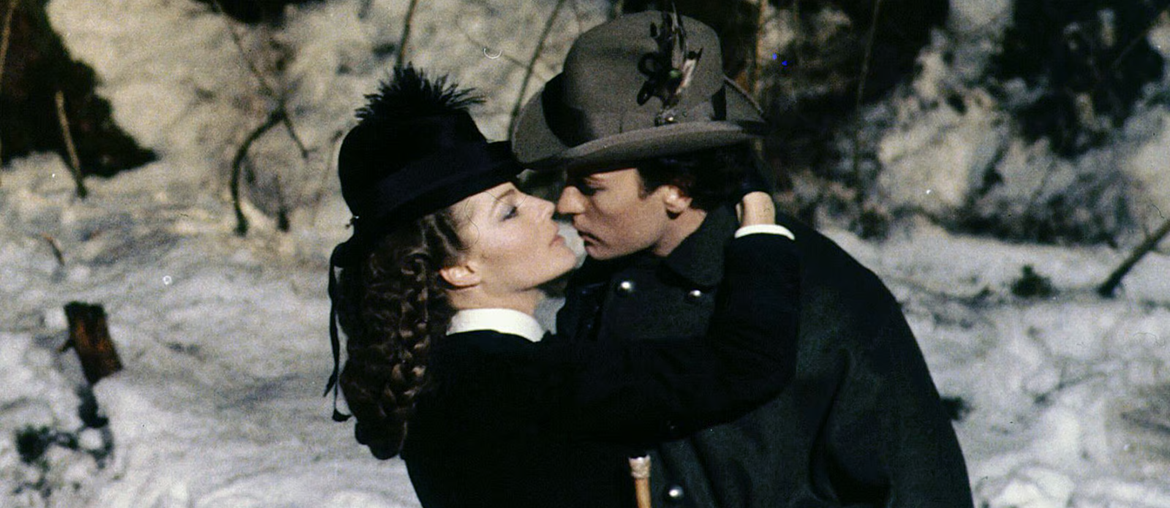
In Luchino Visconti’s Ludwig, Sissi (Romy Schneider) visits each castle in turn. She stands at the foot of Ludwig’s Hall of Mirrors — she who knew the original — and at a sudden cut she laughs. She laughs to see the authentic glory of Versailles copied here in Bavaria; she laughs to see the Moon glimmer with the light of the sun: a counterfeit light, not his own. It is some small irony that, while Ludwig’s Herrenchiemsee is generally a miniature of Versailles, his Hall of Mirrors is a little longer. There is a feeling of the futile, or the vacant, in these adventures: not the world, but a pale repetition of the world — technically beautifully but spiritually slack. And yet we admire them: they have come to define Bavaria’s cultural landscape. There is, in these Babels of the Mad King, a new texture born. Some other feeling fills up the cavity of meaning.
This too is the mood of Ludwig, a film that so perfectly embodies the hollow majesties of Ludwig II’s imagination. It is a mighty affair — four hours of palaced, crowned drama — and yet in it is also a persistent absence. An absence of tension, or propulsion: a groping at meaning and stature. Here is the frame of a great film which can never attain greatness; it is a film that searches itself for what might constitute a great achievement in art. It must search as Ludwig must search; a rich and dreaming king for whom the world seems to fall away. The film is therefore shaped in the way of Ludwig’s own mind; it is a film as Ludwig might have directed it. And in Ludwig is found the mirror of Visconti himself: also an aristocratic scion, also in friction with the tendency of the nobility, also attracted to grand designs in art and expression, also divided in his romantic aspirations and sexual proclivities. Ludwig therefore attains its triple-texture: it is a film about Ludwig II; it is a film in the style of Ludwig II; it is a film about Visconti. In all its excess and indulgence, there is an imperfect harmony: a sense that all the nervous distributors who cut this film to ribbons failed to understand that it cannot be chopped into anything other than what it is. A shorter version could, no doubt, convey the story here represented, but what story is there? Lines are taken up and dropped; the film will jump, then linger, then flit somewhere else. Ludwig is not a film designed to deliver any kind of story. All of its inadequacies seem necessary elements of its composition. It is a total mutuality of form and of content.
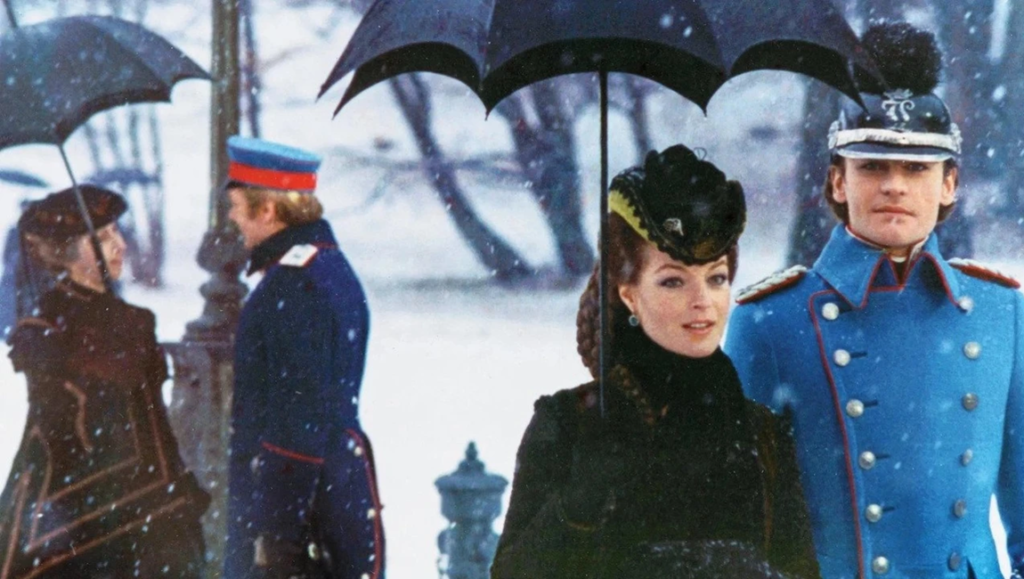
If we are to detect any narrative structure, it is a series of disillusionments in the career of the king. We begin the film with Ludwig an idealistic monarch, who intends an artistic, romantic reign. He will maintain an unreciprocated, pristine love for Elisabeth; he will patronize the arts; his rule will be dictated from the clouds. Here the film is most satisfying, dividing its passions between Schneider’s knowing Sissi (to Schumann’s Kinderszenen) and Ludwig’s patronage of Wagner during his Tristan-passion, which makes frequent occurrence in the soundtrack. Here he is twice disillusioned. First, Wagner’s artistic purity is betrayed by the impurity of the artist himself: Ludwig can no longer trust in the unblemished artist-hero. Second, Sissi must reject the strangeness of Ludwig’s commitment to unreciprocated love. These twin estrangements leave him unanchored, and he drifts increasingly away from matters of state. The Austro-Prussian war breaks out, though Ludwig never appears fully apprised of the significance therein, and this becomes his second situation: the detached, stargazing king.
But then comes the next disillusion: his friend Dürckheim tells him he must live in the world; he cannot become completely moonbound. And so he commits himself to this: to marry cousin Sophie, and so to begin a more conventional reign. One might suppose he is taking a more practical approach to living; forgoing those stained clouds for a sturdy, embodied ground. But in this he must become again disillusioned. He does not love Sophie; more essentially, he does not feel compelled by her. He discovers that it is to men he feels compelled. In light of his new attitude, it seems appropriate that he consummate this desire — abstract no more. But then comes the next major turn. He announces to his priest that he will break off the engagement with Sophie. The priest tells him that this is not the way the world functions; that even if his marriage is loveless, he must commit to it, because this is the theater of the state. Here is an inversion of Dürckheim’s promise: in the first instance he was too abstract, and now he was too practical. It is preferred that he engage in a cynical abstraction of the practical need. To marry lovelessly; to rule heartlessly.
And so Ludwig embarks on his destructive rejection of all these presumptions. No longer will he be the delicate King of Clouds, nor the straightforward aristocrat. He will indulge in his many fancies and delights according to compulsion, and forgo the outer world to the generals and the politicians. It is in this mood that he can build his castles; in this mood that he can shape his world as though he were the tenor of a Wagnerian epic. And a Wagnerian epic, specifically: he is not occupying the reality implied by an opera, but rather the opera itself. He has made his world a stage: he has peopled it with actors who must perform at will, and he has built mighty sets upon the mountains and lakes. We see him in the Venus Grotto, reconstructed from Tannhäuser; we see him in Hunding’s hut, as in Die Walküre; and cooped in Neuschwanstein, as might line the painted background of Lohengrin — Ludwig was himself known sometimes as the swan king. In this new abstraction, he exists entirely in a mirror-world, an art-world, in which the original (from which art must distend) is wholly obscured. In his early years, he resembles Parsifal — a holy fool, enlightened by compassion — but in this late career he resembles better Siegfried, born of siblings, doomed despite all his heroic efforts to an early demise. In his glittering cage he has found no meaning but in great art; he can see no virtue but to summon this art into reality, to blend the two. Perhaps Visconti was of a similar bent. Perhaps the opulence of Ludwig is itself a summoning of another realm, in which to drown the senses.
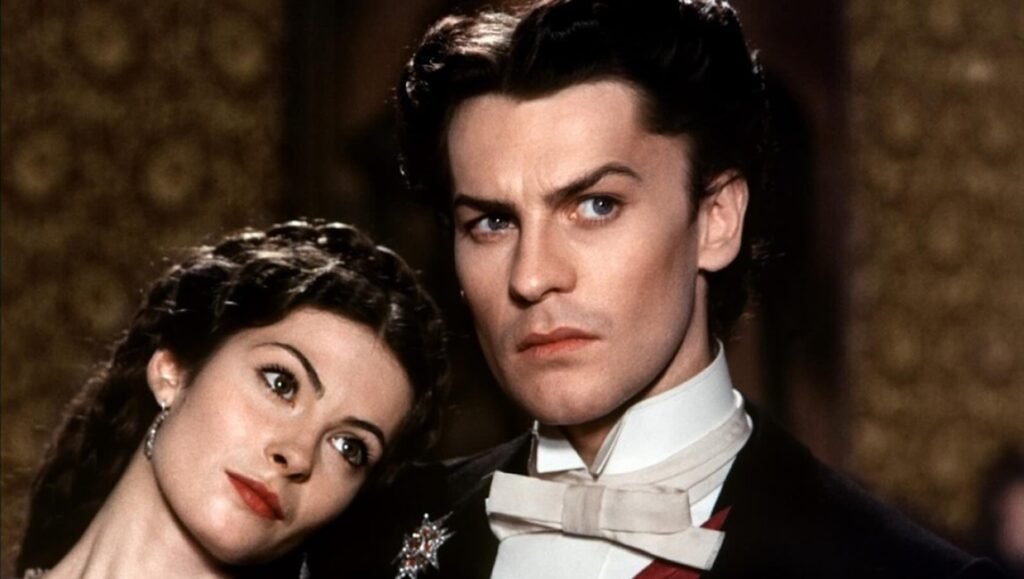
The operatic sense swarms across this film, not merely in its conceit but also in its shape. Wagner’s operas are remarkable in how uneventful they tend to be: not in that they lack drama, but that so few things happen from curtain to curtain. Tristan is the most astounding version of this, in which four hours of music accompany perhaps four or five significant incidents — there is so much and at once so little. One is tempted to apply Rossini’s infamous jab at Wagner to Ludwig more generally: it has lovely moments but awful quarter-hours. One must drift through its peculiar, sometimes stately, sometimes hysterical moods, never sure what is motivating a scene, nor whether any given moment should be interminable or brief. The film seems to match the mood of its protagonist: when in the presence of Sissi or Wagner, it comes to energetic life; when these characters vanish, the film too seems to stumble in search of some other object of fascination, and tends to fail in finding one.
The second part is perhaps improved in the appearance of such an object, or several: those fairy-tale castles themselves. Much is made of their architecture, and perhaps it is important that the film merges genuine on-location photography with opulent interior sets: a repetition of the repetition, another step into the dream-world. Indeed, it sometimes seems as though Ludwig is itself one of those castles, perching on a distant mountaintop, uselessly beautiful in its splendor. Visconti spends much time touring a bewildered Sissi around their many facades and hallways, and it is as she herself tells Ludwig in the early part of the film: they are not the monarchs of history, but rather they too are facades. The redundant face of a world-system that no longer champions Sun Kings or their like; they have entered the universe of Bismarck, and whatever romance there once was — real or imagined — has faded into another time. They are there to act their part, to take to the world stage (and consider how long, detailed, and choreographed Ludwig’s own coronation scene is) and do as their remit bids.
Ludwig’s decline and derangement — if it is much of a derangement — seems then spun from this ideal: a man out of time and out of mind; a man who does not and cannot compromise himself to the necessities of a state foisted upon him; a man whose every behaviour becomes an artificial reflection of some other, truer self, existent only in the world of fancy. A world of chintz and painted gold! Beautiful but absent, grand but empty, the great echo of a since-forgotten song. So the man, so the film — but not without some tenderness. Ludwig’s ending is obscurely tragic, as though the mercenary world could not let him survive such brushes with the pseudo-sublime. He dies — perhaps he is killed — in the company of those who see his existence as inconvenient. Elisabeth would later reflect, “The King was not mad; he was just an eccentric living in a world of dreams.” They might have treated him more gently, and thus perhaps spared him so terrible an end.
Comments are closed.