

Three years ago, I wrote an essay arguing Allen Fong’s Ah Ying (1983) paints a more realistic picture of 1980s Hong Kong than Wong Kar-wai’s arthouse cinema and other action films of the era. While more commercially successful internationally, these counterparts offer idealized versions of Hong Kong, replete with visual flair that often reduces my home to little more than aesthetic signifiers. As a joke, friends now send me posts by influencers trading in these signifiers: poses in front of hyper-dense architecture and in cramped apartments, blurry and captioned with melancholic Wong Kar-wai movie quotes. But not all neon-lit depictions are inherently romanticized. When Angie Chen’s My Name Ain’t Suzie (1985) opens with inverted and kaleidoscopic reflections of neon lights on a windscreen, what it foreshadows is neither unrequited romance unfolding against the nostalgic backdrop of the city nor a cyberpunk muse, but instead a story about real people and their struggles.
In a similar inversion, My Name Ain’t Suzie was conceived as a response to Richard Quine’s 1960 film The World of Suzie Wong, itself an adaptation of Richard Mason’s 1957 novel. Also shot in Hong Kong and revolving around the lives of bar hostesses, Quine’s romantic drama has often been criticized for its exoticized, colonial imagination of the city and its hypersexualized caricature of Asian femininity. Chen first encountered the film as a child, and its male gaze and Western perspective left a lasting impression. Years later, after studying writing at the University of Iowa and attending film school at UCLA, Chen was offered a three-film directing contract with Shaw Brothers, unheard of at the time for a female director. She was determined to retell the story in her own way, or in her words, “from a female and Hongkonger’s angle.”
My Name Ain’t Suzie follows Shui Mei Lai (Patricia Ha), a young woman from a fishing village who seeks to work her way out of poverty as a bar girl in the Wan Chai red light district. Shui Mei is not alone; other girls from her village dream of a prostitute’s seemingly glamorous, cosmopolitan life, scrambling to be handpicked by Auntie Monroe (Betty Ting), the madame at Lucky Bar who periodically visits the village to bring back “shipments” of young women to be trained as prostitutes. Decked out in gold accessories, she brags about eating eggs every morning and meat at every meal, while desperate parents fawn over her wealth, eager to hand her their daughters’ futures.
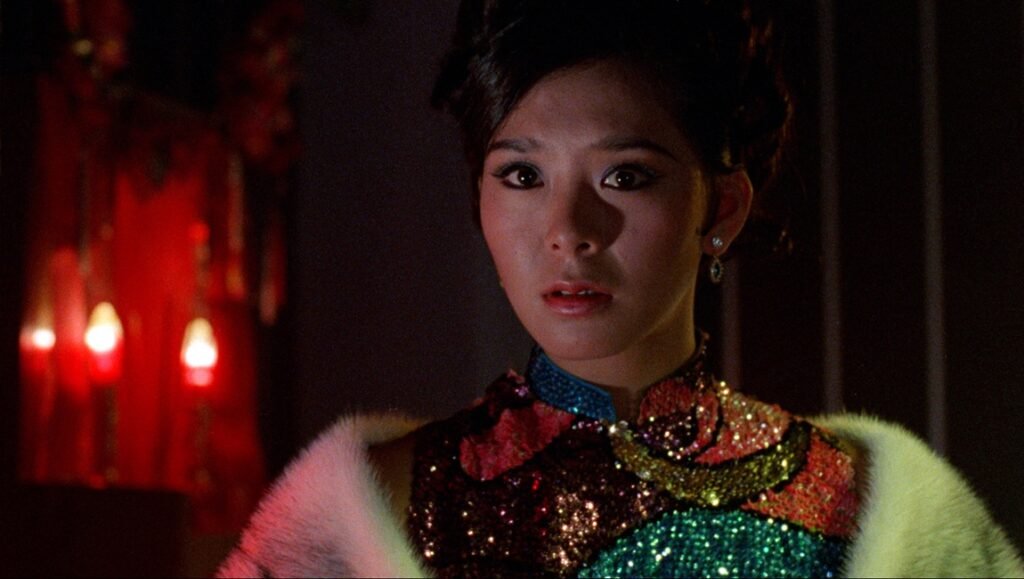
The 1950s and ‘60s were a boom time for brothels and go-go bars in Wan Chai, thanks to the district’s proximity to the maritime hub serving soldiers and sailors during the Vietnam War. But this is not a story about the “golden age” of Hong Kong’s nightlife under shifting colonial influences, nor is it a fetishization of sex work. After the war ended, Wan Chai’s sex industry declined, and the Kowloon district of Hong Kong became the locus of prostitution, catering to locals instead of foreigners. In the film, Lucky Bar goes out of business, and former prostitutes struggle to make ends meet. What was once the epicenter of urban life has been replaced by a gritty reality, absent from the exotic and blithe portrayal of Suzie Wong in 1960. At the heart of My Name Ain’t Suzie, then, is not an innocent woman who has never suffered, or an object of desire waiting to be rescued from poverty, but a collective portrait of women who turn to sex work to rescue themselves and their families. As Madame Monroe declares, “Who said daughters are a bad deal? She can make money for the family all the same!” This is the reality of living not only as a prostitute, but a woman with agency.
Because Chen’s goal was to depict these women as real people rather than stereotypes of the Western imagination, authenticity was a top priority. Along with screenwriter John Chan (Nomad), Chen spent time with real bar girls in Wan Chai during the research process and eventually cast them as bit players in the film. And instead of hiring a contract Shaw actor for the role of Jimmy, the cynical young man with whom Shui Mei falls in love, the production team held extensive auditions. They eventually chose the then-unknown Anthony Wong, who shared Jimmy’s biography as the son of a white father who had abandoned his family. (Wong would go on to become one of Hong Kong’s most celebrated actors, from Hard Boiled to Infernal Affairs; but here, his debut carries the rawness of someone playing a version of himself.)
Expectedly, Shui Mei and Jimmy’s fate is far from the Suzie Wong fairytale: Shui Mei’s mentor, Miss Xiao, and the other girls grow jealous of their relationship, forcing her to leave the bar and become a streetwalker; she later discovers that Jimmy has found his father and is moving to the U.S. with him. After losing both her job and lover, Shui Mei is not saved by a white knight; instead, her cousin Leung Mui leaves the bar with her, and they forge their own path as sex workers. As Shui Mei declares upon her departure, “There’s nothing to be afraid of… We don’t have to rely on anyone. Our skin and flesh is our own.”
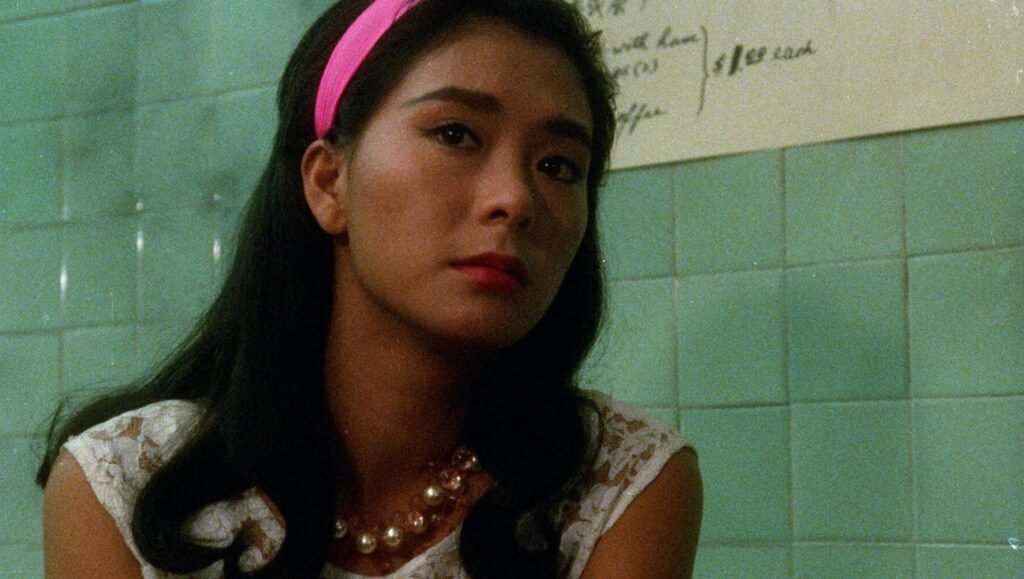
It’s not an easy path. Newly independent, Shui Mei and Leung Mui struggle to find clients and face multiple arrests; and when Shui Mei finally manages to open her own brothel, she finds herself caught in a tangle of rival gangs, with no one from the former Lucky Bar willing to help. Once again haunted by her past, Shui Mei turns to Wong Ying (Deanie Ip), who comes closer than anyone in the film to being Shui Mei’s guardian angel. “In the years after Lucky Bar, I never asked anything of anyone. Not even when Jimmy left did I ask him to stay,” Shui Mei recalls. Knowing the risk of partnering with someone who has been blacklisted from the industry, Wong still agrees to team up with Shui Mei, though not without scoffing — slicked-back hair and cigarettes in one hand — that Shui Mei is stupid enough to fight over a man.
Without any implied hierarchy or savior complex, what begins as a business partnership evolves into a friendship built on trust and camaraderie; they bicker more like an old married couple than colleagues. It is through the crevices of life’s hardships that these women’s light truly shines: in a promise to bring chicken feet home for dinner, in calling each other their beloved in a past life, and, perhaps most importantly, in a vain joke made at death’s door. In these moments, My Name Ain’t Suzie is as much a film about prostitution as it is about the tender resilience that women build to survive.
That resilience is mirrored in the film’s own return after 40 years. Creative differences between Chen and the studio during post-production caused the film to be shelved and excluded from wide release. Disappointed with how it turned out, Chen left feature filmmaking altogether. It was not until its recent restoration that the film received its belated, well-deserved recognition: the Blu-ray limited edition of My Name Ain’t Suzie sold out within hours, as did the first run shortly after. In Cantonese, “Shui Mei” is a colloquial slang for “leftovers”; “Mei Lai,” however, means “beauty.” Like Shui Mei Lai herself, My Name Ain’t Suzie embodies both meanings. Isn’t bridging these two aspects precisely what’s at stake in film restoration? In a world caught in an endless churn of content, film restoration does more than preserve history; it revives the complexities of reality and relationships that defy easy categorization or were once deemed disposable. There is beauty in all that remains, if you know how and where to look.
Comments are closed.