
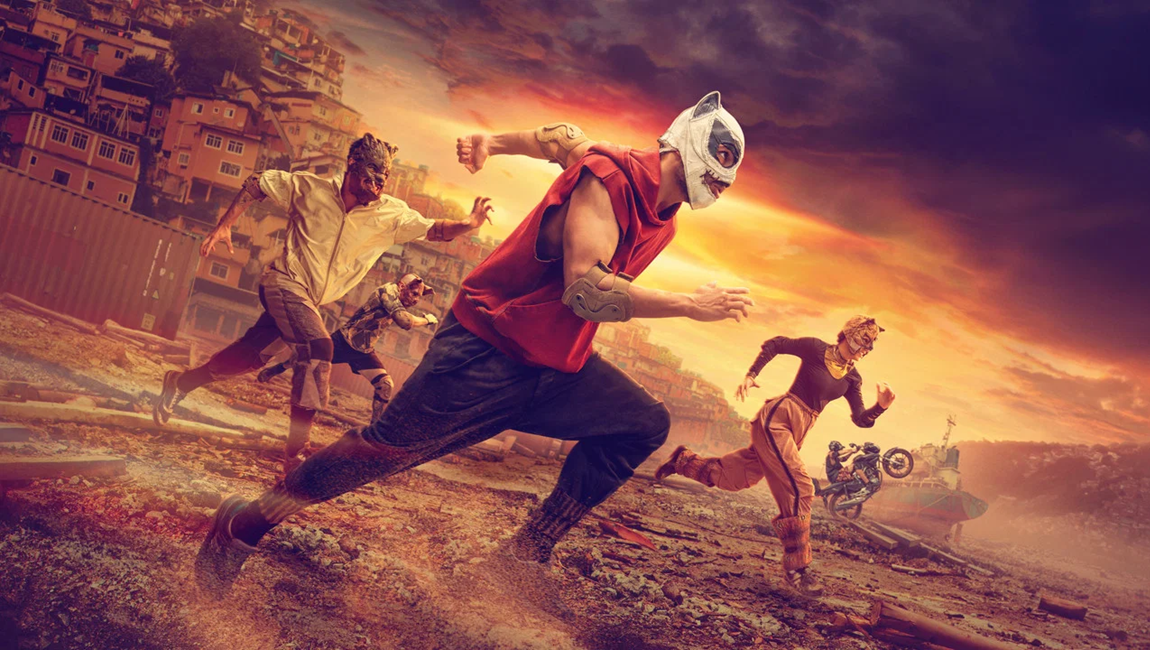
45 years after an environmental catastrophe has emptied the sea around Rio de Janeiro, the city’s main entertainment is a televised series of lethal parkour races. Poor contestants called Bichos run in animal masks under the control of wealthy Players, who bet on the results. Entry also requires collateral: another person whose freedom is forfeited if the runner loses. Mano (Matheus Abreu), a resistance leader who has spent years sabotaging the competition, enters after his sister Dalva (Thainá Duarte) is pledged by her boyfriend. That is more than enough material for a compelling action film, but Beast Race — co-directed by the trio of Fernando Meirelles, Rodrigo Pesavento, and Ernesto Solis — is not able to make the competition exciting or the society around it coherent. A very good premise has become an awful movie.
The real jogo do bicho is not a race, nor does it involve people dressed as animals. Created in Rio in the late 19th century, it’s actually an illegal lottery in which 25 animals correspond to groups of numbers. Bets are traditionally placed with street bookies working from neighborhood stalls, part of a clandestine network that survived decades of prohibition and became woven into the city’s daily life. Beast Race turns the name literal. The bookies and informal wagers give way to human Bichos owned by visible rulers and consumed through mass entertainment. Corrida dos Bichos, the Portuguese title, still carries the original reference.
A film is, of course, free to tear up the institution that inspired it, but in that case the replacement needs to work on its own terms. Beast Race barely has terms. The state is nowhere to be found; rules appear only when the plot needs them; the vanished sea receives the same treatment. Familiar parts of Rio now sit amid the wreckage, but nobody seems especially concerned with how a city without its old shoreline obtains water or moves anything. In the lack of coherent world-building around it, Rio functions as though it were the only city left in Brazil, perhaps the only place left anywhere. Gustavo Hadba at least photographs the locations competently. Beast Race is never ugly in its visual design, and its poverty is carefully arranged to look good: damaged housing and occupied districts become slum-chic production design, while the wealthy live inside the expected compounds of vulgar comfort.
As for the city’s inhabitants, we fix on Mano, who has principles and a sister to save. And… that is almost the entirety of his development. Abreu certainly looks the part while Mano is running, but he still lacks the screen presence to carry a film. The script simply aks him to announce his principles and react to whatever happens next, and that’s about it. His relationship with Dalva is important only because the plot says it is, and Meirelles and co. proceed to use her as collateral so that his participation can begin. Leon (Bruno Gagliasso) and Nadine (Isis Valverde), meanwhile, never make it past page two. Gagliasso plays Leon as evil to everyone, at all times, apparently including God and the rest of creation — there is no public charm or private variation to make his cruelty any more interesting or complicated. Nadine suffered under him and wants revenge. Poor thing: she suffered, now she wants payback, and the script mistakes that for an entire life. And then there’s Abu (Rodrigo Santoro), who is no better written than anyone else, but Santoro does Herculean work and simply refuses to leave him in such a flat, undeveloped state. The screenplay repeatedly reminds us that he is a former competitor in the race, even pushing his snake tattoo toward the camera in case the dialogue has not made the point often enough, but Santoro adjusts his voice and posture until a joke turns threatening halfway through a conversation. At least he seems to have walked into the scene from somewhere.
But the races, which by all accounts should function as the film’s standout sequences, are a mess. We meet too few contestants to understand the field, and the movie seldom establishes what makes one course harder than another. Motorcycles follow individual runners without any clear function, and obstacles seem to appear just as the editing reaches them. We’re also introduced to the idea that someone falling behind will eventually enter the Perimeter, a prohibited residential area whose inhabitants hate the competition for reasons the screenplay regards as self-evident. And the stakes are likewise contrived and inconsistent: if a supporting character takes the shortcut, they die; if a protagonist does it, they live. Things are as simple as that.
Even more fatal to a film with Beast Race‘s conceit is that a parkour film has to let us see a body choose a route. Rodrigo Pesavento’s action direction usually offers medium shots followed by rapid cutting between performers and stunt doubles, while wider views rarely last long enough for us to understand the obstacle before somebody is already clearing it. The editing functions to keep Abreu comfortable, cutting away before his body has to carry the movement. The practical implication is that parkour becomes something that is only really happening between cuts. The filmmakers have explained that Pesavento concentrated on the action while Meirelles and Solis divided much of the drama, but understanding this does not help with assignment of blame: the film’s action is confused, and its dramatic scenes are as good as dead.
But then, Divina (Anitta) starts talking. More accurately, she rarely stops talking. The performer appears in close-up with a gigantic ring light aimed straight at her face, the presence either inserted into television screens or felt floating above the race as a voiceover. In truth, she looks like she recorded a promotional clip that wandered into the movie. A sports commentator’s role is seemingly to clarify the score or recognize a change in strategy or observe the intricacies of physical exellence, but Divina merely tells us that someone is running while we watch that person run. She talks over the races like an unwanted audio-description track. After all that chatter, the route is still a mystery. At times, the film will place her image on a television in a grimy neighborhood bar, where poor spectators watch and suffer along with the contestants, and this could have functioned to demonstrated how the game also belongs to the people it exploits. Instead, the customers serve only as another reaction shot. Anitta reads her lines in a dead monotone, without the humor the part plainly expects, and whenever the runners begin to create some momentum, Divina comes back to explain it away.
Not even Antonio Pinto’s score can do much to change the film’s trajectory, accomplishing little beyond insisting that the races are exciting. And the film’s final punishment comes in this sonic sphere, in the form of Anitta and Tropkillaz’s cover of the Titãs song “Bichos Escrotos.” In this version, her voice is flattened until the track sounds like an AI-generated imitation of the original’s aggression and mockery, and by this point viewers may want to pack their ears with wax. The cover does to the song what the film has already done to the jogo do bicho: recognizable parts are kept in plain view and all else is emptied out. It’s a sad truth to observe that Beast Race is easily the worst feature to have Meirelles’ name stamped on it.
DIRECTOR: Fernando Meirelles, Rodrigo Pesavento, & Ernesto Solis; CAST: Matheur Abreu, Rodrigo Santoro, Ísis Valverde, Anitta, Seu Jorge; DISTRIBUTOR: Prime Video; STREAMING: August 7; RUNTIME: 2 hr. 4 min.
Comments are closed.