
In their book The British B Film, writers Steve Chibnall and Brian McFarlane describe Bond of Fear, an underseen and worthwhile low-budget crime curio from 1956, as “moderately inventive.” It’s a somewhat backhanded compliment, particularly when placed in the context of supremely inventive achievements from the same year like The Searchers or A Man Escaped. In 2026, though, supremely inventive (ostensibly) sets the bar for a theatrical release, and unfussy competence has been relegated to the proverbial bargain bin of the streaming world. Yet, first by air and now by sea, Jean-Francois Richet fights to keep the spirit of the moderately inventive action movie alive on the big screen.
For those who passed out on the couch to Richet’s previous effort Plane, know that Mutiny is marginally more interesting despite the fact that Richet is still grabbing from the same bag of broad tropes to set the table for another action hero rampage in an exotic location. This time, Jason Statham plays professional bodyguard Cole Reed, and he dukes it out with treacherous sailors on the high seas to avenge the assassination of his billionaire boss, Tibu. A movie about maleficence in the international shipping industry, Mutiny docks during a particularly charged political moment: U.S. President Donald Trump is waging an unwinnable war against Iran over control of the Strait of Hormuz. But Richet (and by extension Statham, producing here under his Punch Palace Productions banner and adding fuel to the fire for the inevitable PhD candidate writing a thesis on Statham-as-auteur) very pointedly avoids politics. In an early exposition dump, Reed plays chess with Tibu, who asks him if he misses being a police officer. “Miss the action,” Reed replies laconically, “not the politics.” It’s a missed opportunity for some good termite artist commentary, instead opting for as neutral and narrow a vision of geopolitics as possible. At least Richet seems invested behind the camera: the confined nature of the setting necessitates more invention — a moderate amount, one might say — than a run-‘n’-gunner set on an open plateau would.
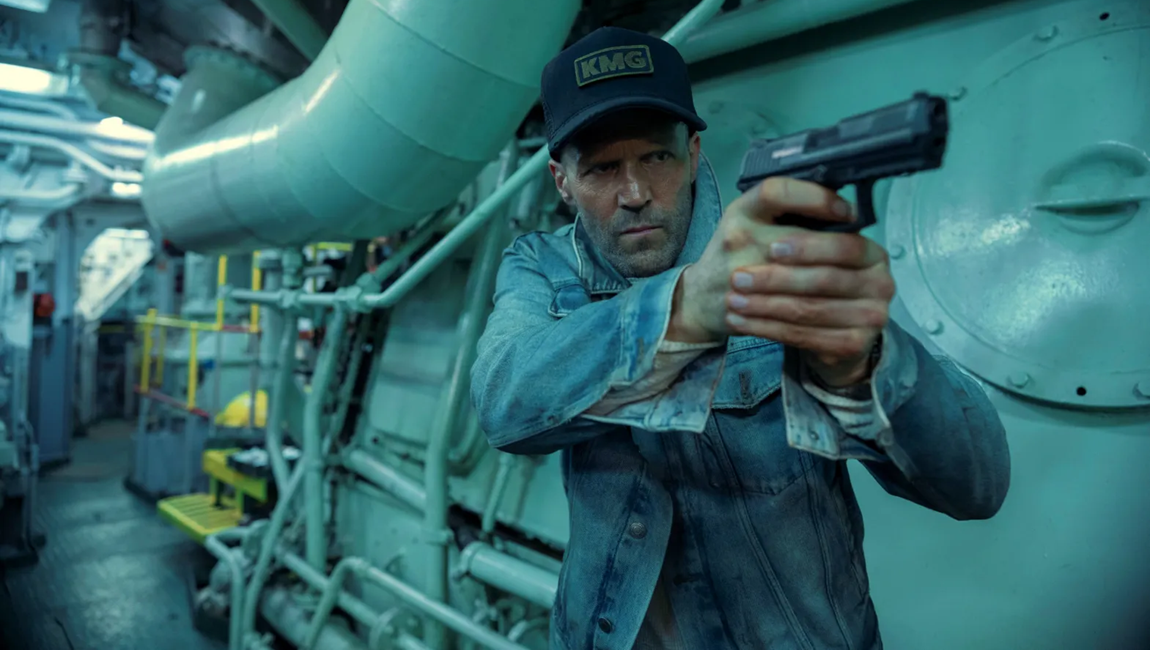
Small flourishes go a long way in Mutiny — shooting otherwise banal dialogue in a car through the rearview mirror, for example, or photographing the action through portals and small crevices between shipping containers once we’re on the ship. One canted angle, shot from above, looks down on Reed as shadows spill through metal bars, resembling an old-school survival horror video game. Yet Mutiny doesn’t merely look like a video game in parts, it unfolds like one, too: advance to the next level, circle back if you need to, and retrieve this object or ring that alarm; solve this puzzle here; escort that person there. Like many a Metroidvania, Richet contrives roadblocks to get us to different parts of the ship. It’s needlessly busy, but it also opens the movie up to explore its most interesting character: the ship itself. The KMG Artemis is so richly textured as a location, moments — albeit too brief — in between the action bring to mind the glories of Leviathan or At Sea, reminding us of the sheer magnitude of the vessel and the ocean it traverses. Richet even does the Vertigo shot from inside a ventilation shaft for no narrative-driven reason at all — it’s simply cool shit. There’s a great experimental film to be made by splicing shots of empty space here together.
The structure of Mutiny writ large is decidedly not experimental, however; it’s a death-delivery machine. Gunplay is smooth, close quarters combat is brutal, and the parkour is kindly kept to a minimum. It’s just not as efficient as it should be considering its trim 96-minute runtime. Richet takes his sweet time getting us to the boat, and there’s an unnecessary coda on dry land following the climactic fight; a little extra shimmying during the screenplay stage could’ve done away with some of the nonsense endemic to the action movie form. That said, in a time when action movies struggle to make a case for their own theatricality, Mutiny reminds us that they shouldn’t have to. It’s completely unremarkable, occasionally (perhaps unintentionally) beautiful, and latently in touch with our current moment. In other words, it’s exactly what you should be seeing at your local AMC on a weekly basis.
DIRECTOR: Jean François Richet; CAST: Jason Statham, Annabelle Wallis, Roland Møller, Adrian Lester, Arnas Fedaravicius; DISTRIBUTOR: Lionsgate; IN THEATERS: August 21; RUNTIME: 1 hr. 35 min.
Comments are closed.