
It makes sense that an author like Enid Blyton might enjoy a resurgence in popularity in times like these. War, political turmoil, the looming threat of global societal and environmental collapse — where better to escape to than the safe, quaint, resolutely old-fashioned world of Blyton’s novels? Cozy Brit-core has been something of a mainstay in entertainment for some years now, perhaps for those very reasons, with material like The Great British Bake Off, The Crown, and Bridgerton offering audiences the chance to look away from the stress and horror of everyday life and into the cheer of a traditional summer fête or the grandeur of a stately mansion to soothe their troubled souls.
Only Blyton’s Britain is a painfully and problematically antiquated one today, and indeed the middle-class, middlebrow Middle England represented in her books is hardly at the forefront of pushing for the political changes required to at least stave off the aforementioned societal collapse. And so Ben Gregor’s The Magic Faraway Tree, adapted from Blyton’s The Faraway Tree series, arrives to cinemas in rather poor taste. For all its modern updates — in particular, the multi-racial casting might have caused Blyton as much consternation as it might cause Middle England today — this cutesy story of a trio of jolly kids who find magic and mystery in the woods when their family must relocate from London to the countryside is grating in its tweeness and tone-deaf in its forced hopefulness. Worse still, it’s also abysmally assembled.
The problems lie primarily with Gregor, whose inexperience in directing feature films shows from the very first scene. We’re afforded just one scene with the family in London before their rural exodus, and said scene features just the parents, Tim (Andrew Garfield) and Polly (Claire Foy), and takes place in the kitchen of their home. Gregor consistently fails to find scope in the story, anywhere to situate the narrative, so it feels narrow and incomplete. A scene with Polly’s mother (Jennifer Saunders) in London takes place in the back of a car, and her storyline is left entirely unresolved; she’s only glimpsed a few times in the movie’s climax. A subplot involving Tim’s childhood builds toward a pivotal reunion that ought to be the very heart of the movie; then, as shot, this reunion barely even occurs. And whatever all this empty space is sacrificed for is unclear, as Gregor and writer Simon Farnaby (typically far more reliable) regularly opt for convenience over complexity — if you’re wondering why the villagers don’t heed a word of what Tim and Polly are saying at the end, it may be that it was just easier to write that way.
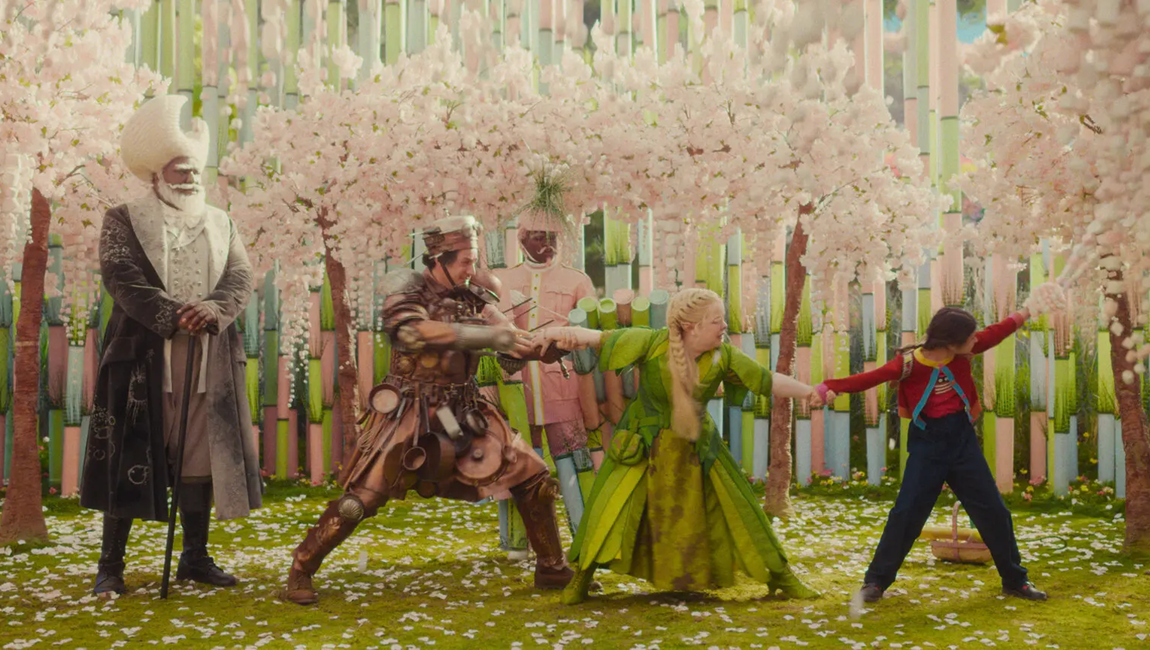
The Magic Faraway Tree is a movie filled with dead air, where half the shots last a beat too long, perhaps lest the younger viewers fail to keep up. Not that there’s much to keep up with, since the episodic plot merely trundles through fantastical encounters, realized with the bare minimum of artistic imagination, in a half-hearted race against time. Gregor’s magical world is underdeveloped, and lacks sufficient contrast to the real world outside to convey any sense of wonder. There’s precious little ceremony to The Magic Faraway Tree; Isabella Summers’ score seems to have been deployed to fill in what the filmmaking couldn’t, but all its heavy lifting becomes overbearing, and it weighs the movie down. The whole thing is leaden where it should be light, gauche where it should be graceful, and extremely sloppy, too.
If there are diamonds to be unearthed from all this rough, they’re tarnished. The adult cast give largely spirited performances, though talented performers like Rebecca Ferguson and Jessica Gunning are given too little to work with, and Garfield does too much work with his little; the child actors, sadly, are uniformly poor, though that can arguably be hung on Gregor, who can hardly elicit a single convincing line reading out of any of them. These kids are supposed to be escaping into a world of their own, their chance to look away from the horrors of a new life they never asked for, though even here it’s hard to take this movie seriously — the family’s relocation is semi-self-inflicted, a privileged choice to abandon one’s privilege and embrace the good old-fashioned lifestyle of old-fashioned England. The magical world depicted here is a dream of returning to privilege, the nightmare left behind being an exclusively middle-class nightmare. But the real nightmare is the movie: sickeningly twee, egregiously regressive, and entirely chaotic in its construction.
DIRECTOR: Ben Gregor; CAST: Andrew Garfield, Claire Foy, Nonso Anozie, Nicola Coughlan, Jessica Gunning; DISTRIBUTOR: Vertical; IN THEATERS: August 21; RUNTIME: 1 hr. 50 min.
Comments are closed.