
Adapted from Peter Heller’s novel of the same name, The Dog Stars is set in a world that’s been decimated by a global pandemic that finds its survivors distrustful of their fellow man, hoarding limited supplies and living in self-isolation. And if your first thought upon reading that is some variation on “not again” or “too soon,” you can breathe a small sigh of relief. Published in 2012, the book predates COVID and, more specifically, America’s polarized faceplant of a response to the pandemic, and the film made from the novel is directed by Sir Ridley Scott, a filmmaker who, over half a century, has demonstrated negligible interest in commenting on the world as it currently is. One of the original aesthetes to make the leap from advertising to feature-filmmaking, Scott is first and foremost a worldbuilder. Initially known for his painterly use of light and color and an expansive approach to mise-en-scène that often obscured his ponderous narratives, Scott has prided himself in recent years for putting a maximum amount of production value on screen as expeditiously as humanly possible (the filmmaker’s latter day legend was burnished by 2017’s All the Money in the World, which found the director reshooting all of Kevin Spacey’s scenes after the actor was accused of sexual misconduct only weeks before the film was scheduled to open in thousands of theaters, still improbably making its deadline). As such, The Dog Stars reflects the priorities of a filmmaker who refuses to slow down even as he approaches the age of 90 and, as a result, his films have taken on a bit of a mercenary quality. Scott commands a big check, makes his days without fuss, and starts pre-production on his next film seemingly within minutes of wrapping the previous one.
As a producer of large-budget spectacle, Scott remains a paragon of economy and efficiency, but that’s proportional to how functional the filmmaking is and how prosaic his imagery has become in recent years. That now exists uncomfortably alongside the director’s longstanding indifference to narrative momentum, story structure, and character. The filmmaker is exactly as dependable as the material he’s working from, and far too often his films fall into a “good enough for government work” cadence. The Dog Stars finds the octogenarian filmmaker making a post-apocalyptic survival tale of the sort that has become omnipresent in pop culture over the last three decades; the kind of film where humanity’s last hope tries to rebuild society from the ashes, only to come to the much-explored conclusion that hell is other people. To say that Scott’s film feels late to the party is quite the understatement; there’s not a single idea or image in the film that doesn’t feel regurgitated from a thousand video games, cable dramas, graphic novels, or dystopian sci-fi films. Befitting a filmmaker who famously made a movie about Christopher Columbus, The Dog Stars feels like Scott is planting his flag in land that’s already been densely settled.
Set in the not-so-distant future, The Dog Stars introduces us to Hig (Jacob Elordi, vacant and performing in a flat monotone), a former mechanic and pilot living on a dilapidated airstrip and airplane cemetery in the hinterlands of northern Colorado. Cohabitating with Bangley (Josh Brolin, who one assumes can do these sorts of gruff ex-military men roles in his sleep at this point), an ornery sharpshooter and survivalist living his best life at the end of the world, Hig falls into a regular routine of flying his small prop plane — with his beloved dog Jasper by his side — to the surrounding areas to scavenge for supplies and possible signs of the world starting up again. It’s a dreary, lonely existence that finds the towering and sullen pilot contemplating crashing his plane into the side of a mountain whenever he goes up in the air. We learn Hig’s wife died during the plague (along with approximately 99% of the planet), and even though it’s been years and he’s been confronted with pervasive death and inhumanity, he’s still super broken up over it. Ever the emo type, Hig still flies to visit his overgrown home in a suburb outside of Denver so he can sit on the edge of his old bed and flashback to his dead wife rubbing her pregnant belly while gazing beatifically at him (the extent to which Hig has a personality really does begin and end with “former wife guy”).
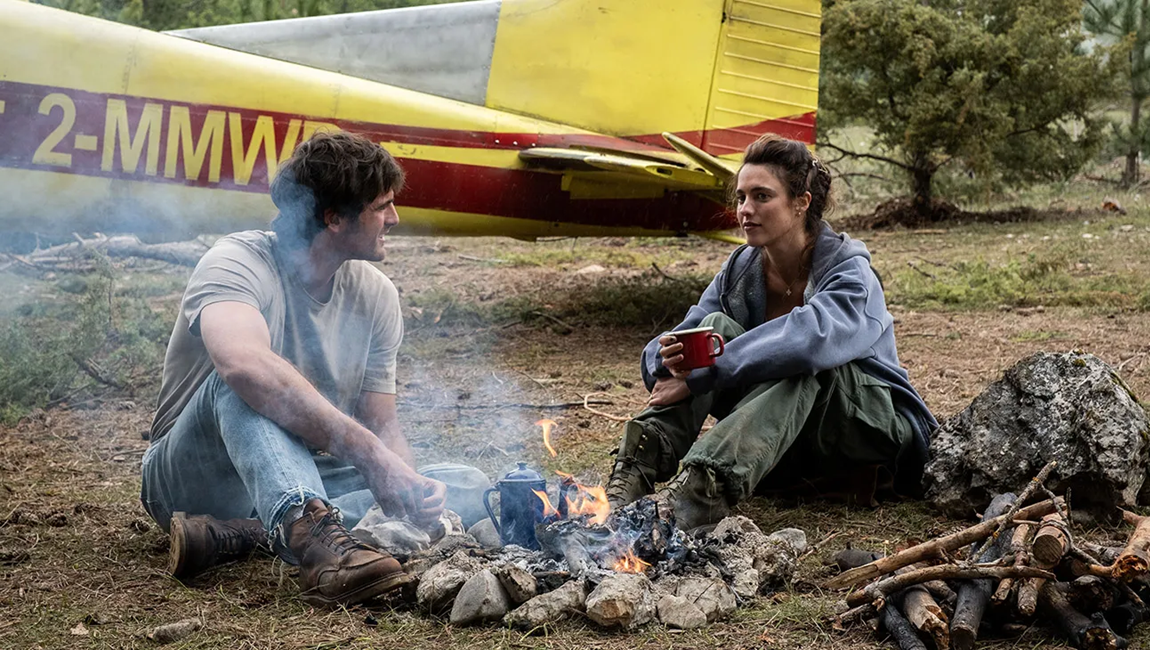
On one of his reconnaissance flights, Hig hears a static-filled voice on the radio which he sources to Grand Junction, on the other side of the state. Hig’s desire to reintegrate with what remains of society rubs against Bangley’s isolationism; the older man argues the outside world is nothing but death and uncertainty, whereas they have security and everything they need to survive on their fortified stretch of land. After a personal tragedy leaves him more emotionally vulnerable than before (consider this your trigger warning if you’re sensitive about the death of loyal animals), Hig throws caution to the wind and takes off for parts unknown in his plane, leaving Bangley to hold down the fort against roving gangs of feral, tattooed marauders. Hig doesn’t get far, though. Suffering engine troubles mid-flight, Hig’s forced to put his Cessna down in a tree-lined clearing, which he learns is adjacent to a secluded ranch owned by another grizzled ex-soldier known as “Pops” (Guy Pearce, all but visually indistinguishable from Brolin) and his comely, former medical resident daughter Cima played by Margaret Qualley (the character names in this film seem to have been created at by a cat walking across a keyboard). Arriving at a tentative truce, Pops suspiciously eyeballs Hig as he goes about repairing his plane and building an impromptu runway so he can take off, while Cima, far from oblivious to the 6’5″ eligible bachelor in her midst, cozies up to Hig in the hopes that he might stay on with her and Pops. But Hig is consumed with getting to Grand Junction, treating his curiosity as his own personal salvation.
It’s to the film’s small credit that it’s ultimately more interested in its life-sized characters working together in common cause than the barbarous, cannibalistic hordes at the gates. In contrast to recent films like 28 Years Later: The Bone Temple or eleven seasons of The Walking Dead, the film is (mostly) uninterested in cartoonish exaggeration and comic book villain origin stories; it simply treats “the others” as pervasive, unknowable threats looming on the horizon. Despite the film’s scope — Scott used northern Italy as a stand-in for Colorado, and the filmmaking feels most alive when we observe Hig’s Cessna as it pierces the clouds, its distinctive yellow paint standing out against the trees far below — The Dog Stars is modest in its ambitions: most of the film’s second act is dedicated to Hig and his new friends clearing tree stumps from a field and bonding over the simple, thought lost-to-time, pleasure of freshly brewed coffee and cigarettes. But the film’s lack of interiority works against it in these scenes. Elordi and Qualley look handsome next to one another — the latter spends most of the film wearing teeny tiny cut-off shorts and, despite the character’s wistfulness about the absence of grocery stores, Cima apparently maintains a healthy supply of Gillette — but the characters are mopey duds who speak in greeting card sentiments like “you don’t have a monopoly on grief.” The two attractive twentysomethings share stories of their dead loved ones, cuddle together for warmth, and Elordi even shares his iPod with Cima to remind her of the joys of music (Hig must have watched Garden State before the world ended), but there’s no spark or inner life to these scenes. These two beautiful people have allegedly been celibate for the better part of a decade, but all that’s on their minds is soberly reminiscing about their respective dead spouses and contemplating what Hig might find in the elusive Grand Junction.
It’s noted with considerable ruefulness that the Scott of old would have had a field day art directing and lighting the hollowed-out ruins of major U.S. cities, whereas in The Dog Stars our dystopian hellscape is as thinly sketched and forgettably rendered as our characters (Scott’s longtime D.P. John Mathieson snitched on the filmmaker’s “modern” approach to filmmaking a few years ago, noting how the director runs half a dozen cameras at the same time and prefers to find his films in the editing room; it mostly explains why the lighting in these films always looks so flat and the dialogue scenes have such a televisual rhythm to them). There’s a maddening lack of consistency and internal logic about exactly how much cities have decayed and been reclaimed by nature; sometimes we see skyscrapers overrun with vegetation, while at other times we see buildings are still drawing power for lights, refrigeration units, and digital billboards (the one consistent is that the signage for all the fast food chains littering these urban deserts are always visible, if artfully just out of focus). In spite of literally billions dying, there’s nary a sign of human remains littering the streets or even the lingering horrors of triage. These sorts of tableaux might be boilerplate by now — the early scenes that find Elordi with an assault rifle being trailed by Jasper as they explore cavernous spaces feel like a direct homage to Will Smith in I am Legend — but Scott’s decision to eschew the human face of the planet dying is only further evidence of how airless and sanitized The Dog Stars is. Scott’s approach to the subject matter is as derivative as it is disinterested.
Rather light on conventional thrills, the most charitable read on The Dog Stars is its making a small-c conservative argument for the pull of the familiar and that the security of home is more valuable than the potential upside of the unknown — in the words of TLC, “Don’t go chasing waterfalls, please stick to the rivers and the lakes that you’re used to” — and that strangers aren’t to be trusted, which isn’t exactly stirring stuff. Further, it’s difficult to reconcile how closed-off that philosophy is with how affable most of the people that Hig encounters are (the exception being the film’s eventual sidequest to Grand Junction, which plays like a couple of episodes of The Last of Us compressed into fifteen minutes of screen time). The film wants us to find hope in hopelessness, through the healing bonds of ad hoc families, but it’s not willing to drill down into these characters or this world. For all its polish and its high-concept façade, The Dog Stars largely amounts to pretty people sawing logs, which is an apt metaphor for this writer’s enthusiasm for the film.
DIRECTOR: Ridley Scott; CAST: Jacob Elordi, Josh Brolin, Margaret Qualley, Allison Janney, Benedict Wong; DISTRIBUTOR: 20th Century Studios; IN THEATERS: August 28; RUNTIME: 1 hr. 58 min.
Comments are closed.