
One of the earliest scenes in supernatural horror movie Never After Dark is of everyday familial intimacy — as a young woman drives along a heavily wooded road, complaints of carsickness ensue from her sister in the backseat, glimpsed via the rearview mirror. The two chat for a while, but when the scene cuts to another angle of the vehicle’s interiors, the companionable atmosphere is suddenly jarring: the driver is all alone. Has she been talking to herself? Is the girl a hallucination? Miku (Kurumi Inagaki), it turns out, is long dead, her spirit only visible to her sister Airi (Moeka Hoshi) in reflective surfaces. This revelation is the first of many in Dave Boyle’s twisty, strikingly novel take on the traditional ghost story, priming viewers for a film in which things aren’t always what they’re expected to be.
Aided by Miku, clairvoyant and “travelling Ghostbuster” Airi nudges trapped souls to cross over into the next life. The sisters’ latest job involves investigating and smoothing over the strange happenings at a remote hotel, a setting that ushers in all the familiar thrills of a great haunted house story — creaking doors, a malevolent entity with unfinished business, a local history of violence. Discovering that the ghost (Mutsuo Yoshioka) is far more violent than she’d anticipated, the initially unflappable Airi grows increasingly frazzled over the course of the film, even as she decides to stay the course against Miku’s warnings. Boyle not only conjures up dread and suspense through questions of what the ghost is really after and whether Airi will be able to make it out alright this time, but he also builds to a poignant meditation on grief, guilt, regret, and redemption.
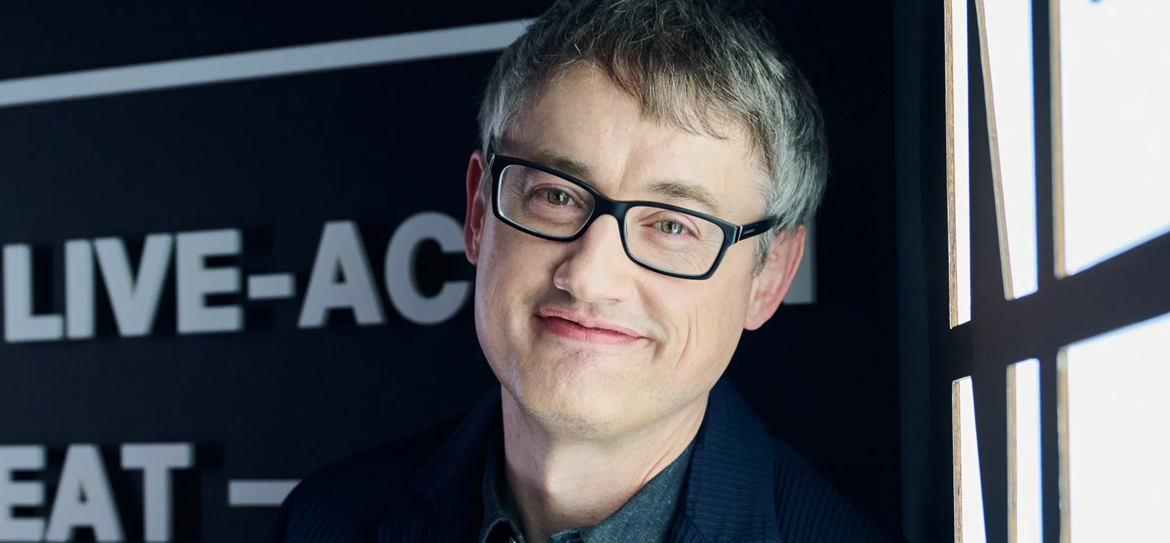
Ahead of the film’s release, I spoke with the American writer-director, whose past work includes includes musicals like Surrogate Valentine (2011) and the Netflix action drama series House of Ninjas, about evoking Edgar Allan Poe, preparing actors to react to unseen horrors, and crafting one of the genre’s most terrifying antagonists.
Gayle Sequeira: I read that you not only studied Japanese, but also lived among the community in Australia. How did that period of your life shape your interest in the culture, in making Japan-set movies and working with Japanese casts?
Dave Boyle: That’s a great question. The experience of learning a second language and living outside my bubble was a hugely formative experience in my early adulthood. My early films were directly about that experience, and through them I met a lot of amazing creatives all over the world — but especially in Japan. They became my partners over the years. I didn’t actually live in Japan until I worked on House of Ninjas, but since I’d had that experience of working with Japanese actors and producers and I’d kept up my language skills over the years, I was ready for that opportunity when it came.
GS: There are so many evocative images in Never After Dark, from that of Airi’s spirit visible in a mirror in front of her slumped-over body to the killer’s box of teeth. Was there an image that unlocked the film for you?
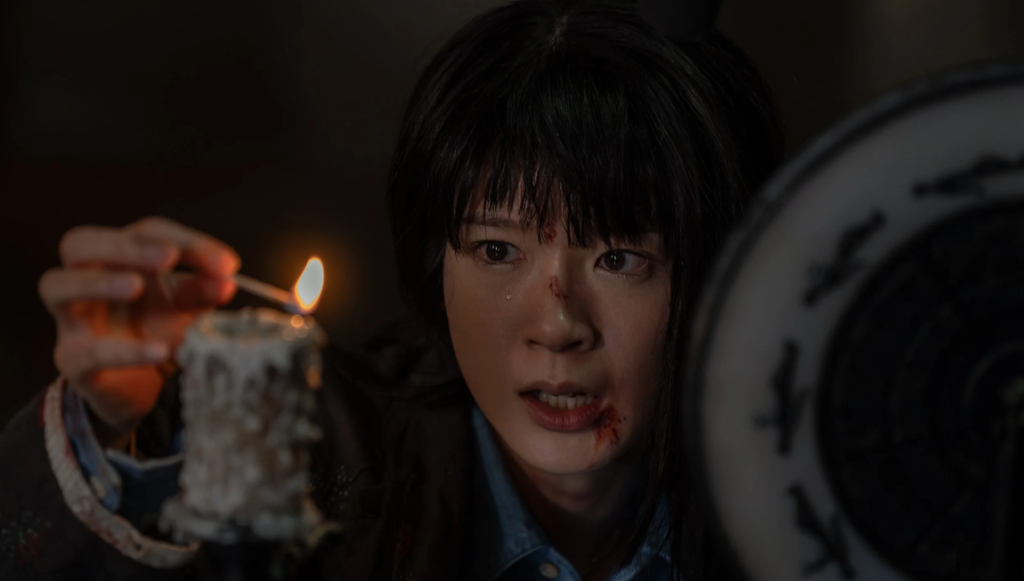
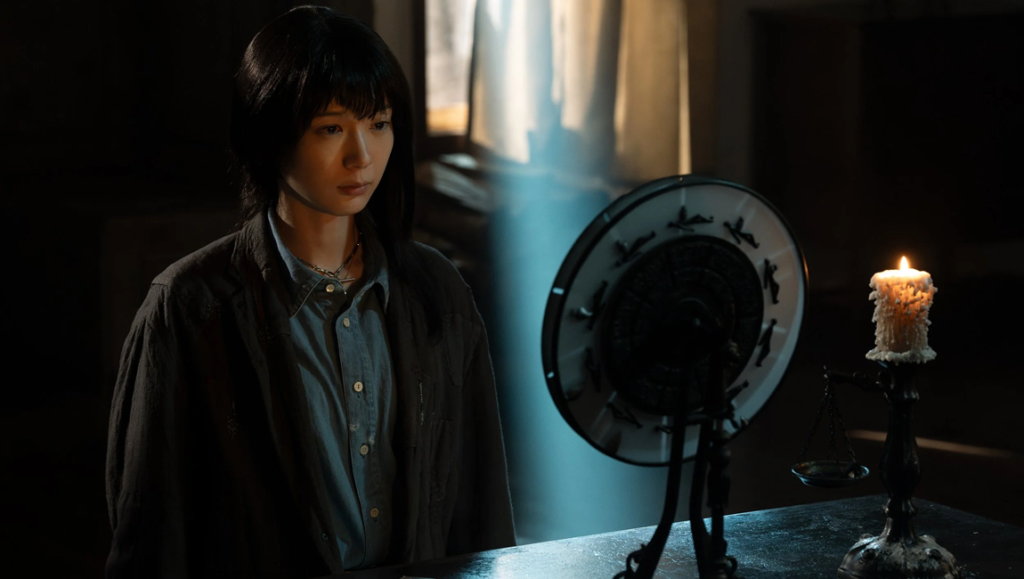
DB: The image that kickstarted the movie was the ceremony Airi performs in the middle of it. I knew I wanted to do a movie about a psychic, but I wanted to personalize it and make it about somebody who was from a fictional tradition that had never been seen before. So the first image that came up was someone with a candle, a spinning mirror and a pair of scissors, who, with just these simple elements, was conducting a ceremony that would be hypnotic. It’s a fictional ceremony — I made it up — but I wanted it to look convincing to viewers.
GS: When you did House of Ninjas, you’d said that what made it relevant to modern times was the fact that they lived by a set of old values, like not eating meat and having restrictions placed on who they could marry. What drove the rules and rituals Airi has to follow, like never conducting the ceremony to cross over into the spirit world after dark?
DB: That was really the joy of making the movie for me. I’m always fascinated by people who are out of step and live by values that the rest of the world might find “off.” The challenge with such characters, however, is you have to explain the rules to the audience, which is not all that interesting to do through dialogue. So I try to depict it through the character’s behavior instead. I wanted Airi’s rules to be something you slowly picked up on along the way. I wanted the items she carried with her to suggest a larger world beyond the framework of the movie. I was hoping people would imagine that there were other psychics like her, traveling around with their kits and spinning mirrors and conducting these rituals, and that we just happened to meet one of them engaging in this mysterious belief system and the practices that go along with it.
GS: This is a film that plays with what we’ve come to expect from the traditional ghost story and the haunted-hotel movie. What films from either of those subgenres were you influenced by?
DB: I’m a huge fan of ghost stories and haunted house movies, which is why I wanted to make this film. Both genres are challenging because so many stories in that space have been told already, and they’re also very difficult to write endings for. There are so many films about ghosts that I love the first half — or even three-quarters — of and then, by the end, I find that there’s no satisfactory payoff to be found after all the anticipation and mystery that’s been built up. My goal was to hit all the genre touchstones that we love and then end the film in a place that was surprising and new. One movie that the entire cast and crew watched was The Changeling [1980], starring George C. Scott, because it’s a great combination of a ghost story and a mystery. The Japanese ghost story tradition was also something that we had in mind as a touchpoint. There were many things we deliberately did differently and others that we wanted to pay proper respect to.
GS: Tell me about developing The Man — the design of his gaping mouth is unnerving, as is his physicality and the steady, commanding pace at which he moves. It’s unsettling how he swiftly catches up to Airi even as she’s running for her life. What were your conversations like not only with the prosthetics department, but with Mutsuo Yoshioka himself?
DB: That’s a great question. It started with the image of a man who looks like his mouth is unnaturally wide open in a scream, and it’s only once you get a little closer that you can see he’s been wounded in some way. I always had the idea that we would just see a little bit of the character at a time and that it would be a while before you got an in-your-face view of him. That was both from the point-of-view of building suspense, as well as a practical decision, given the twist at the center of the film. We had to be strategic about how much we showed.
I had a concept artist I worked with, Kevin Senzaki, who has a day job as a sound designer. He did an initial sketch for me that I took to Tomo Hyakutakte, the film’s prosthetics designer who I’d worked with before on House of Ninjas. He’s a legend in Japan, the guy everyone goes to with impossible requests. My request was for a prosthetic device that could be attached to the actor and that would require minimal CG enhancement to maintain the illusion of depth in his mouth. So I wanted the space where the actor’s chin would normally be to instead evoke the cavernous space of a wide open mouth. Even just scheduling-wise, it had to be something that could be put on in just 45 minutes to an hour. We couldn’t have had the actor tied up for hours. So once Hyakutakte-san and his team made the prosthetic, we did a series of makeup tests with Mutsuo. The design allowed him to speak, and eat meals through a straw, which was great. We did a full test with lighting and everything to zero in on the movements that the character would have. We tried all kinds of things and eventually realized that less was more. So by the time we got to set, we’d done a lot of rehearsals and we knew what we were doing. There wasn’t a whole lot of experimentation.
GS: Moeka Hoshi is terrific in the film, particularly in the many scenes in which she has to react to horrors that are unseen and imagined. There’s that scene in which she’s picking The Man’s collection of teeth off the floor and is struck by flashes of the people to whom they belonged and how he’d hurt them. What direction do you give an actor who needs to get into the headspace for a sequence like that, in which there’s nothing tangible to react to?
DB: That’s a great question. Moeka and I talked a lot, the whole way through the shoot. I tried to be as open as possible and answer any questions she had because so much of what she’s doing doesn’t make all that much sense unless you have contextual information, which isn’t always presented onscreen. We had a lot of conversations about the meaning of the props she had, her wardrobe, and what kind of life the character was leading. Moeka was very careful to calibrate her performance around how different this experience was for Airi compared to the previous jobs she had undertaken as a medium.
I tried to shoot the movie in order as much as possible and so the end of the film coincided with the end of the shoot. For the scene in which Airi gets flashes of the victims of these terrible crimes, we’d already filmed those flash inserts. Those shots are less than a second long, but we still wanted them to have enough detail that you could pause the movie and get enough of a backstory of who each of these victims were and why they were chosen. We wanted The Man’s selection process to feel careful and deliberate. But since we had those shots, I could show the footage to Moeka just before that scene and let it inform her performance.
GS: This is a single-location film, with the hotel space envisioned as ominous — there’s a corridor that’s eerie each time it’s glimpsed — and yet it appears beautiful when Airi transitions from this world to the spirit world. Those shifts in light are just stunning. Could you tell me about achieving that visual balance between the macabre and the striking?
DB: The tradition of Gothic storytelling needs a certain amount of beauty for the horror and the spirit of the grotesque to shine through properly. I knew the film had to have an elegance to it, and the hotel needed to have this seductive quality and be attractive to viewers. With House of Ninjas, the idea was to present ninjas as being in the shadows of ordinary life, and so I tried to make it feel as everyday as possible. The ninjas in the show wear Covid masks and everything is presented as stripped-down and without adornment. Never After Dark, however, needed to be baroque and gothic. It needed to evoke the feeling of reading one of Edgar Allan Poe’s works. There’s a beauty to his language, and that’s what we aspired to.
Our cinematographer, Patrick Ouziel, and I spent a lot of time at the location during prep. We weren’t shooting a lot of coverage, but had planned out the cuts well in advance. So there wasn’t a whole lot of doubling up. One bit of action meant one shot and then we’d move on. There were a handful of times when we used probe lenses — usually used in commercials to shoot food — to get extreme closeups. When you saw the candle in the opening scene, I wanted it to feel like you were looking at a building instead.
Comments are closed.