
Ted Kaczynski offers us one of the great case studies in worthwhile notions and piss-poor execution. It’s hard to look at his ideas and not see some value; industrial society does kind of suck, so it’s no wonder he’s been picked up in certain corners of the internet as a not-entirely-ironic cult hero. And reasonable people found things to like about Industrial Society and Its Future before the Unabomber TikTok edits, too. “The argument Kaczynski puts forth is fundamentally quite right,” Haruki Murakami writes in his book Underground, a journalistic appraisal of the 1995 Tokyo sarin attack. “Many parts of the social system in which we belong and function do indeed aim at repressing the attainment of individual autonomy.” However, as most of us know, Kaczynski also killed three people and injured nearly two dozen others — a pretty difficult square to circle when considering his net contribution to the 20th century. But the 21st century is starting to look a lot different from the 20th, and radicalization is practically a commonplace. As such, now is really the best time to be considering the Ted Kaczynski phenomenon: there’s a lot his story can teach us about the potential boundaries of intellectual exploration, the role trauma plays in perverting otherwise brilliant people, and what praxis really ought to look like. You’ll find none of that in Januz Metz’s film Unabomber, though. It’s a feature-length Mindhunter ripoff that strips away anything unique to Kaczynski in favor of generalizations worthy of America’s Most Wanted.
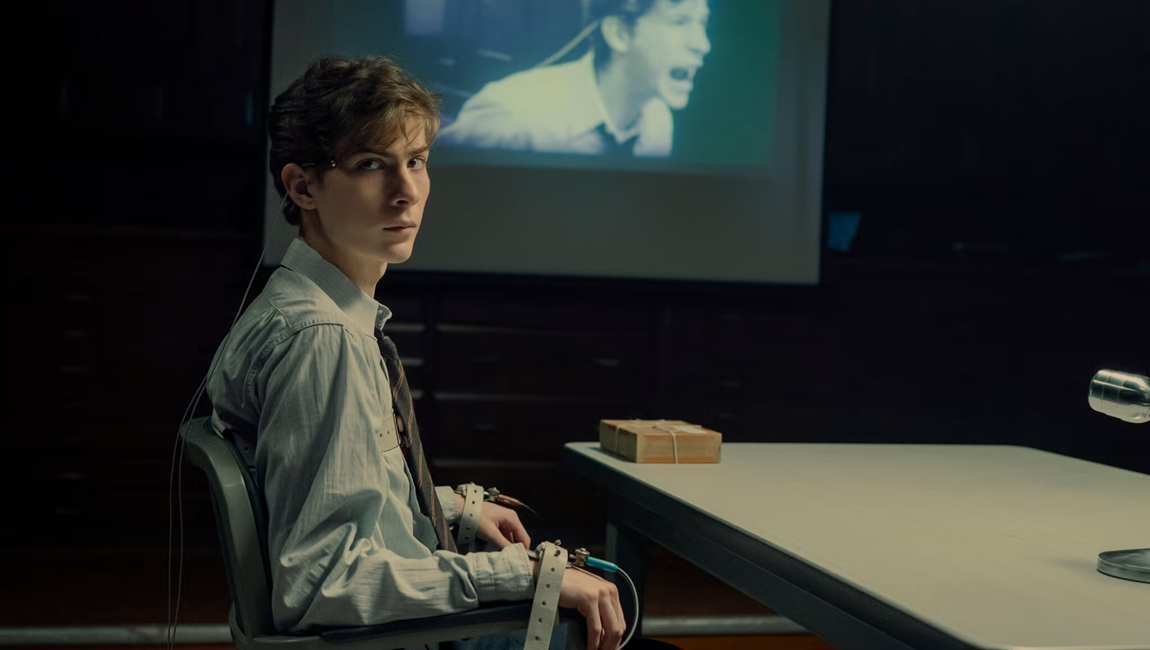
Unabomber opens on, you guessed it, the inside of a mailbox. We travel with an unremarkable package the short distance between it and the home where that package detonates, only to be launched into a series of newsreels informing us of the Unabomber’s notoriety. From there, the film cleaves itself in half, cross-stitching two periods in Kaczynski’s life: his time under the auspices of Harvard psychology professor Henry Murray, and his capture by the FBI in 1996. At Harvard in the late 1950s and early ’60s, Kaczynski is a young and impressionable math genius (played, with boyish intensity à la Chalamet, by Jacob Tremblay) who is manipulated by Murray into participating in an escalating series of abusive experiments. In 1996, Kaczynski is an anonymous killer hunted by FBI Agent Joanne Miller (Shailene Woodley, given more screen time yet somehow less to do than in her nonverbal role in July’s Motor City). Neither of the parallel storylines inform each other in any meaningful way, nor is there any emotional, visual, or thematic consonance between them. There’s only one cut that brings the two strands together: as a teenager, Kaczynski writes Experiment #1 in his notebook; in 1996, we see the older Kaczynski building what will become his last bomb.
It’s difficult to construe what, exactly, Metz wants us to think about Kaczynski. Is he a psychopath? A sensitive kid who was broken by a man who might’ve been in the CIA’s pocket? Metz throws out famous intellectual names like Kant and Jung to imply a cerebral undercurrent, but his film can’t pick an ideological side, and its form can’t sustain simple cat-and-mouse chases or scenes with intense emotional clashing — how could it be expected to handle the weight of thinkers like Immanuel Kant and Carl Jung? Metz relies on stark shot/reverse shot scene construction, and his lighting setups burn with blown-out simulations of natural light. Unabomber aspires to adopt a severe, Fincherian disposition, but it winds up more closely resembling a prestige picture from the early 2000s.
Unabomber is the kind of film that thinks calling A Beautiful Mind instead “An Ugly Mind” would be enough to subvert the formula it follows so slavishly. A major reveal toward the end of the film suggests that a young Kaczynski has really had more control over the psychological experiments than he let on. But we in the audience are not really given any indication that little Ted is capable of this, so it reads more as a “You can’t fire me, I quit!” moment than a true volte-face. The mic drop? Kaczynski storms out and crosses the street when the crosswalk signal says to wait, thereby sealing his fate as a supervillain. It would play as comedy if it weren’t so perfunctory — a trashy, exploitative, hothouse take on the Kaczynski story would certainly be preferable. It might even be more honest.
If there’s any torch to be lit for Unabomber, let it be for its multiple nods to Henry David Thoreau, who’s referred to on several occasions directly or indirectly as an inspiration for American extremists. It brings him out of the milquetoast ivory tower and back into the realm of the dangerous, and if it gets at least one person reading Walden who otherwise wouldn’t have, the mediocrity delivering the message will not entirely have been in vain. Otherwise, best to move along.
DIRECTOR: Janus Metz; CAST: Jacob Tremblay, Russell Crowe, Annabelle Wallis, Shailene Woodley, Alexander Ludwig; DISTRIBUTOR: Netflix; STREAMING: September 25; RUNTIME: 1 hr. 37 min.
Comments are closed.