
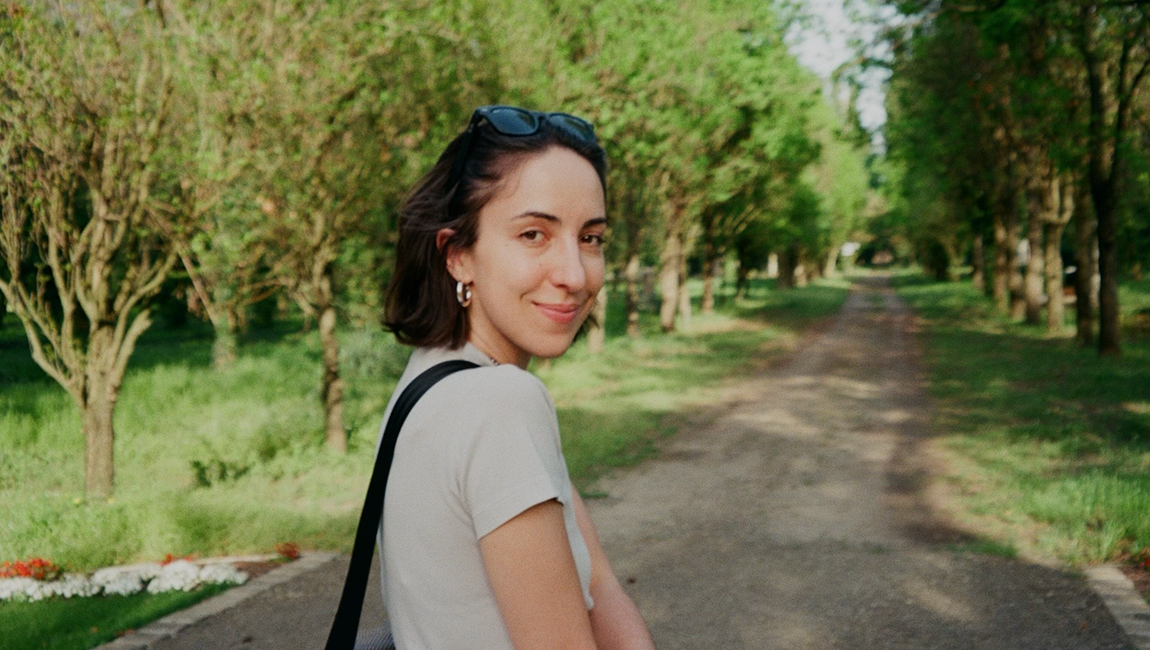
Few filmmakers have the benefit of having real, honest-to-goodness hype around their debut feature. Many of our best talents come out of nowhere with very little of their previous work, like shorts, available to us until after they’ve made their mark. For Sophy Romvari, writer and director of Blue Heron, it’s always been a “when” she will explode into the larger cinema scene, not “if.” If you’re a certain kind of film person, Romvari’s work has been known to you for years. Breaking through with her personal, sometimes autobiographical, shorts like Pumpkin Movie or Still Processing, hers is a name you’ve likely discovered while perusing Criterion Channel or MUBI. After over a decade of experimenting with form and narrative “truths,” Romvari has made her long-awaited feature debut. Surprising no one, it’s a knockout.
Following a familial crisis through the eyes of child, Blue Heron is Romvari grappling with some of her own history via fiction. In Still Processing, she excavated long-buried feelings of grief around her older brothers’ deaths by viewing family photos for the first time. In an astonishing display of vulnerability, Romvari challenges herself and her viewers to parse what it means when we turn the camera on ourselves. Can we ever create an “honest” perspective when there will always be an unseen hand placing the camera? What becomes of a memory when we shape it for others to see? These have always been questions that Romvari has grappled with, and now, in Blue Heron, she unravels these thoughts through the parameters of a narrative.
It’s easy to view young Sasha (Eylul Guven), the child at the center of Blue Heron, as a stand-in for Sophy. It’s even easier to see the director in the adult version of Sasha, played with devastating quiet grace by Amy Zimmer. Adult Sasha is a filmmaker in pre-production on a film about her brother. As the two Sashas try to make sense of a brother in pain, if you know Romvari’s work, the parallels will surely cross your mind. The brilliance of Blue Heron, through a camera always peering through windows and mirrors, is that it renders these comparisons facile at best. Romvari isn’t interested in you, the viewer, picking apart a life she’s already laid bare many times over. She wants to peel back the layers of memory and force you to question whether it can ever be “honest” — especially through cinema, an art form that will always keep our relationship with memory behind a screen.
I rarely invoke my own history with a filmmaker when it comes to interviews, but in a strange way, one that Sophy points out during our conversation, much of my career feels inextricably linked with her work. My path as a journalist really took a huge leap around COVID, right around the time I saw Still Processing. I was working as an overnight janitor and shut myself in a closet to watch this short that many of my friends on Twitter had been talking about. Needless to say, I was immediately taken by a film and filmmaker who were expressing so much of what I’d been missing from cinema. Working backwards through her work was one of my movie-watching joys. We’ve since become friends, and it’s been one of the more fulfilling parts of my life to see where we both are all these years later, in our separate fields. Blue Heron is both the exact film I’d expect the maker of Still Processing to make and yet so far beyond anything I could have ever imagined. It’s a miracle of a film.
Ahead of Blue Heron’s release, Sophy and I caught up at the Criterion offices to discuss the film, the lost art of blocking, directing child actors, and so much more.
Brandon Streussnig: You’ve always played around with narrative convention. Many times, you’re the one in front of the camera. So much of Blue Heron is a logical extension of that, except now it’s entirely fictional and you’re using actors. Was that more of a challenge?
Sophy Romvari: With my short films, the ones that I’m in, it was not by virtue of wanting to be an actor or be in them. It was just kind of the nature of exploring very personal themes and things that have happened to me. So it made sense that I would be in those films. I have always wanted to work with actors and love working with actors. I love performance-driven movies. I was just working with extreme limitations as well.
The easiest way to make anything is to set up a camera and film yourself. For a long time, I was exploring things that were within my own accessibility and limitations. When I decided to make this film, there was a moment when I thought I might play Adult Sasha when it was a smaller version of the film. The longer I worked on the script, though, the more I committed to this being a robust narrative feature, and it became very clear to me that that was not the best route.
The things that are meta about the film are more interesting if they’re not literally meta with me on-screen as the filmmaker. You can still do those things and still have them be meta-textual without it being so on the nose and putting the actual filmmaker in the film. I tried at first to hide the fact that she was a filmmaker and to try to make my identity less obvious as the filmmaker. At first, I had written it as though she became a social worker. Then I realized that that was thinly veiled. It’s like when a filmmaker makes a film about a writer, but it’s still just obviously a filmmaker.
So I decided to just commit to the fact that even if it’s not me on screen, her being a filmmaker, it’s not going to make a difference to the audience’s experience whether or not she’s a social worker or a filmmaker. So why hide from it? So, to answer your question, I do love working with actors, and I feel like a lot of the work I did previously was experimenting with how to achieve naturalistic performances. I was able to apply a lot of what I learned from my shorts from my own point of view, but also working with non-actors, and then apply it to working with actors and children, and a whole variety of experience levels with the different actors.
BS: I asked this recently in another interview with a filmmaker whom I know fairly well, but she’s been open about pushing back against this idea that every film of hers is “her most personal yet.” It got me thinking about other people I know, who make art, and how maybe we can misconstrue what it means to be extremely “personal” on screen. I think your work invites that feeling to some extent, but is it something you bump against at all?
SR: It can be frustrating because I feel like, depending on the context in which that is said, it can feel quite minimizing to the craft that goes into making a film, especially a film that is personal. Just because something is personal, that doesn’t make it easy.
It makes it harder in many ways because you’re trying to find a way to make something that is actually cinematic and engaging and pulls people in. Just by virtue of something being personal, those things don’t come easily. I spent a lot of time studying that with my short films and actually almost did a master’s thesis on that topic because I was studying personal filmmaking, hybrid filmmaking, but based around grief memory. So many of those films are also by women, which I think is interesting.
Historically, women are often mining their own experiences, and I think that there is sometimes an inherent dismissal when that is the main acknowledgement, like, “Oh wow, this is so personal, so emotional, so vulnerable.” My film is a very carefully crafted film that I spent years working on the script and then a lot of time developing the aesthetic of and how it was shot with my cinematographer, and it’s all very precise. Then, when people see it, it can feel a little bit like, “Oh wow, you just filmed your diary. XOXO.”
It’s not easy to pull off: to toe the line of having your own vulnerability be a part of the story, but then create an actual narrative that is engaging. It’s interesting that it’s not usually an acknowledgement or accusation made against male filmmakers, especially when they do make deeply personal work. It’s not the thing that is highlighted.
BS: Are there ever moments, then, where you maybe felt yourself pushing back on what to include or how personal to get?
SR: Not so much pushing back, but it was more about what is actually serving the story? What’s actually interesting? What’s going to be visual and evocative? I never wanted to include things just for the sake of them being true or true to me. Sometimes you can try to fight for something in a film when you’re making personal work that is ultimately not that important to the overall effect. I tried to utilize what was also given to me.
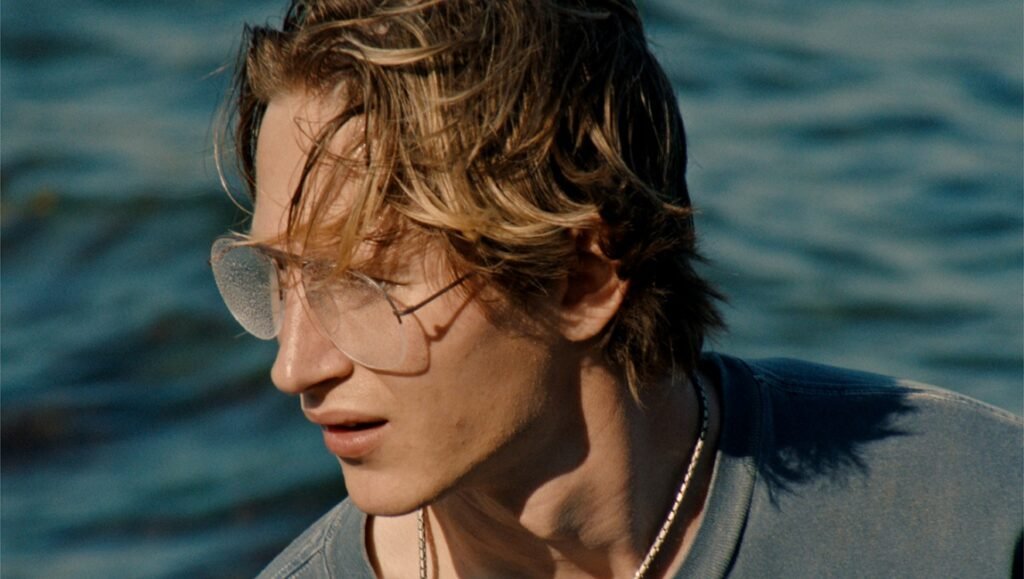
For example, Edik, who plays Jeremy, was street cast. He was not a professional actor, and so I really took what he was giving me. His presence was so strong and so evocative on its own that I didn’t try to push him into a performance that was outside of his range. I never thought, “Oh, he’s not really behaving like my brother,” because he wasn’t.
So much of being a director is just, “Okay, what’s happening right now and how can I funnel it into the limitations that I’ve created for myself with my own vision to make this cohesive?” Because you can say, “Oh, it’s raining and the day is over. We can’t shoot this movie anymore.” Or you can say, “Oh, it’s raining. How can I pivot, make this interesting, and use it to my advantage?” Which actually did happen in this movie, the scene where it’s raining, on the day I thought, “Oh wow, this is going to ruin everything.” But then I was challenged to pivot into something that was more cinematic. You can’t stick to the plan, and you can’t control the elements. That’s part of what’s exciting and fun as a director. You’re given all these different pieces, and then it’s your job to put them together and make it engaging for other people. I think that’s the fun. If you prepare well, then you can challenge yourself and pivot while you’re directing.
BS: I have to ask this because, outside of myself, I don’t know that there’s anybody on Earth who loves M. Night Shyamalan as much as you. He’s one of the all-time greats at directing child actors. You get such beautiful, honest performances out of the child actors in Blue Heron. I know you’ll always have your influences, it’s kind of just how it goes, but was he ever a guiding light for that, despite how dissimilar your work is?
SR: It’s funny. I love M. Night Shyamalan, and I also love Spielberg. But these two filmmakers, I don’t think, could be any more different than the work that I make, technically. I’m sure all of your inspirations seep in some way, or the things that you love seep in, but I don’t see my work in any way really similar. What I love about both of their filmographies is actually, ironically, the fact that their work does feel very personal to me.
It does feel very vulnerable in that they’re acknowledging their own flaws, and they’re very earnest. Especially M. Night, even if it’s very flawed at times, it’s very original, and he’s really pushing himself to create things that are original and very daring. I really respect the way he challenges himself as a filmmaker to do things that are maybe not the popular way to make movies, and he’s constantly reinventing himself.
In terms of child performances, that was one of the biggest challenges before I made the film. I knew what I was getting into. During the casting process, I took my time to try to find, especially for young Sasha, someone who could fulfill that role. Eylul really is just an exceptionally talented young actor. I think my approach to working with children is trying to create an environment that is kid-friendly and not to ask children to behave like adults. That’s also narratively something I was really determined about. I wanted to make a film that is from a child’s point of view and doesn’t imply an adult sense of the world. I wanted her to be aware of her surroundings, but not in a way that makes her feel like an adult when she’s just a child.
Oftentimes, movies about children can veer into that, but it was important to me that there was a separation between children and adults. That’s the whole structure of the film. I really tried to create an environment that was playful and light. Even though the themes of the film are quite heavy, we really tried to encourage the atmosphere on set to be delightful, and it really was. Another way we tried to create that atmosphere was by shooting with a long lens because you have the camera at a distance, so you’re not putting it right in a child’s face and asking them to act natural.
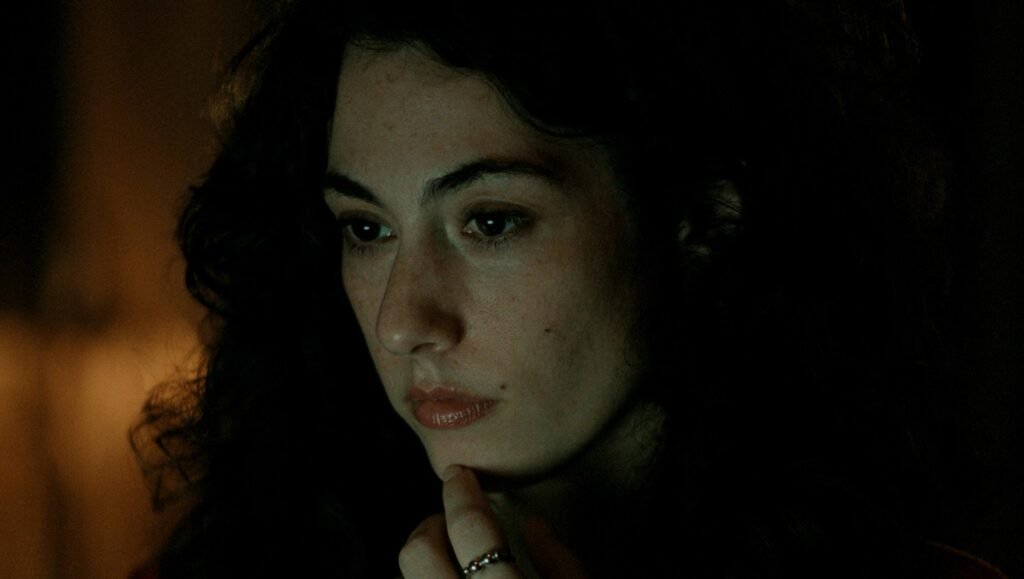
I think all of those things lend to a naturalistic environment, because it’s a very unnatural thing to do. Then we also had this thing we would do sometimes, especially with the boys, if the kids were doing something interesting, between takes, we had this term my focus puller came up with called “50/50,” where we would just roll if the kids were doing something interesting. There are a few things that made it in. Like when Sasha’s lying on the couch, and she’s playing with her hair, and the dad is on the computer. She was waiting between scenes, and I loved how natural she looked. So we just started rolling, and then I asked her, “Can you do your lines?” Then she just did them rather than setting up the scene. I think the word “action” can be really damaging. It can really break you out of your sense of comfort. So I tried whenever I could not to say “action,” especially with the kids.
BS: Can you talk to me about the blocking and how you composed your images with Maya, your cinematographer? I love how it’s not only often from a child’s perspective, like you said, but you also have these stunning images through mirrors and glass, like we’re peering into a memory.
SR: I was determined to actually block the camera to the actors rather than the other way around. I didn’t want the actors to have to hit marks, especially the children. A big way we were able to accomplish that was the implied motion through the zoom and we never moved the camera. It’s always on a static tripod, but by allowing that space, that fluidity for the actors to move, we can create a sense of motion without it actually interfering with their natural movements.
That was definitely something that allowed more space for the actor’s motion. I mean, oftentimes when you’re hitting a mark, you’re thinking more about hitting the mark than you are about just being present. So in every way possible as a director, I think I try to remove the technical barrier. It’s not their job to be technically proficient; it’s our job to meet them where they’re at. That was a very Cassavetes ethos that we adopted. Blocking is so undervalued in many ways — camera blocking as well as actor blocking.
There were definitely challenges. There’s this long pan that goes through the entire house, and we’re following the actor all the way through the house. We’re watching her through the window, and then we land on the parents, and there is timing involved, but we try to limit the amount that is put on the actor for when things happen. So we would have crew members in the house and say, “Okay, now the camera’s on you, so you can start your scene,” and things like that. But yeah, so much of the film was shot from outside the house.
BS: I think production design, specifically the kind we see here, is also undervalued. There’s so much praise for historical films or fantasy films, but we rarely see discussion about how hard it is to accurately capture something as mundane as suburban living. Jeremy’s bedroom with the half-made bed and unframed posters felt so authentic to me. What was your process around this feeling more real versus simply trying to recreate the ‘90s?
SR: There’s a fine line, like you said, because you can really push a period. I think it comes through in nuance more. My costume designer, Maria, was trying to select items that were evocative and naturalistic from the ’90s, but they were not screaming ’90s with neon colors and things like that. She is so intelligent as a costume designer because she finds ways where it’s not just about the color and the logos or these kinds of obvious things, it’s also about the fit. So the way that Jeremy’s clothes fit on his body, they drape off of him. She was really paying attention to details like “how is the stitch on the sleeve?” “Is that how they had it in the ’80s and ’90s, or is this something that was recreated?” She was finding authentic pieces. These kinds of small details really add up to the authenticity, and the same goes for the production design.
Victoria, my production designer, is very detail-focused. She’s an ikebana artist, and she makes beautiful floral designs. She’s texturally focused and color-focused. The two of them actually worked really well together. It’s quite difficult to evoke even just the ’90s with a limited budget, and trying to pull that off and feel naturalistic. You don’t want to distract from it, you just want people to feel, “Okay, I’m in the 90s, now here we are.”
BS: I think it’s so cool that this, in some ways, and certainly not to diminish it, because it is very different, feels like a big-budget continuation of the conversations you were having in Still Processing. The still photos breaking through the narrative made me feel like we’d been watching Adult Sasha’s film for the entire first half, like her version of Still Processing. As your work evolves, where are you with the “creative non-fiction” of it all?
SR: I love that you bring that up because it’s something that I don’t know is evident to every viewer, but I obviously opened and closed the film with this bookending of the iPhone shooting off the top of this mountain. My implication with that is that she is actually location scouting for the movie that you just watched. You can see her zooming in on the iPhone, and it’s meant to mimic or mirror the long zoom shot that the film then opens with. I was trying to imply a location scout, and I do want there to be the possibility, it doesn’t actually affect the movie, I think, if this is not your experience of it, but that perhaps the movie that we see in the first half of the film is her own film, and everything else is the research for that film.
Because that is true to my life, right? Making Still Processing and doing all the research is what led me to make Blue Heron. In many ways, the second half of the film is like a creative recreation of that period of my life. It is kind of a big budget Still Processing, even though “big budget” is not real. It’s like a fictional recreation of that period of my life when I was in research mode and in my thesis and studying and researching and documenting. That’s why it was really important for me to have someone play that part rather than it being me, and I’m so, so glad. I’m really excited for people to see what Amy does in this film because I think it’s very subtle and it’s very nuanced. It’s hard to understand how difficult it is to pull off a performance where so much of what you’re doing is listening.
I made a sort of syllabus for Amy to watch. I think it was called Subtle Woman Cinema, and it was all women that are listening or recording conversations or trying to understand things in retrospect. Then she has this one, obviously a very emotional scene, and it’s quite overt. Besides that, so much of what she’s doing is just taking information, and it’s building and building and building. It’s a very layered and empathetic performance, and I, A), would not have been able to pull it off technically; B), I wanted to just focus on directing; and C), I actually really love watching this movie. I don’t know if that would have been the case if I were in it. She’s incredible, and she brings such depth to the film. I’m so, so glad that’s her.
BS: Something I’ve loved seeing, as you’ve done the festival run and just general press for the film, is that you’ve been so upfront and open about the realities of an independent filmmaker. You talk about how festivals can be exploitative or how there’s very little material support for indie filmmaking. Is this you trying to inform those who want to do this, or is that just a natural extension of the honesty that comes with your work?
SR: It’s a great question because I feel like for all the complaining I’ve done, I have nothing to complain about now. I’m in the Criterion office with you. My film is being distributed by Janus, by far my dream distributor. I’m being cared for as a filmmaker. My work is being cared for in a way that I never even dreamed of. So I can be a bit of a squeaky wheel because I like to acknowledge the reality of what it is to be a filmmaker, and it really does take everything. It takes everything. It’s such a sacrifice.
You know I work in a movie theater. I actually think it’s quite beautiful that when you and I met, you watched Still Processing in the closet when you were a janitor. Now we’re at the Criterion offices talking together, all these years later, and I’m going to go into the Criterion Closet. It’s beautiful.
I do think I still aim to always be as transparent as possible, especially about things like budgets and about the financial reality, because that doesn’t get spoken about. I now have more of a platform where I don’t think it’s time for me to just stop acknowledging those realities. I do want to say, though, that my perspective has shifted because I do feel the immense privilege of being a filmmaker.
When I was making shorts, it was much scrappier. With my feature, I feel like I got so much perspective on the privilege of living in Canada and getting to make a film entirely funded by grants. I got to make exactly the film I wanted to make. I got to work with exactly the people I wanted to work with. It was a beautiful collaborative process that I feel that if you can create the right environment, making films is just a joy, and it’s such a privilege. So I think it’s something you have to toe the line of fighting for what is always going to be difficult, which is being an artist, but also I think it is an immense privilege to be an artist, and especially in the economic world that we’re living in right now. The fact that I can make it work at all is just, yeah, I feel very, very lucky. I feel very lucky that the film has been received in the way that it has been.
Comments are closed.