
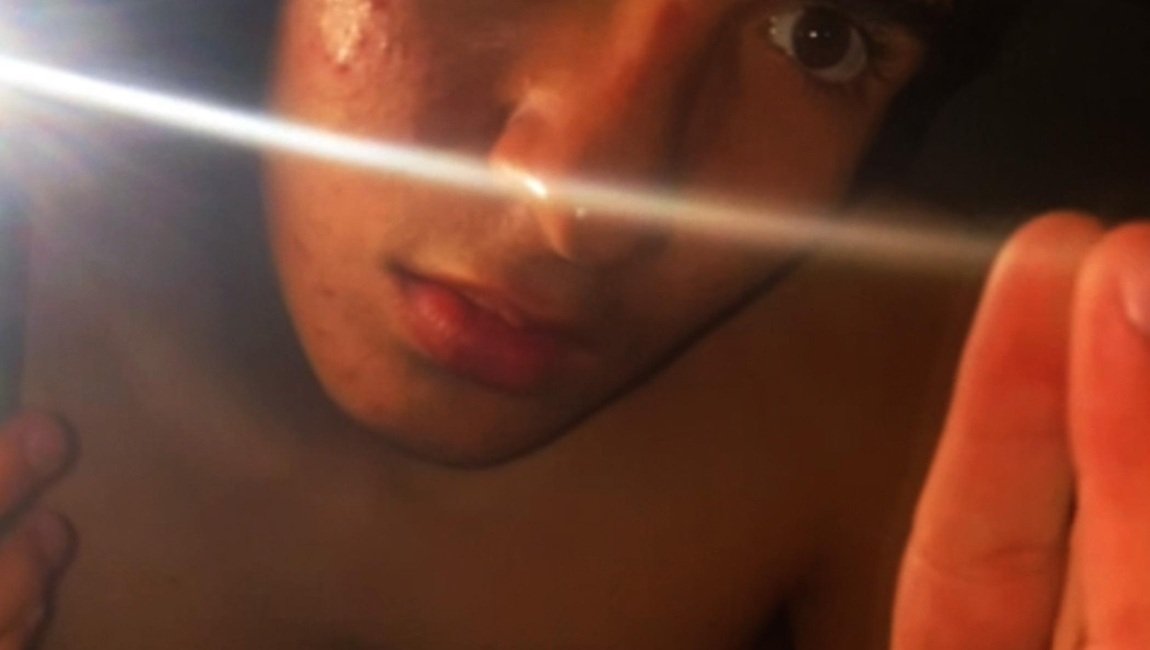
Frédéric Da wants to make it known that his new social drama, isaiah’s phone, is a work of complete fiction. This despite the film’s unsettling epigraph which ominously reads: “In April 2022, a student at Millbrook High filmed himself committing a horrific act of violence. His phone was seized by police as evidence. Its contents have remained unseen until now.” The scenes that follow capture, both narratively and formally, a tangible world and a deeply familiar alienation. Credited as the cinematographer is Isaiah Brody, who stars as the awkward teenager whose relationship with his phone and his peers causes a dark spiral.
At one of two packed screenings of the film during last weekend’s LAFM run, Da spoke extensively about the little trickeries of filmmaking involved in making every frame look organic. Brody, like the film’s character, was one of the rare teenagers not allowed a smartphone. Da developed the film with his wife and producing partner Roxane Mesquida, and with his parents’ approval they gave Brody an iPhone to shoot the entire film over the course of about two months. He shot just a few hours a day, getting directing notes from Da and refining scenes. The entire production cost nothing — not relatively, but actually zero dollars.
The business of Hollywood, which is currently in its second monopoly pendulum swing, has always operated on the premise of calculated exclusion. As production budgets are grotesquely ballooning, and Los Angeles is becoming increasingly impossible to work in unless you direct music videos and branded content, Da managed to make a festival circuit film for no money. It wasn’t long ago that filmmakers were lamenting about how short films that cost less than $30k would never place at a respectable festival. Ultimately, it comes down to why you’re interested in making movies. If you ask Bazin, there is a historical and biological predilection toward the mechanical replication of reality. But then the question remains: how can one capture an eternal truth about the world when the minutes on screen are counted in dollars? Or alternatively, what can a cinema unburdened by financial stakes reveal about the very practice?
Da was Brody’s film teacher from 6th grade through high school. In fact, a lot of the cast featured in isaiah’s phone were in his film classes, and participated in his first feature, Teenage Emotions. Da and Brody now both live in Paris, where Da says Brody spends all his time at the movies, while a number of his former students represent the much derided generation of college students who struggle to engage with once-upon-a-time pop literature like Dickens. Yet Da’s cultivation of their intellectual curiosity is evident by the existence of isaiah’s phone. During a post-screening Q&A, Brody and Max Vadset, who plays Isaiah’s classmate, discussed their favorite discoveries in Da’s class. They mention Takeshi Kitano’s Fireworks and Lukas Moodysson’s Show Me Love — how refreshing to know these kids are serious people!
When Isaiah gets his phone on his 16th birthday, his palpable excitement is emitted through grainy, under-the-cover vertical footage. Even though it’s very clear that he feels profoundly isolated, the gap between him and others doesn’t seem impenetrable. He is medicated for depression, for ADHD, and also because sometimes he gets stomach aches. His tenderness with his father and his sister immediately endears him to you. As he begins to record everything via the titular diegetic narrative device, the gap widens. Two attempts at connection, one with a girl named Sasha and another with a boy named Max, are soured by Isaiah’s gawkiness, his constant filming of his surroundings, but also just by regular pre-pubescent cruelty. The terror of rejection both moves and paralyzes Isaiah, and Chekov’s gun over in his father’s closet threatens to beset the life of every person on screen. Brody’s performance hangs on an impossible balance of optimistm and desperation. Between the rage, the outright emotional despair, and the pestering agitation to do something about it all, Brody imbues Isaiah with a penetrability that prevents the film from being pigeonholed as an exploration of what’s happening with young men. And, of course, that’s also in no small part thanks to Da’s dynamic edit, which finds a way to meticulously construct something so fluid.
Isaiah’s characterization reflects a graveyard of abandoned interests. When he first starts getting to know Sasha and she asks him about what he likes to do, he draws a blank. He takes up his long untouched drumset to impress her (she loves ’90s rock), but loses interest as soon as she gets back together with her boyfriend. Max tries to lure him into his stoner’s cinephilia, but that ends with an incident that finds Isaiah bullied with accusations of being a gay rapist. The fragility of his ego is persistent and his spirals under the covers when he’s talking into his phone become quickly untenable; these scenes, which we see repeated quite a lot, mercifully never begin to feel redundant. Isaiah’s face is usually indecipherable, with the textured darkness tinged in red, the sequences oscillating between long takes of the vertical footage stretched out to 16:9 and short cuts strung together by delayed flashes, depending on his mental state. But the fragility is evident from the start, and so are the stakes of every potential connection.
Da often makes it difficult in isaiah’s phone to know when you’re supposed to laugh, which is a cumbersome task for audiences who already struggle to discern between sincerity and irony. At the film’s LAFM screening, one scene in particular, which sees Isaiah filming himself lip-syncing in the mirror while shirtless after taking way too much of his medication, elicited light chuckles and neck-bending gawfaws, along with more worried sighs. Part of the horror of watching Isaiah’s debacle is that the film infuses extremely adult psychological dilemmas into a coming-of-age setting without any palpable sense that adults were involved in the film’s making. The pain is plainly recognizable if you are a human being who has been a child, yes, but also if you are an adult who has ever veered toward a mental breakdown.
isaiah’s phone is sure to draw some superficially obvious comparisons to Gus Van Sant’s Elephant, but Da rather cites David Holzman’s Diary as a more direct source. While Van Sant’s film similarly locates teenage angst within the barrel of a gun, the artifice of malleability James McBride operates within is much more aligned with the aesthetics of Da’s film, whose form feverishly feeds its narrative. Between this and Sophy Romvari’s Blue Heron, found footage cinema is asserting itself as a preferred mode among the generation of filmmakers who grew up with MiniDVs in their hands. The propensity toward digital record-keeping as a vestige of a life lived has been condensed over the past three decades since the camcorder first became widely available, into smaller and smaller capsules — a crisis for all those who maintain that film is a physical thing.
Bazin’s veneration of deep focus in The Evolution of the Language of Cinema notes that depth of focus brings the spectator into a relation with the image closer to that which they enjoy in reality, making its structure more realistic. But we live in a world where people increasingly spend most of their time in virtual spaces and play their music loudly in confined public places. Scrolling has replaced things we once thought to be intrinsically set in stone, like looking up and ahead when you’re walking. What does reality look like if not vertical? Perhaps in Frédéric Da’s isaiah’s phone, vertical video officially has its’ Citizen Kane.
Comments are closed.