
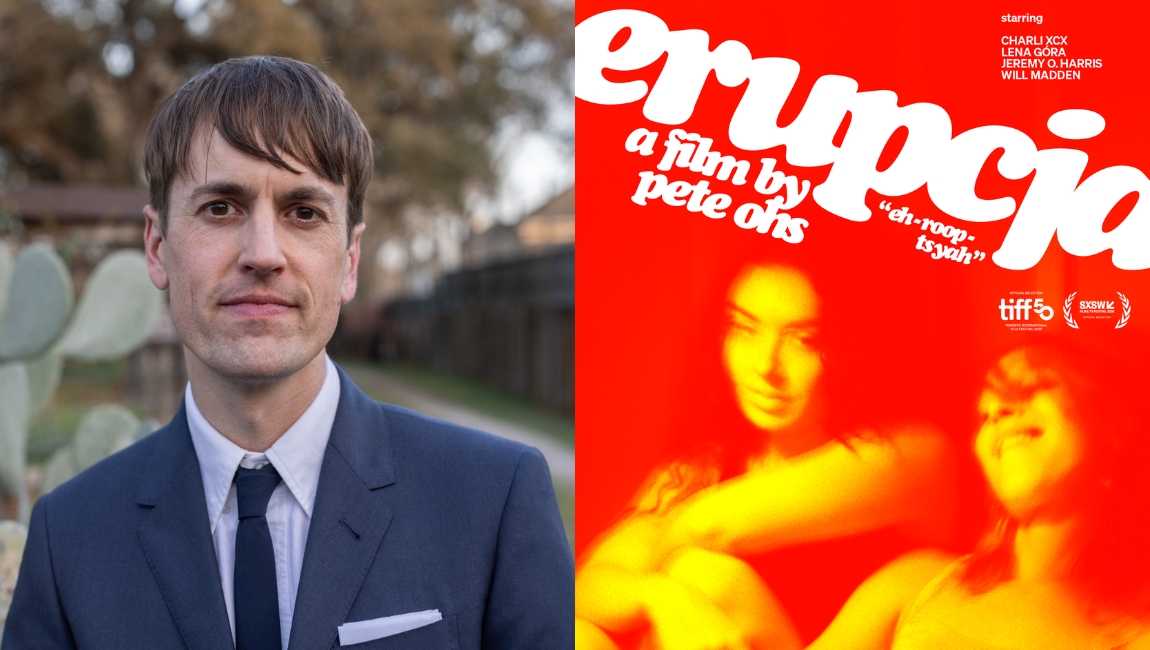
To watch a Pete Ohs film is to watch a film unspool right before your eyes. While that may sound obvious — all movies play out before you — his work feels as if the film is creating itself in real time. Ohs’ on-the-ground, sequential shooting allows his films a feeling of spontaneity. Like life, anything can happen, and there’s a very real sense of creation that permeates his frames. Through a body of work that includes recent indie standouts Jethica and The Strange Beauty of Being Bitten by a Tick, Ohs and his frequent collaborators have carved out an area of independent filmmaking that has a look, move, and feel unlike anything else. His process is so collaborative that he always includes his main actors as co-writers on each movie.
His latest, Erupcja, keeps that ethos alive and well, save for one very interesting wrinkle: he’s got a massive pop star at the center of the film. Starring Charli xcx, music’s most enthusiastic cinephile, Erupcja follows a couple on vacation in Warsaw as a volcano erupts in Italy. This is key because while Rob (an excellent Will Madden) wants to propose to Bethany (Charli xcx), she’s come to Warsaw for other reasons. Someone important from her past is somewhere in the city, and the volcano might just be the thing pulling them back together.
What Charli brings to Erupcja is far more than star power. She’s an instant match for Ohs’ lurid, kinetic vision and proves she was absolutely made for movies. When a singular artist is given the tools to leap forward, be it more exposure or larger budgets, there can sometimes be the worry that they’ll lose sight of what brought them to the dance. Ohs loses none of himself. His fantastical genre flourishes lightly weave throughout the more human drama, and it makes for what might be his most ambitious and flat-out best film yet.
Ahead of Erupcja’s release, I sat down with Ohs to talk the film, Charli, making films feel alive, and making the tools accessible to a younger generation.
Brandon Streussnig: I’ve always loved the air of creation that exists in your films. There’s always a sense that they’re being unspooled right in front of you as you watch. Erupcja feels as if it’s being made right in front of you, and you’re finding it as you go. Can you tell me about your process?
Pete Ohs: There’s a word that my close collaborative filmmaker friends and I like to talk about with movies, which is that we want them to feel alive, and that can mean many different things. So much of the way that I go about making a movie is to move in the direction of creating something that feels alive. We make it without a script. There are some nuts-and-bolts things, but that’s it.
I also didn’t go to film school. I studied computer science. I sort of feel like I’ve created this computer program that results in a movie. What it really is is a sandbox that is defined, and within that framework, we can do whatever we want, but there is a structure to work within. I enjoy it, and I think it can actually be quite good for creativity.
So we have an outline, and we write the dialogue. It’s not improvised within the scenes. We’re writing the dialogue. But the big thing about it is that we’re shooting the movie in order, and we’re figuring it out as we go. The outline’s only half of the movie, so we really don’t know what the second half will be. What this means is that as we are making it, we are required to really be present. By the act of moving, you are now living the story, so now it’s going to be alive, and we are discovering things. We are learning, we are growing in the same way that these characters are living and growing.
I just think that way of making results in a product that feels different from something that is made with a different process. When something is just made from a script, there’s a big challenge that they have, and there are many ways to find it. There’s a challenge, though, to make it alive because those words are dead. Those words are in the past. Those words are not the present, and life is in the present. So this thing that you wrote a month ago, a year ago, five years ago, it’s the past, it’s dead. The challenge now is, how do I make this alive?
So by not even writing the script yet, we don’t have to worry about overcoming that hurdle. We have other hurdles to overcome, but I think that’s what allows and naturally invites this particular feeling that, regardless of what genre or what tone, I do think has this aliveness to the experience of watching this movie that feels quite different from other movies made with other processes.
BS: In that process, then, are there ever moments where you discover something later, and you think, “Well, shit, now we have to go back and redo something we did earlier,” if it doesn’t align?
PO: I mean, you can’t go back in life, right? You keep going forward. You can make more decisions that help it make sense. I just remembered a little video that the algorithm gave me about a jazz pianist who’s playing with Miles Davis, and he’s telling this little anecdote about how he played a chord, and he played the wrong chord. And he thought, “Oh no, I played the wrong chord.” But then Miles Davis played certain notes after that that all of a sudden make that wrong chord right. So it’s that same idea where it’s like, you definitely can’t change the past. We’re not going to go back and reshoot things. The game we are playing with ourselves, the escape room that we’re trying to get out of, is only forward-moving. We just had to find the solutions, the notes that make that previous decision not wrong.
BS: Something I really like about your work is where it finds empathy. I’m thinking specifically of this one and then, in Jethica, where both of the characters Will Madden is playing kind of suck. Especially here, as Rob, when Charli’s Bethany leaves him and disappears, you get it at first. You’re like, “This guy is such a wet blanket, who cares?” Then, as you go, you start to see how sweet he can be and how maybe he didn’t deserve this. You allow for complicated feelings that I’m not sure always exist on screen.
PO: The way the story comes to be is through all these individual conversations with each of the actors. When you’re talking to somebody, they are the main character of the story. They can’t help it. They’re seeing their character that way, and their ideas are steering the movie. It’s giving themselves more scenes. It’s making the movie more about them because that’s what I’m asking of them. I’m asking them to think about their character and all those kinds of things. What that naturally does is create empathy within myself, or helps me to understand these people. I’m not trying to make them do anything. I’m just trying to learn about these characters in these situations and how they would behave, and not pass judgment on any of them.
I remember moments earlier in the shoot where we started to think it was funny how silly Rob was. “Oh, he’s such a wet blanket. He’s so lame.” We’re kind of laughing about it, but because filmmaking is a holistic process, it’s not just the shoot, we did multiple takes, we explored different things. As we get into the edit, it’s yet another opportunity to fine-tune the nuances of those things, and you find the correct balance where it’s like, I can understand why Bethany would act this way, and I can understand why Rob would act this way. If I made Rob too annoying, I would be like, “It doesn’t make sense. Why did she even travel here with him? Why didn’t she break up with him in England?”
So you had to find the thing that makes these behaviors make sense and that still inevitably leads to where it inevitably leads to, while also sort of feeling surprising. I think that’s just the challenge of filmmaking and storytelling. I’m definitely coming from a place of not having some sort of agenda, though. I’m not trying to make some point, aside from just having empathy towards each other being a good practice.
BS: You typically work with other filmmakers and writers. Callie [Hernandez] is in a bunch of your movies. Jeremy O. Harris is in this one, and he comes from a background as a playwright. Now, the lead of this movie is a major pop star. I know Charli is entrenched in the film world, she’s a Letterboxd superstar, but what did working with someone whose background is in music bring to this?
PO: What did she bring that was different? I wish I had a really good answer for that because I mean, everyone brings something different because they are different people. They’re invariably bringing what they’re bringing.
The thing that I loved about having a musician be one of my main collaborators is that I’m always trying to get filmmaking to be more like music-making. When I first described to Charli how I make movies, it resonated with her where she said, “Oh, that’s sort of like when I go into the studio and I have George [Daniel], and A.G.[Cook] there and I have my close collaborators together, and we are figuring it out as we go, and somebody has an idea, and we just get to sort of follow our impulses.” That is how I like to create and how I’m trying to create with film. I think that’s where we’ve arrived with filmmaking, that we can function that way. That’s what’s so cool about the fact that the cameras are smaller and lighter and can record longer and can do all these things that it needs to be less of a machine, and it can be more like a paintbrush. It can be more like playing a guitar.
To have a collaborator who was coming from that place was really encouraging because sometimes when I have a collaborator who’s had more experience on other types of movies, on commercial shoots in L.A., on some HBO series, I’m having to bring them over into this music-making realm, this other way of doing it. I didn’t have to do that at all with Charli. That was already her natural mindset. That’s already how she likes to roll, how she can just go with the flow of the creative process. It’s a discovery. We can sense things. We know we need to figure out what the hook is, but we’re pretty good about the verse as you move forward, and that just made working with her really, really enjoyable.
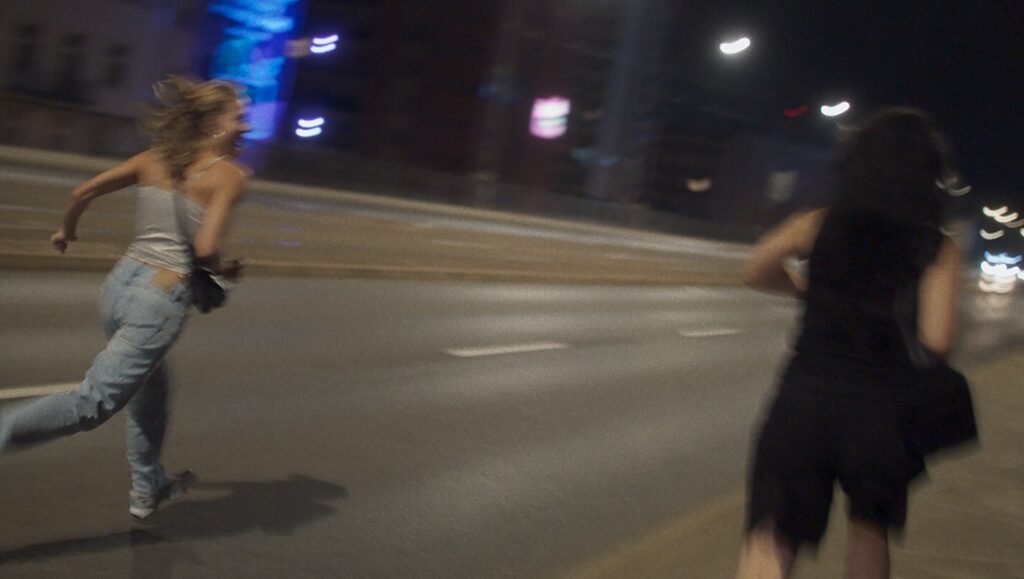
BS: I love all of the moments of her exploring Warsaw. You have these great shots of her and Lena Góra running through the streets. This isn’t a big-budget film and you likely didn’t have much security. Were there ever moments, since you’re making this so low-key, where people around you were like “Whoa, that’s Charli”?
PO: She came to Warsaw by herself. She didn’t bring any team. She didn’t bring any assistants. She just showed up, which is so great and cool. She stayed at the Nobu Hotel, where Jeremy was staying too. They were kind of like buds, and they would get the Uber over to my apartment for the beginning of a day’s shoot, but it was all very low-key. When we would go out into the world to shoot, she would get recognized sometimes. Most of the time, the angels who would spot her were very respectful. They would see that we were shooting a scene. I wouldn’t even notice they were there, but as we started to wrap, they would kind of come over and form a line to get their selfies.
There was one night where they’re running around on the streets, and they’re at this nightclub, and we had permission to be there, but it’s not like we made an announcement, and it’s just me with a 5D. So it doesn’t look like a movie shoot’s happening. Then word got around that Charli was in the building. They thought maybe she’s here to DJ or something. As it gets later in the night, not us, people are drunk, people are getting excited. There was a moment of tension I felt where we were on a stairwell, and you could feel the vibration starting to increase. Not anything negative, but just the excitement. Almost like a fire is breaking out, where it’s like, “Oh, there’s somebody here. I want to get to her. I might not get to her. There’s not enough time left for me to get my selfie.”
Thankfully, we had our group of people. It wasn’t just me there. We have our other Polish friends who are with us, and they also correctly recognized the direction the energy was going. So it was very easy for us to just be like, “We’re just done. Let’s just go.” Charli is also a pro at navigating those kinds of situations, too. She has a spidey sense for it, where she’s just like, “I think we’re done here.” And I’m like, “Yeah, we’re done. Let’s just get out of here.”
BS: I find it so interesting, particularly in your last three films, that you’re almost working within the confines of genre. Jethica is a ghost story. Tick is a thriller in some ways. Now with Erupcja, you’re making a disaster movie of sorts. What excites you about playing in these sandboxes?
PO: For me, a big part of filmmaking is Mr. Rogers and getting to enter the land of make-believe. When it was time to go to the land to make-believe, you’re like, “I’m just so happy to see what Daniel Tiger’s up to.” So when making videos with my friends when I was 15 or when making movies with these collaborators now, I want it to be honest. I want it to be truthful. I want us to explore humanity, but I don’t necessarily want or need it to fully be about real life. I want to get to play make-believe. That’s what’s fun to me. I want to live in a world where ghosts are real. I want to live in a world where there are secret cults. I want to live in a world where magical things happen, where volcanoes erupt when you touch hands.
That’s definitely the energy that I entered into Erupcja with, where it’s like, yes, this is kind of fun and weird that I’m doing a Polish film. That’s another genre that was fun to experiment with. But the idea of just making a movie about real life turns me off. Real life is for that. Filmmaking is for magical things to happen.
As we moved through the story, it became this fun thing for me to also subvert that desire I had. During the shoot, Etna actually erupted. That’s why Mount Etna is the volcano that erupts in the movie, because that just literally happened that day. We’re like, “Well, we definitely have to use that in the movie.” Then later, as we are working through the story and I’m starting to analyze it, I finally Google volcanoes, and I learned this fact, where for the whole shoot, I thought it was so significant that Etna had erupted, and then I learned that it’s actually not that significant. Then I get to grapple with that, too. It excites me that I’m able to move nimbly enough that I can incorporate this stuff into the movie, into the story, but that’s how I enter it, where I’m like, “I want to get to play.”
BS: You recently posted a reel on Instagram that showed you editing the film from raw clips, but in the caption you included a link where anyone could go to your site and re-edit those same raw clips however they wanted. I thought that was so lovely. Jeremy shouted it out too, saying that the things younger filmmakers are doing with CapCut and other apps are often better than what’s being done professionally. Where does the desire to make this all accessible come from for you?
PO: I remember being a kid in Ohio with limited access to stuff and just not even knowing what things are, what it looks like. What does it look like to edit a video? How does it work? I remember feeling discouraged by the fact that I didn’t know. Then I found that I could listen to a director’s commentary, or I could just get a little sliver of insight, and how encouraging that felt. So I’m happy to share things like that so they can see it too.
I do everything in the movies. I shoot, I edit, I conceive, but I can also see that there are two generations below me now who are growing up doing all those things, too. That’s both intimidating to me as a creator because I’m like, “they are going to replace us.” But it’s also really exciting that they are going to exist in that space where they can so fluidly and intuitively move through mediums and move through media. I am always searching for inspiration in the world, in my life. To get to see what they might do with it is selfish for me. I want to see what they do because it’s exciting. It makes me excited to go make something again, too.
Comments are closed.