
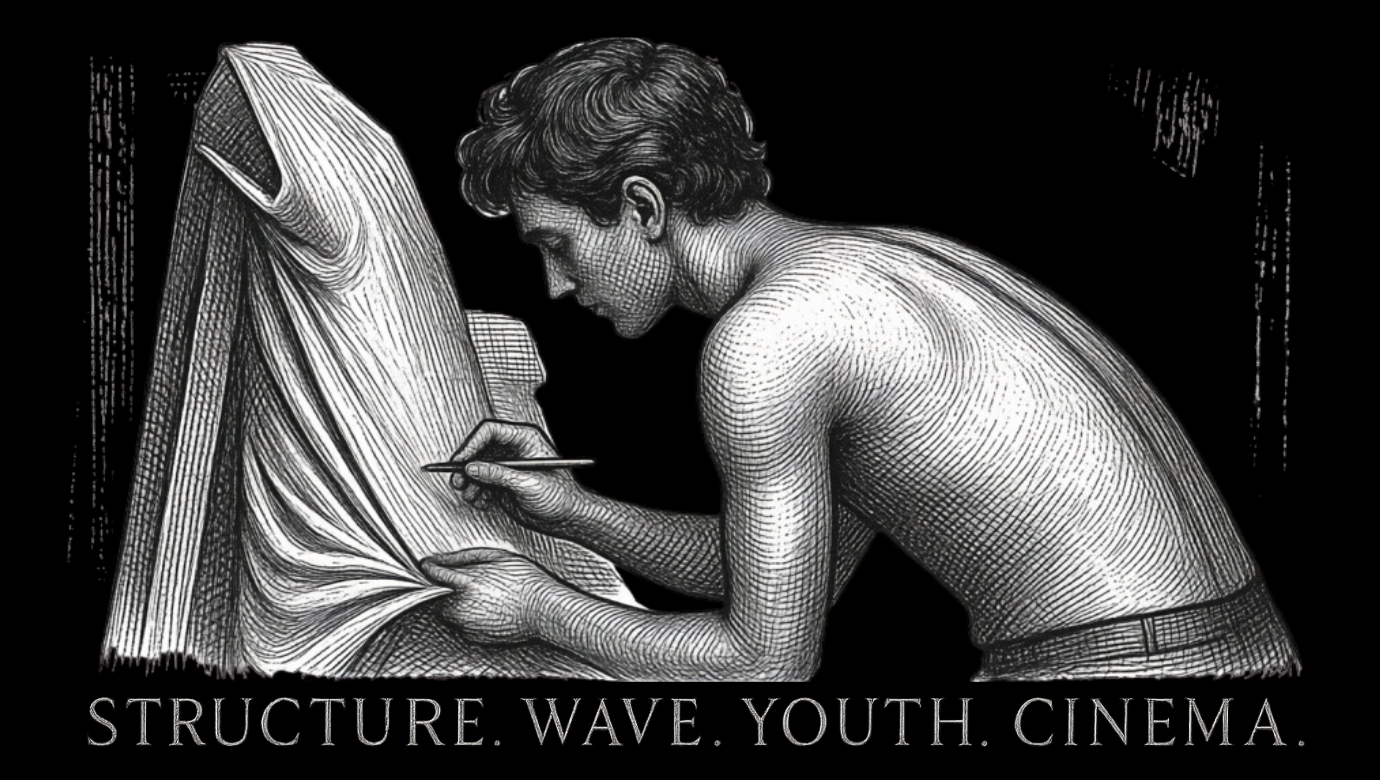
Since stepping down as In Review Online’s Editor-in-Chief in 2019 — and settling into the more fitting role of the site’s “Black Hand” — my life has taken a number of unexpected turns. Among the most rewarding of the past half-decade has been my research on four extraordinarily innovative Chinese filmmakers collectively known as the Structure. Wave. Youth. Cinema. Experimental Film Group.
“SWYC” (pronounced “Sweek”) has long appeared in writing on China’s New Documentary movement, usually in reference to the fully independent I Have Graduated, which screened at several international festivals in the 1990s, and sometimes to the eight-part Tiananmen series, originally produced within CCTV, later completed independently, and ultimately blocked from any form of public release. But the group’s other work has remained almost entirely unknown. I only began to piece together the full scope of the SWYC collective’s filmography over the course of several meetings with the filmmakers in China, learning their history, and witnessing the endurance of their nearly 40-year friendship. Once it became clear that few SWYC works from the 1990s had ever even been digitized — and that many survived only on VHS, U-matic, and Betacam tapes — a small team of collaborators and I began the work of locating source materials, preserving these films digitally, and translating everything. The resulting program — which has screened at Berlin’s Cinema Transtopia and Washington, D.C.’s JF Books, and is now nearing the end of a month-long run at New York’s Spectacle Theater — restores an important lost chapter of China’s New Documentary Movement.
Formed in the late summer of 1989 in a CCTV dormitory, SWYC also takes its name from the initials of its four founders: Shi Jian (时间), Wang Zijun (王子军), Kuang Yang (邝杨), and Chen Jue (陈爵). Shi, Wang, and Chen were all part of the 1986 graduating class at the Beijing Broadcasting Institute, now the Communication University of China. They met trained sociologist Kuang, the eldest member and something like the intellectual anchor of the group, somewhat later, during the production of a 1988 CCTV project on the Huaihai region that was halted by censors before completion. Their shared frustration with the limits placed on creative work within the state television system — especially in the wake of tightening controls after June 4, 1989 — bound them together and shaped a collective practice grounded in both ethical responsibility and formal experimentation, pushing documentary form forward.
The group’s landmark documentary conference at the former Beijing Broadcasting Institute in December 1991 is rightly recognized as one of the foundational sites of incubation for China’s New Documentary Movement, bringing together independent filmmakers such as Wu Wenguang and He Jianjun alongside formally adventurous state television works like CCTV’s sprawling Odryssey of the Great Wall (and SWYC’s own Tiananmen). The influence of this group can also be traced throug important Chinese state television programs in the 1990s like Oriental Time and Space (东方时空), Documentary (纪录), and People’s Home (百姓家园), which helped reshape audience expectations by placing ordinary lives on screen and opening new space for amateur documentarians. Yet many of the group’s own most ambitious works remained unseen, thwarted by censorship and by the contradictions of trying to forge a new documentary language from within the state system itself.
This program attempts to right that wrong. The films selected move across an unusually broad range of subjects and forms: from the sprawling historical sweep of the two sister series and “city symphonies” Tiananmen and Notes from Beijing (one made at CCTV, initially, and one at Beijing TV), the guerilla filmmaking of the raucous and eulogistic youth portrait I Have Graduated, to the ecological consciousness and experimentalism of Only One Earth, to the intense and raw ethical dilemmas confronted by Reform School Students, and the move outside China’s capital for Jujube Fruits and Little Mao and Sparrow, both formally playful micro-documentaries that take a microscope to China’s regional lower class. The program is united by a shared attentiveness to lives unfolding at the edge of official visibility, and by a restless desire to push documentary beyond inherited conventions. Whatever their flaws, these are films that deserve to be seen, argued over, and restored to the broader history of Chinese documentary cinema. And I can think of no better occasion for my own InRO homecoming than the chance to invite some of my favorite writers to weigh in on them.
Comments are closed.