
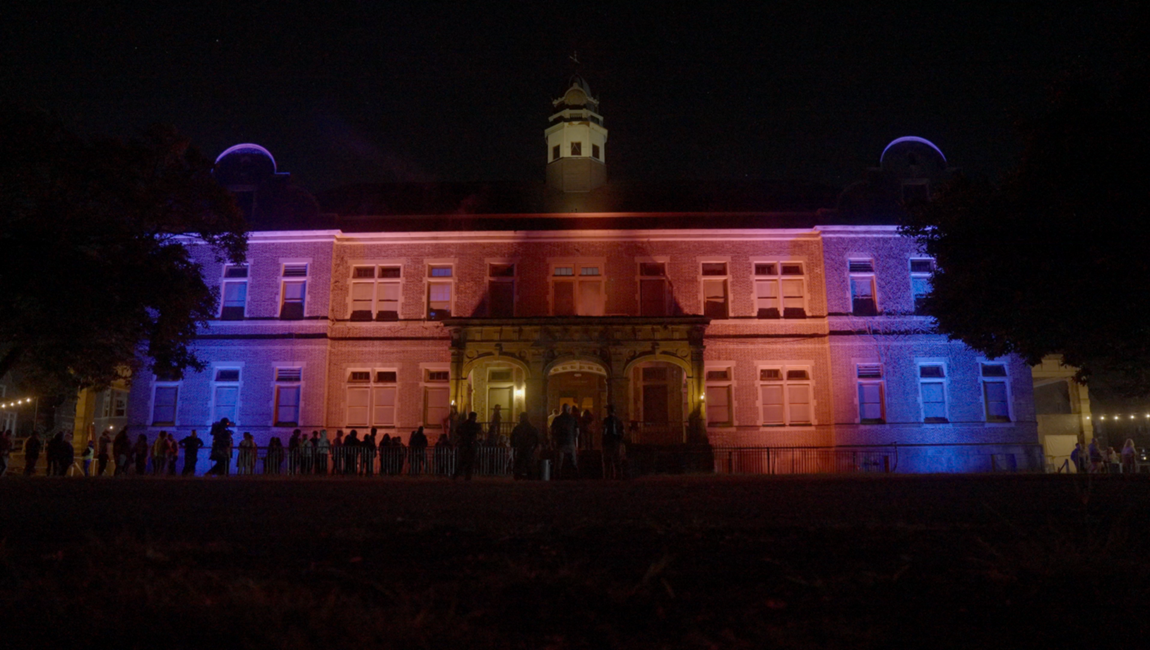
Nathan R. Stenberg, Mike Attie, and Katarina Poljak’s The Haunting of Pennhurst is an archival and verité look at the transformation of the notorious Pennhurst State School and Hospital from a real-life house of horrors that warehoused the disabled for nearly 80 years to what could be considered a form of problematic dark tourism. But what sets today’s Pennhurst Asylum — which consists of “haunted attractions” as well as history and ghost tours — apart from the usual capitalistic ventures designed to profit from tragedy is that its marquis fright nights are sustained and run by a group of performers with a wide variety of disabilities. And they’re all as firmly dedicated to making visitors question why the unfamiliar often feels so threatening as they are to scaring them. In fact, Stenberg, a multidisciplinary artist and disability scholar who assumed he’d be documenting an “entertainment attraction commodifying atrocity,” has said that he instead discovered something far more nuanced — folks finding “community on grounds once designed for their death.”
Yet what ultimately becomes a deep and unusual study in the reclamation of power jarringly begins with onscreen text that reads: “The following film contains sensitive materials, including abuse, ableism, blood, death and dying, discriminatory language, medical violence, suicide and sexual assault…” Notwithstanding this “enter at your own risk warning,” the overall tone of the doc is counterintuitively inspiring. For at its core, The Haunting of Pennhurst is a multilayered portrait of marginalized men and women who’ve come together to take matters into their own hands, and are on a shared mission to create a better future by honoring and giving voice to those historically silenced.
That would include the cohort of former longtime resident Roland Johnson, whom we hear early on in archival audio, whose vivid VO descriptions of living at Pennhurst are deftly interspersed throughout. “What did the place sound like?” an interlocutor asks. Without hesitation, he replies, “It sounded like fear.” Which nicely echoes a sentiment from Autumn Werner, a Zen-like twenty-something with two younger autistic sisters and a chronically painful genetic condition that nevertheless allows her to contort her arms forward in spooky fashion. Werner’s the fresh hip face of contemporary Pennhurst, whose jobs seem to run the gamut from educator and museum director, to training performers (in everything from character development to that which is ableist and thus verboten), to makeup artist. “The fear is not only that we did this, but that we could do it again,” she stresses about the inhumane practices that occurred at Pennhurst right up until the so-called school and hospital ceased operating in 1987.
Werner also offers that she’s “comfortable feeling uncomfortable” on the multi-acre expanse of dilapidated buildings. She wholeheartedly believes that the sacred site could very well still be home to the spirits of those imprisoned and experimented on for the supposed good of society. Indeed, through a raft of archival photos and letters, accompanied by an ominous sound design, we learn of slave labor practices masquerading as “vocational training,” and of people turned into guinea pigs for procedures posing as necessary medical interventions.
Which is why when commercial enterprises, a crucial key to Pennhurst’s investors staying multimillion-dollar profitable and therefore able to preserve the sprawling compound, like Ghost Hunters or the ghost-hunting convention Paracon arrive, Werner pleads with the outsiders to respect the dead, and to listen rather than fear. After all, what may sound like a vicious growl could simply be a nonverbal being communicating through their own distinct language. Of course, visitors are also urged to check out the gift shop (along with the Etsy store that stocks Pennhurst straitjackets). After all, it’s only through the exploitation-based financing that the haunters are able to resurrect and keep alive the collective memory of the many who suffered at Pennhurst through no fault of their own. As Werner rightly points out, the people weren’t bad, it was “the environment that didn’t allow them to be good.”
In fact, the soft bigotry of low expectations speaks louder than words as VO of a newsman condescendingly expounding on the “MR child” is heard while images from the highly creative and visceral attraction unspool. As one participant points out, “Everyone performs — the parts they don’t want people to see, the parts they do want people to see. That’s the whole problem with disability — you’re not performing in the way they want you to perform.” So when the haunters, framed as shadows passing across a brick wall, finally exit the grounds late at night, it’s more than just the end of a shift rendered cinematic. It seems we’re watching souls set themselves free.
Comments are closed.