
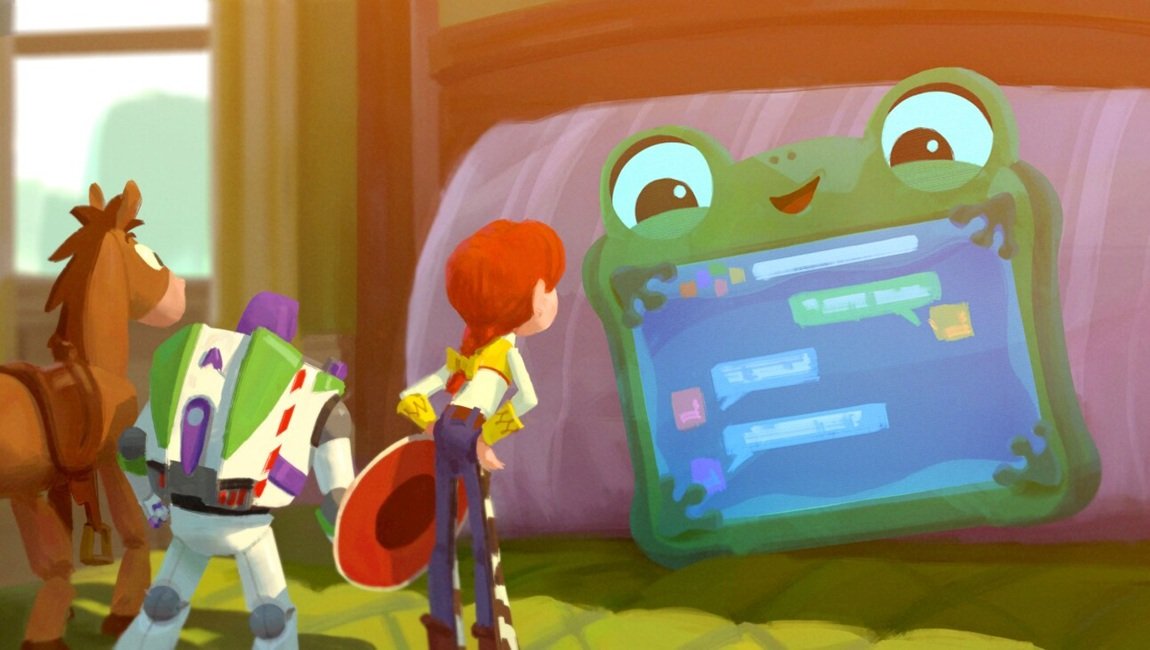
Back so soon, Mr. Stanton? Following the unmitigated, off-the-rails trainwreck of In the Blink of an Eye in February, one might expect the director to put his career on ice and retreat to the bowels of the Steve Jobs Building to lick his wounds. Alas, Stanton stands defiant, returning to screens within months to ponder the effect technology is having on our children and to bemoan the passing of the way things used to be. There’s a rich irony found in the fact that his new “what do we do about the iPads?” story comes on the heels of total capitulation to the post-human billionaire (now trillionaire) agenda and is the fifth entry in a franchise spawned by the first ever fully computer-generated movie, but there’s an even greater surprise in the knowledge that this time around he manages to keep the train on the tracks: Toy Story 5 is all-ages entertainment the likes of which we shouldn’t have to be nostalgic for.
Working with co-writer Kenna Harris, Stanton shifts the focus away from series icons Buzz and Woody and onto Sheriff Jessie. (It should be noted that this marks, at 63, Joan Cusack’s first lead role, ladling spoonfuls of folksy charm that, despite the added screentime, doesn’t grow exasperating.) Having taken the mantle from Woody in Toy Story 4, we find her watching over our merry band of toys under owner Bonnie’s continued care. Their utopia is rudely disrupted, however, when Bonnie receives a tablet named Lilypad — because she has difficulty connecting to the kids on her block — which launches Jessie and friends on a quest to curb Bonnie’s screen time and make her a real friend.
The building blocks may seem rudimentary, but you can’t get to the word absquatulate without first writing the letters a and b, and Toy Story 5 stacks the blocks mighty high with the year’s most sterling screenplay. Not a moment is wasted, and every beat either directs us toward the next scene or forecasts a chess move to be played later on. Why Pixar is the only major studio that remembers how to tell an efficient story (Hoppers, for all its faults, ticks like clockwork) is a total mystery, yet it’s comforting to find that someone, somewhere in Hollywood, still knows the value of narrative economy. As a result, the film effectively dramatizes the tension between past and present: it gives the reckoning directly to Jessie rather than cast a defeatist pall over the whole affair like last month’s The Devil Wears Prada 2 (also a Disney product), and in so doing keeps the series’ two key ingredients in play: a genuine earnestness and a miraculously unforced sense of Americana.
Toy Story 5 does depart from its predecessors in taking on a more heightened verisimilitude, adopting a realer-than-real approach to Smalltown, U.S.A., with “in-camera” tricks that rival the most creative in contemporary live-action filmmaking. Out of nowhere, we’ll get a wide shot, evoking Jacques Tati, scanning Bonnie’s neighborhood and landing on the last house without a Lilypad, or a snap zoom from inside her father’s car out to the sidewalk where Bonnie holds her own malevolent tablet. Indeed, there is more craft — effort to compose shots and sequences that tell the story visually — and ingenuity in this family movie than in the planimetric composition and dialogue-driven storytelling that have come to rule the most serious-minded American cinema in the 2020s. Pixar movies resonate at the box office because they lean on established IP, true, but they also know how to tell stories visually.
Yet there’s an Achilles’ heel to the method: Toy Story 5 is told with a polish and an urgency just on the other side of glib, coating the adventure in a sleek sheen that makes the movie easy to watch and easy to be moved by, but also somewhat intangible. Like the digital barbarians at the gate to which it purports to be an antidote, Toy Story 5’s pleasures are largely fleeting. The film moves so fast and so breezily that you don’t know exactly why you’ve been reduced to a puddle of tears by the end of it; we aren’t given time to register some of its best material, like a Plato’s Cave realization for a phalanx of lost Buzzes or Jessie’s late understanding (a la Doc in Inherent Vice) that while you can’t change the course the world is headed in, you can contribute positively to it in your small way. When it does slow down enough to let us digest the ideas on its mind, though, it lands with the same purity and emotional simplicity of a great Beach Boys song — and the film’s refusal to bend to the reactionary is its greatest achievement.
Yes, Toy Story 5 concedes, technology is now an inextricable part of our lives; it also needn’t take them over. It plainspokenly, soberly suggests that a connection with nature and other human beings can co-exist with the conveniences of modern tech, and it uses the prism of imagination to facilitate a conversation about a well-lived life: it encourages us, at any age, to engage in the spirit of play we likely take for granted. Toys facilitate real connection because they facilitate imagination, and imagination is essential if we intend to deepen our relationships to those around us and, most importantly, our own inner lives. These are perhaps pedestrian notions when you spell them out, but that’s why we go to the movies — to rediscover the value of common truths, if only for a moment.
DIRECTOR: Andrew Stanton; CAST: Tom Hanks, Tim Allen, Joan Cusack, Greta Lee, Conan O’Brien; DISTRIBUTOR: Pixar/Walt Disney Pictures; IN THEATERS: June 19; RUNTIME: 1 hr. 42 min.
Comments are closed.