
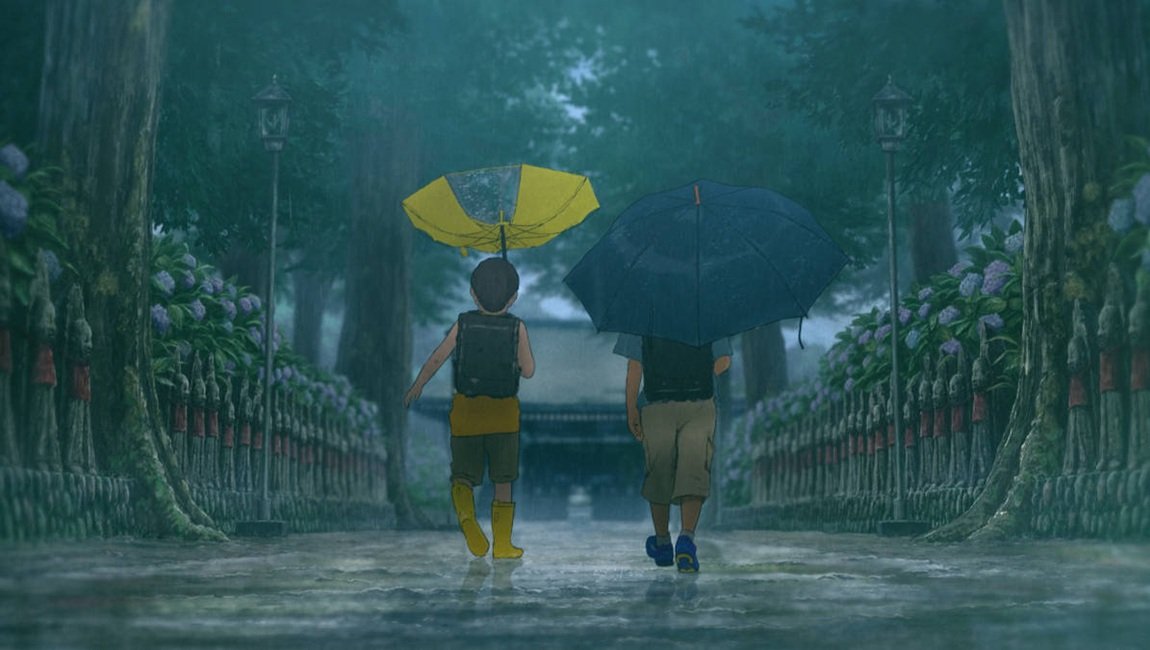
Two young boys, one reserved and one outgoing, become fast friends at elementary school in Kohei Kadowaki’s ambitious and thoughtful animated film We Are Aliens, forming a bond that will transform the lives of both, and not necessarily for the better. An enigmatic opening, in which a child’s voice is heard enquiring why the blood moon is red, followed by a taxi driver sitting alone in his car during a rainstorm, is an early indication that this story of a childhood friendship might be a little more mature than its protagonists. Sensitive and keenly observed, Kadowaki’s feature debut is an emotionally turbulent but engrossing character study that, despite its initial tone of tender wistfulness, remains true to life in its depiction of the complexity of human relationships.
Tsubasa is a quiet kid, reticent to open up, whose only rebellious streak manifests in playing video games against his mother’s orders while home alone. Gyotaro is the opposite, boisterous and prone to innocent troublemaking, though still a top student at school. When he tentatively attempts to make friends with Tsubasa, the pairing could hardly seem less likely. But Tsubasa is in need of company, and the boys hit it off swiftly. Kadowaki is equally swift, though, barrelling through the years to chart key points in their shared story, and it’s not long before their differences, and the changes wrought upon both by the rapid development of childhood and adolescence, begin to cause serious fractures in their partnership.
Kadowaki first filters this through Tsubasa’s lens, wherein Gyotaro appears either as a joy or as a menace, both loveable and contemptible. In his imagination, his exuberant new friend is so bewilderingly strange and vibrant he might even be an alien, which is where the first cracks of their friendship begin to form. Tsubasa’s reserved nature turns more nihilistic, his patience for Gyotaro withers, and they start to grow apart. Then, Kadowaki switches his lens, and shares the story from Gyotaro’s perspective. Expectedly, he’s less of a terror here, only a misunderstood wild child with good intentions but poor execution. This kind of odd couple dynamic is a pretty familiar setup, but Kadowaki has enough original ideas, and a remarkable understanding of character development for someone new to feature filmmaking, that the movie feels fresh and unpredictable.
One such original idea is the manner in which Tsubasa’s section of the film is recontextualized through Gyotaro’s. Little of what we’ve already been shown is actually repeated (though what is repeated is of paramount significance): rather, we’re shown the kid that Tsubasa never got to see, or perhaps just forgot — the earnest, reflective, vulnerable side of him that appeared when they first met, then was quickly overwhelmed by extra-terrestrial conspiracies and jealous peer pressure. As the fractures increase in number and severity, sympathy is sewn for Gyotaro, who will come to suffer substantially more in the fallout. But Kadowaki’s conceit is never so narrow as to answer all its own questions — Gyotaro leads himself to believe that his former friend is the source of all the woes that would befall him into adulthood, just as Tsubasa shrugs off any suggestion of responsibility until it’s literally beaten out of him. The details of their painful separation are as important as the many other contextual details, like Gyotaro’s tumultuous family situation. Wisely, Kadowaki stresses that which his characters stress as important, leaving the peripheral details to sneak up on both the viewer and those characters as equally important.
Honing in on emotional experience as it does, We Are Aliens is a highly involving film. Action leads to reaction, but always after following the emotional path of these boys, later men, toward those reactions. Events inform thoughts and feelings, rather than directly informing other events, and the time-hopping structure, whose collage-like quality often obscures narrative clarity, places further emphasis on mental state over plot mechanics. The one major leap backward through time (when Kadowaki abandons Tsubasa’s story to tell Gyotaro’s) aside, We Are Aliens is almost entirely linear, yet its style, pace, and fondness for large temporal ellipses give it the timbre of memory. It’s as if the whole movie takes place inside the minds of these two boys — but, then, isn’t the mind where life takes place?
Enriching the movie further are the many beautiful little details, both momentous and casual: a close-up of a wooden umbrella handle splintering as it slides against a wooden beam; Tsubasa’s feet skidding a little as he descends a concrete river bank; the sight of a fingerprint as it picks up a grain of rice; a small, single bubble emerging from an empty soap dispenser. The depth of thought that has evidently gone into the particulars of every frame of We Are Aliens is testament to its excellence, to the sensitivity of a director who has seemingly cut no corners in realizing his vision. This is a smart, affecting, complex, and deeply rewarding movie.
Comments are closed.